AI SDK Vue 3.0.321 Patch Released: Synced with ai@6.0.321

AI SDK releases Vue adapter patch 3.0.321, aligning versions with core package ai@6.0.321.
Vercel's AI SDK team released @ai-sdk/vue@3.0.321, a patch whose only associated change is syncing with the core package ai@6.0.321—a typical version alignment release. The Vue adapter introduces no new APIs or behavioral changes, and the release was automated by the github-actions bot, with 3209 commits merged into main since the last release. The article notes that AI SDK uses a monorepo multi-package structure, and since adapters depend on core package interfaces, they must release in sync when the core ships a patch to keep dependency resolution and type definitions aligned. For Vue developers, upgrade risk is low, but they should verify the ai core package version, confirm lockfile updates, and run existing tests. The article recommends pinning the full set of AI SDK package versions in CI or using a unified upgrade PR to batch-update, avoiding version mismatch between the adapter layer and core package.
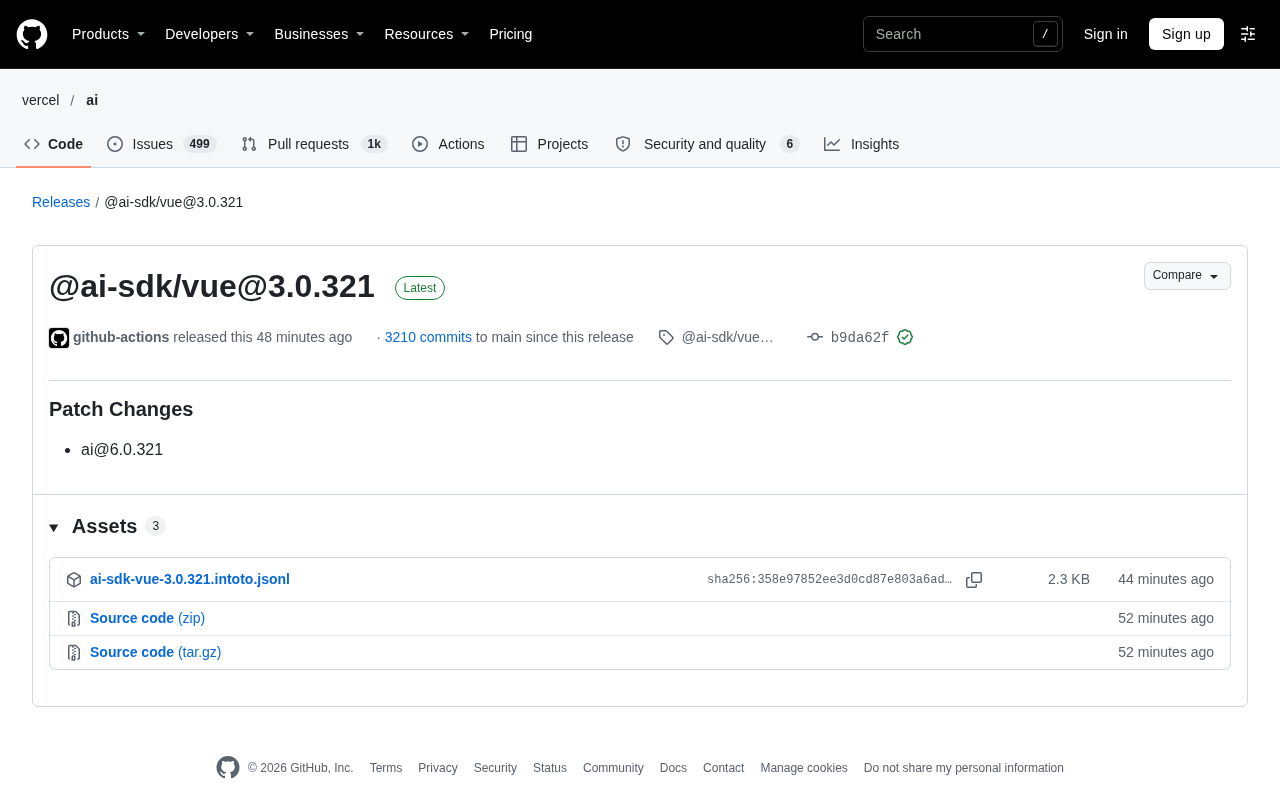
Vercel's AI SDK team has released a new patch version of the Vue adapter package, @ai-sdk/vue@3.0.321. Judging from the version number and changelog, this is a minor sync-focused update, with the core change being alignment with the release cadence of the core package ai@6.0.321.
Patch contents: a typical version alignment
According to the GitHub Release page, @ai-sdk/vue@3.0.321 is labeled as Patch Changes, with the only associated change being ai@6.0.321. This means the Vue package itself introduces no new APIs or behavioral changes; its main purpose is to keep the adapter layer version-consistent with the core package.
Patches like this are common in the AI SDK release process. AI SDK uses a multi-package monorepo structure, where the core package ai and the framework adapter packages (Vue, React, Svelte, etc.) are released independently, but the adapters depend on the core package's interfaces. When the core package ships a patch, the adapters often need to follow suit to ensure dependency resolution and type definitions stay aligned.
This release was completed automatically by the github-actions bot, with 3209 commits merged into the main branch since the last release. The commit carries a GitHub-verified signature, indicating the release went through the standard CI channel rather than a manual operation.
Monorepo and multi-package version management
AI SDK's monorepo model (managing multiple packages in a single repository) is very common in modern frontend toolchains. In this structure, the core ai package and adapters like @ai-sdk/vue and @ai-sdk/react share the same repository but each have their own package.json and version number. Since adapters declare a dependency range on the core package in peerDependencies or dependencies, when the core package ships a patch, the adapters need to release in sync to narrow that dependency range—otherwise users may resolve to an incompatible version combination at install time.
It's worth noting that a common practice in monorepos is to use tools like Changesets to automatically manage version numbers and changelogs. This explains why this release was done by the github-actions bot and why the changelog only points to the core package—the adapter itself had no code changes to record separately; its version number was simply advanced automatically by the toolchain.
What this means for Vue developers
If you're using AI SDK in a Vue project to build streaming chat or generative UI, you can upgrade to this version directly. Since it's a patch version, upgrade risk is low and existing usage patterns won't break.
The practical impact is mainly at the dependency management level:
- When pinning the
@ai-sdk/vueversion, it's advisable to also check theaicore package version in your project to avoid version mismatch between the adapter layer and the core package. - If your project uses a lockfile, confirm after upgrading that the
aipackage has also been updated to 6.0.321; otherwise you may encounter type mismatches or runtime behavior differences. - For projects using composables like
useChat, patch versions typically don't change the public API, but it's still recommended to run your existing tests after upgrading.
The useChat composable and streaming UI
useChat is the core composable AI SDK provides for Vue, simplifying integration with streaming chat interfaces. It internally encapsulates message state management, request sending, streaming response parsing, and incremental updates. Developers only need to bind the returned reactive references like messages, input, and handleSubmit to render the chat interface in their templates. The Vue adapter layer depends on the streaming protocol parser and type definitions provided by the core package, so when the core package adjusts internal protocols or type declarations, the adapter must release in sync to ensure useChat's type inference and runtime behavior remain consistent.
This is why version alignment has practical significance for composable users: even if the public API signature doesn't change, type-level alignment can still affect compilation results in TypeScript projects.
Engineering signals behind the release cadence
Judging from release frequency and commit volume, AI SDK is still in a high-frequency iteration phase. 3209 commits in a single patch cycle indicates the team is continuously making small fixes and internal refactors in the core package, while adapters primarily follow along.
The takeaway for users: don't manage adapter versions and core package versions separately. AI SDK's packages are tightly coupled, and upgrading one in isolation can easily plant hidden issues. A more robust approach is to pin the entire set of AI SDK package versions in CI, or use a unified upgrade PR to batch-update them.
Also, the Release page itself doesn't list specific fixes—it only points to the core package version. If you need to confirm whether a specific issue has been fixed, check the ai@6.0.321 changelog rather than the Vue adapter's page.
Semantic versioning and the meaning of patch numbers
Under semantic versioning (SemVer) conventions, an increment in the patch position of MAJOR.MINOR.PATCH represents a backward-compatible bug fix with no breaking changes. @ai-sdk/vue's 3.0.321 and the core package ai's 6.0.321 have different major versions, indicating that the two packages independently follow their own SemVer evolution lines—the adapter's major version reflects the stability of its own API, not the core package's version.
Understanding this helps assess upgrade risk: a patch-level change theoretically won't break existing usage, but the real compatibility of cross-package dependencies depends on whether the adapter's declared dependency range covers the core package's new patch. Therefore, when pinning versions, you should review both packages' version constraints rather than assuming safety just because the patch number is small.
Summary
@ai-sdk/vue@3.0.321 is a routine patch sync release that introduces no new developer-facing features. Its value lies in maintaining version consistency between the Vue adapter layer and the AI SDK core package. For most projects, handling it as a standard patch upgrade is sufficient—just pay attention to whether the core package is updated in sync.
Related articles

9 AI Subscription Plans Compared: The Real Cost Per 100M Tokens Revealed
Bilibili creator tests 9 AI subscription plans from Volcano, Alibaba, Tencent, Baidu, Zhipu, Xiaomi, MiniMax and more, converting them all to real cost per 100M tokens, breaking down fixed-quota vs. three-tier coefficient billing and how caching, time-of-day discounts, and window limits affect actual quota.
Vibe Coding for Beginners: Expressing Intent Instead of Handwriting Code
What is Vibe Coding? A 137-episode Bilibili course defines it: the core is expressing intent, not writing code. This article analyzes Vibe Coding's productivity logic, target audience, and entry expectations to help beginners decide if it's worth learning.

LangChain Beginner's Guide: An Agent Development Roadmap from LangGraph to Deep Agents
Clarify the encapsulation relationship among LangChain, LangGraph, and Deep Agents, and master the learning path and selection logic for agent development frameworks—suitable for beginners in large model development.