@ai-sdk/vue 3.0.323 Patch Released, Bringing AI SDK Updates to Vue Developers

@ai-sdk/vue releases patch 3.0.323, syncing with core package ai@6.0.323.
In the AI SDK ecosystem maintained by Vercel, the Vue binding package @ai-sdk/vue has released version 3.0.323, a routine Patch Changes-level update that also syncs changes from the core package ai@6.0.323. It was automatically published by the github-actions bot, with GPG-signed commits and 3 downloadable artifacts. The article explains the AI SDK's core package plus framework bindings architecture and recommends checking core package changes before upgrading.
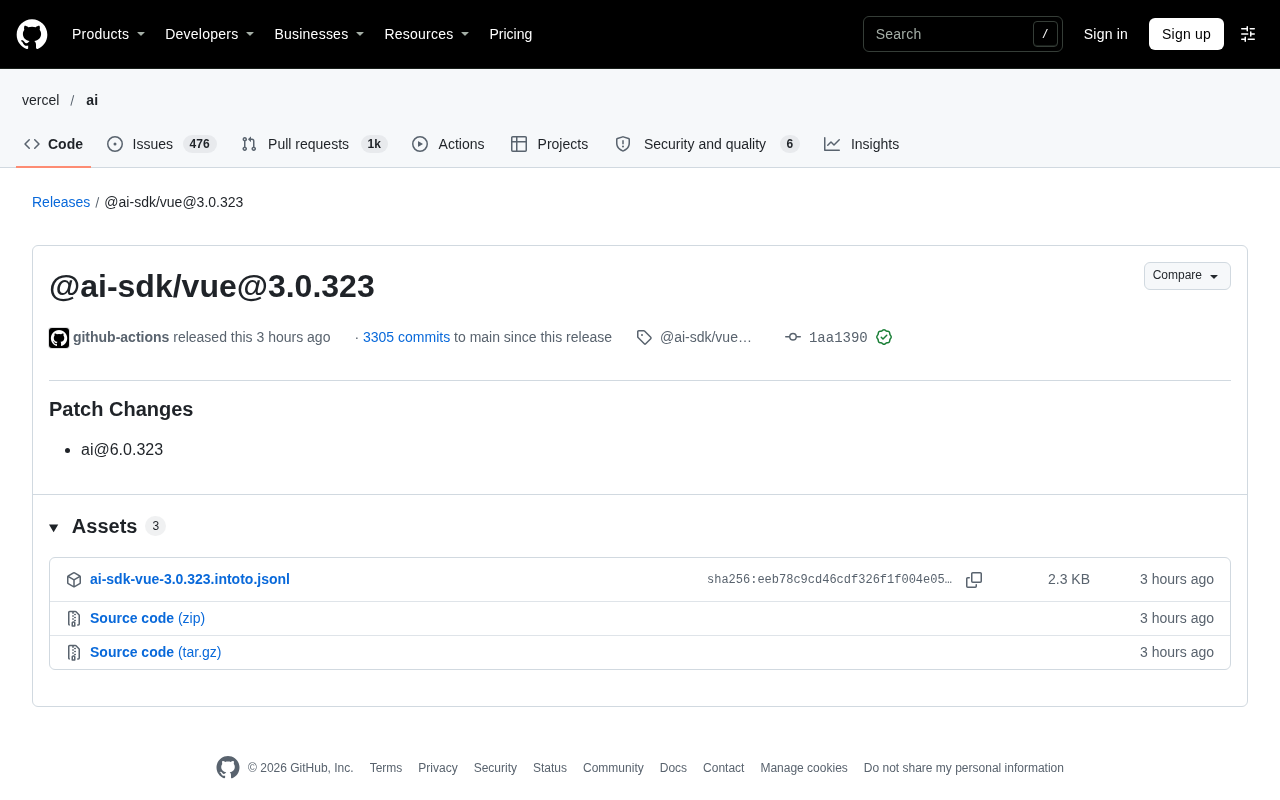
In the AI SDK ecosystem maintained by Vercel, the Vue-oriented binding package @ai-sdk/vue has released version 3.0.323. According to the GitHub Releases page, this is a routine patch update that also syncs the changes from the core package ai@6.0.323.
What This Version Updates
Patch-level changes
The release notes classify this update as Patch Changes, meaning it is a fix-oriented iteration rather than one that introduces new features or breaking changes. For teams already using @ai-sdk/vue in production, these versions can usually be treated as safe upgrades.
One detail worth noting: the release record explicitly lists ai@6.0.323 as an associated item. There is a version linkage between AI SDK's framework binding packages and the core ai package, and this patch for the Vue binding is essentially advancing in step with the core package.
In semantic versioning (SemVer), incrementing the Patch position formally means it contains only backward-compatible bug fixes, introducing no new features and producing no breaking changes. However, in an ecosystem that adopts synchronized version numbers, the semantics of a Patch increment are weakened into "a re-release aligned with the core package." In practice, judging whether a Patch upgrade is worth following immediately usually requires combining two considerations: first, whether the corresponding core package version involves changes that affect binding-layer behavior, such as streaming responses or tool calls; second, whether the binding package's own diff is non-empty. For projects that pin exact versions in CI, these frequent Patch releases also create noise in dependency update PRs, so consider using range versions or automated merge strategies to reduce maintenance costs.
Integrity and verification information
This version was published by the github-actions bot account, with commit hash 1aa1390, on the main branch, at a position approximately 3304 commits ahead of the previous node. The commit carries a GitHub-verified signature with GPG key ID B5690EEEBB952194, indicating that the release process went through signature verification.
The Assets section provides 3 downloadable files, consistent with the typical artifacts accompanying an npm package release.
The GPG key ID B5690EEEBB952194 mentioned in the article is the public key identifier used by GitHub Actions to automatically sign commits and release artifacts. During automated release workflows, GitHub uses this key to sign commits and tags, and after verification passes, a "Verified" badge appears on the commit record. The value of this mechanism lies in supply chain integrity: it proves that the version was indeed produced by the CI pipeline configured in the repository rather than pushed manually from a local machine, reducing the window for malicious releases caused by credential leakage. Note, however, that signing only guarantees "the source is official CI" and is not equivalent to a security audit of the code content; dependents still need to verify installed artifacts using the lockfile and integrity hash.
Interpreting the AI SDK's Multi-Framework Binding Strategy
Why release a version specifically for Vue
The AI SDK adopts a core package plus framework bindings architecture: the core ai package provides unified underlying capabilities such as model invocation and streaming responses, while bindings such as @ai-sdk/vue and React adapt those capabilities to specific frameworks' reactive systems. This split allows teams with different tech stacks to choose the integration approach they are familiar with.
The Vue binding being released separately means it has its own version number and release cadence. One point the community cares about is whether the binding package can stay in sync when the core package iterates slightly. Judging from this release, the trailing version numbers of the two match, and the linkage is clear.
The AI SDK uses a lockstep versioning strategy between the core package and framework binding packages: whenever the core package ai releases a new version, the framework bindings follow with the same or nearly the same version number, ensuring that the core API contract the bindings depend on remains consistent. The benefit of this approach is a clear upgrade path—@ai-sdk/vue@3.0.323 corresponds to ai@6.0.323, so developers do not need to infer compatibility matrices themselves. The cost is that the binding package's own semantic versioning signal is diluted: even if there are no code changes in the binding layer, the version number still increments as the core package advances, so the version number alone makes it difficult to determine whether the binding layer actually has fixes or improvements. This is one reason why the release notes classify the change as Patch Changes but do not list specific fixes.
The value and limitations of patch versions
For dependents, the practical value of a patch version lies in its low upgrade cost. The release notes do not list specific fixes and only point to changes in the core package, which in practice creates a trade-off: the motivation to upgrade mainly comes from following the core package rather than functional improvements in the binding layer itself.
If your project has high requirements for version stability, it is advisable to first assess the impact against the changes in ai@6.0.323 before deciding whether to upgrade immediately.
Upgrade Recommendations
For projects using @ai-sdk/vue, this update can be handled through the usual patch upgrade process: update the dependency version, run existing tests, and observe whether streaming interaction-related features work properly. Since the official release does not disclose specific fix details, checking the change notes for the core package ai@6.0.323 before upgrading is the safer approach.
Overall, 3.0.323 is a routine ecosystem synchronization release. It reflects more the continuity of the AI SDK's maintenance cadence than any additional capability enhancement in the binding. Vue developers following this ecosystem can include it in their routine dependency update plans.
One-line Summary
@ai-sdk/vue releases patch 3.0.323, syncing with core package ai@6.0.323.
Paragraph Summary
In the AI SDK ecosystem maintained by Vercel, the Vue-oriented binding package @ai-sdk/vue has released version 3.0.323, a routine Patch Changes-level update that also syncs changes from the core package ai@6.0.323. This version was automatically published by the github-actions bot, with commits carrying GPG signature verification and 3 downloadable artifact files attached. The article explains the AI SDK's layered architecture of core package plus framework bindings: the core package provides model invocation and streaming response capabilities, while bindings adapt to each framework's reactive system, with matching trailing version numbers reflecting the linkage. Since the official release does not disclose specific fixes, the article recommends checking the core package's change notes before upgrading, updating dependencies and running tests through the usual patch process, with particular attention to streaming interaction features. Overall, this is an ecosystem synchronization release that reflects more the continuity of maintenance cadence than additional enhancements in the binding.
Related articles
 Tech Frontiers
Google Omni 1.2 Flash: 15-Second AI Video at Just $0.07 per Second
Google DeepMind releases Gemini Omni 1.2 Flash: 15-second video, 720p at $0.07/sec (30% cheaper), multi-turn editing without regeneration, draft upscaling to 4K.
 Tech Frontiers
No AI Ghostwriting: Writer's Quarter Reinvents Novel Writing with a Visual Workbench
The Writer's Quarter is an AI-free novel writing and planning tool that unifies character building, story planning, and manuscript writing in one visual workbench. This article analyzes its positioning, target users, and differentiated value amid the rise of AI writing tools.
 Tech Frontiers
Fleeep: A Unified Inspiration Collection Notes App for Creatives
Fleeep is a notes app for creatives that unifies screenshots, bookmarks, saved posts, and inspiration into one calm, cross-device, offline-capable space. This article analyzes its positioning, differentiation, and target users.