@ai-sdk/vue 4.0.129 Released: Dependency Updates and Patch Maintenance

@ai-sdk/vue 4.0.129 patch release syncs dependencies with ai@7.0.129 and provider-utils@5.0.55.
@ai-sdk/vue 4.0.129 is a routine maintenance patch with no new features or breaking changes. The core update aligns the Vue adapter layer with upstream dependencies `ai@7.0.129` and `@ai-sdk/provider-utils@5.0.55`. This is a typical example of the Vercel AI SDK monorepo's cascading release mechanism, where framework sub-packages passively follow upstream changes to maintain API compatibility. The upgrade is low-risk for existing Vue projects and can be handled as part of regular dependency maintenance.
Version Overview
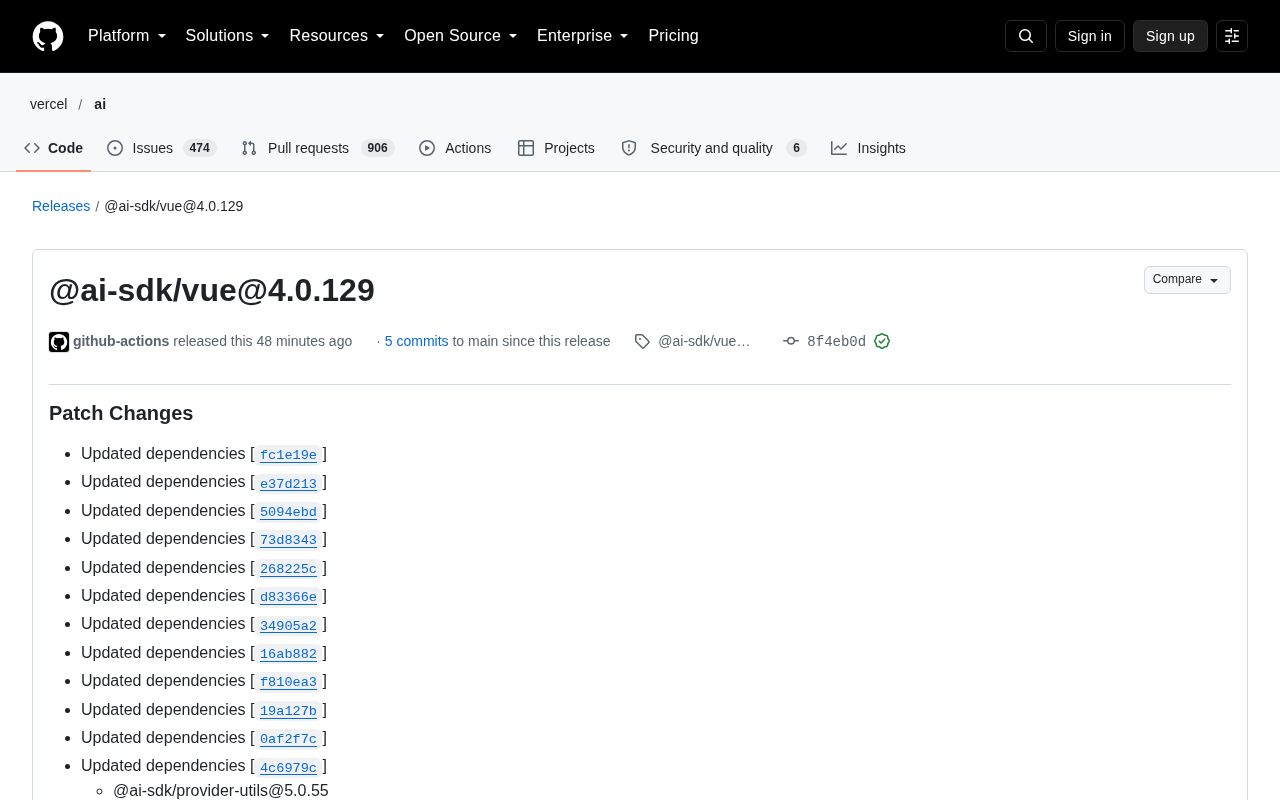
@ai-sdk/vue has released version 4.0.129. This is a patch release focused primarily on dependency updates, automatically published by GitHub Actions and verified with GitHub's signature.
@ai-sdk/vue is the Vue framework adapter within the Vercel AI SDK ecosystem, helping Vue developers quickly integrate LLM calls, streaming responses, and chat UI state management into their applications. This update is a routine maintenance release centered around syncing upstream dependencies.
What's in This Update
According to the release notes, 4.0.129 is a Patch Change, and the core change is the synchronization of several upstream dependencies. The release log lists over a dozen Updated dependencies entries, referencing commit hashes such as fc1e19e, e37d213, 5094ebd, 73d8343, and more.
Specifically, this release aligns the following associated package versions:
@ai-sdk/provider-utils@5.0.55ai@7.0.129
This means @ai-sdk/vue's Vue adapter layer stays in sync with both the core ai package and the provider utilities package. For Vue projects already using the AI SDK, this kind of alignment ensures API compatibility across sub-packages, preventing type or runtime issues caused by mismatched dependency versions.
What a Patch Release Means
Under Semantic Versioning (SemVer), a Patch version (incrementing the third digit) typically contains only backward-compatible bug fixes and internal dependency updates — no breaking changes, no new public-facing features. As a result, upgrading from an older 4.0.x version to 4.0.129 is generally a low-risk operation.
The AI SDK uses a monorepo-based coordinated release mechanism, where core logic is concentrated in lower-level packages like ai and @ai-sdk/provider-utils. Framework adapter packages like @ai-sdk/vue are passively triggered to release new versions whenever their underlying dependencies are updated. This release is a direct reflection of that cascading mechanism — multiple changes landed in the lower-level packages, and the framework layer followed suit.
About SemVer and Monorepos: Semantic Versioning divides version numbers into three segments:
MAJOR.MINOR.PATCH. MAJOR indicates breaking changes, MINOR indicates new backward-compatible features, and PATCH indicates backward-compatible bug fixes or internal maintenance. A monorepo is a project structure where multiple related packages are managed within a single repository. Vercel AI SDK uses this model, co-locatingai,@ai-sdk/provider-utils,@ai-sdk/vue, and other sub-packages for coordinated development and releases. The benefit is that cross-package changes can be made atomically in a single PR with aligned versioning. The trade-off is that even a sub-package with no substantive changes of its own will be triggered to publish a new version due to upstream updates, resulting in many "empty" patch releases. Understanding this mechanism helps developers assess whether a given version bump is truly worth paying attention to.
What Developers Should Do
For Vue developers currently using this SDK, here are a few recommendations:
- Keep versions in sync: If your project has
ai,@ai-sdk/provider-utils, and@ai-sdk/vueall installed, it's best to keep them on versions from the same release cycle to minimize compatibility risks. - Check the underlying changelogs: This Vue package release doesn't list any direct functional changes. To understand what actually changed in behavior, you'll need to review the release notes for
ai@7.0.129and@ai-sdk/provider-utils@5.0.55. - Treat it as a routine upgrade: As a patch release, upgrading generally requires no changes to your application code and can be incorporated into your regular dependency maintenance workflow.
Summary
4.0.129 is a typical maintenance patch release whose core value lies in dependency synchronization and version alignment, not feature iteration. It reflects the AI SDK ecosystem's high-frequency, incremental release cadence. For Vue teams building AI applications on top of this SDK, updates like this are worth including in routine upgrade plans to continuously benefit from upstream fixes and stability improvements. Since the original release notes are limited in detail, the specific functional impact should be confirmed by consulting the changelogs of the core packages.
Related articles

Free Unlimited Claude Code Solution: Agnes AI + CC Switch Setup Guide
No paid subscription needed — pair the free AI platform Agnes AI with the open-source tool CC Switch to provide a backend for Claude Code, enabling unlimited free calls to text, image, and video models. This guide covers the full setup, test results, and usage boundaries.

A Complete Zero-Cost Guide to Getting Started with Claude Code for Beginners in China
A beginner's guide to Claude Code for users in China: two installation methods (command line and IDE plugin), full configuration steps for replacing the official API with the free domestic LongCat model, and a hands-on demo of building a small tool with natural language, plus tips.

When the NSA Gets Involved: The AI Supply Chain Crisis Behind Open-Source CVEs and API Key Hijacking
Multiple open-source projects disclosed severe CVEs in one day, PHP flaws alarmed the FBI, and Railway and OpenCode were breached with API keys stolen. This article breaks down the vulnerability window, AI-accelerated exploitation, and the AI supply chain crisis behind the API key black market, with a developer defense checklist.