AI SDK Vue 4.0.141 Patch Release: What the Dependency Chain Update Means

@ai-sdk/vue 4.0.141 patch released, syncing two underlying dependencies—a low-risk routine follow-up.
@ai-sdk/vue 4.0.141 is a patch version whose core change is merely syncing two dependencies, @ai-sdk/provider-utils@5.0.60 and ai@7.0.141. It introduces no new APIs or components, is auto-published by github-actions with a GPG signature. This kind of dependency-alignment patch is common in AI SDK's monorepo model, and its value lies in ensuring the Vue adapter layer stays consistent with the underlying provider wrapper and core package. Since provider-utils carries shared logic like request wrapping and response parsing, its minor version changes can affect compatibility with specific providers. The article recommends pinning versions rather than using range symbols for AI dependencies, and provides three pre-upgrade checks: confirm no version conflicts, run streaming chat tests, and watch provider error logs. What truly warrants caution is cross-major-version upgrades, not patches like this.
Vercel's AI SDK ecosystem has rolled out another version iteration. @ai-sdk/vue@4.0.141 is released as a patch version—on the surface, just a routine dependency update, but placing it within the overall release cadence of the AI SDK reveals some signals about where frontend AI integration is heading.
What this patch actually changed
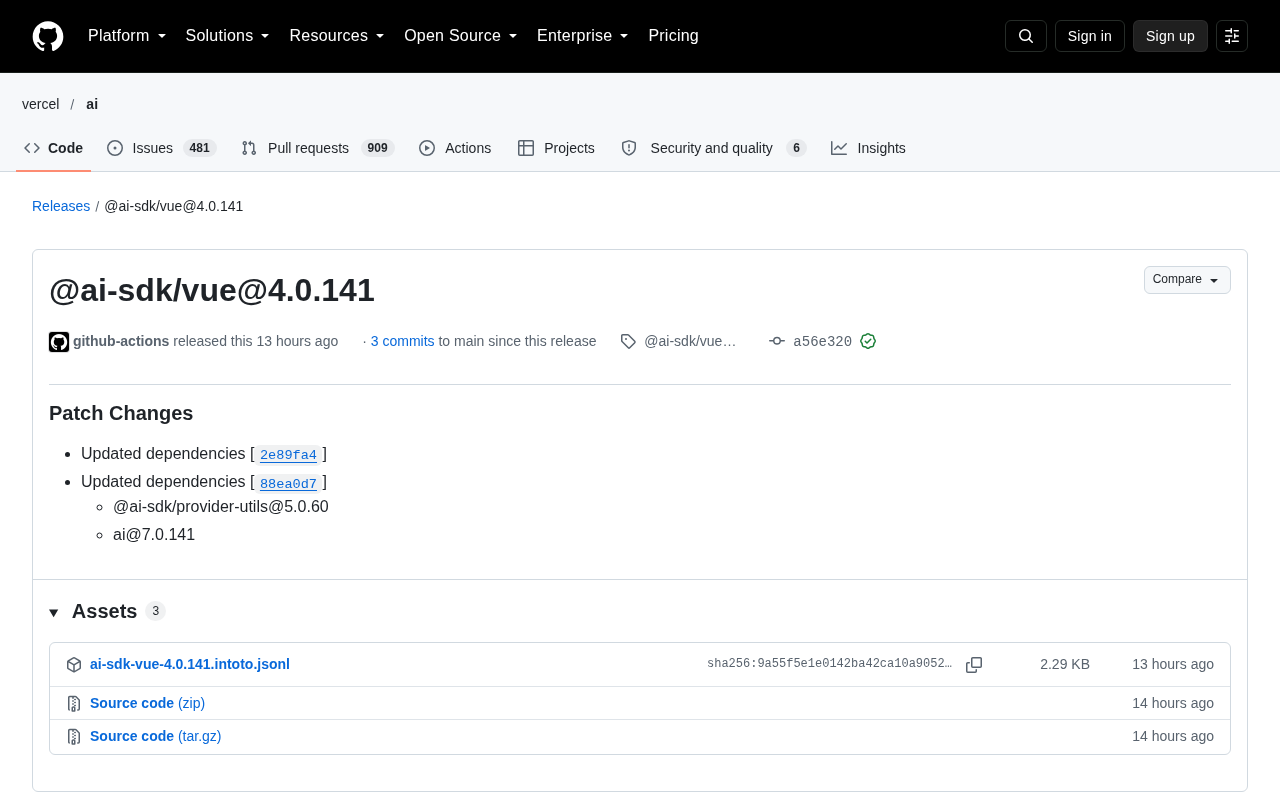
According to the release record on GitHub, the change type for @ai-sdk/vue@4.0.141 is marked as Patch Changes, and the core content consists of two dependency updates: @ai-sdk/provider-utils@5.0.60 and ai@7.0.141.
In other words, this version itself doesn't introduce new APIs or new components. Its value lies in aligning the Vue adapter layer with the underlying provider utility library and the core ai package to the same batch. The commit carries a GitHub verified signature (GPG key ID ending in B5690EEEBB952194), indicating the release process goes through a standard automated pipeline triggered by the github-actions bot.
This kind of "dependency-sync" patch is very common in monorepo projects. AI SDK splits the core logic, provider adapters, and framework bindings into multiple packages that version independently. Whenever any underlying package fixes a bug or adjusts behavior, the upper-level framework package needs to tag along with a version bump—otherwise users could end up with an inconsistent combination.
Why Vue developers should care about dependency versions
@ai-sdk/vue is positioned to let Vue applications integrate large model capabilities through the Composition API. It relies on the ai core package to handle the heavy lifting: streaming responses, tool calls, message state management. The synchronization with ai@7.0.141 and @ai-sdk/provider-utils@5.0.60 means the fixes or adjustments in this release happened at a lower level.
provider-utils typically carries the shared logic for request wrapping, response parsing, and error mapping for various model providers. Its minor version changes can affect compatibility with specific providers—for example, how a particular API field is parsed, or how streaming chunk boundaries are handled. For those using the Vue wrapper layer, upgrading to 4.0.141 ensures these underlying fixes are properly propagated upward.
From an engineering practice standpoint, pinning version numbers (rather than using ^ or ~) is more prudent for AI-related dependencies. Large model service endpoints don't always behave stably, and an inadvertent dependency drift could cause hard-to-reproduce anomalies in production chat features.
On the Composition API integration approach of @ai-sdk/vue: Vue 3's Composition API centers on the setup() function and reactive primitives like ref/reactive/computed, allowing logic to be organized by feature rather than by options (data/methods) into reusable composables. The useChat, useCompletion and other composables provided by @ai-sdk/vue follow exactly this paradigm: calling them returns reactive messages, input, handleSubmit and other state and methods that can be bound directly in templates. Streamed tokens automatically trigger view updates through Vue's reactivity system. Compared to writing call logic in mounted or Vuex/Pinia, the composable approach decouples AI state from the component lifecycle and makes it easy to share a session across multiple components. Understanding this helps assess the impact of upgrades: patch versions only swap dependencies, they don't change the return structure of composables.
Reading AI SDK's release cadence from version numbers
@ai-sdk/vue sits at 4.x, the ai core package has reached 7.x, and provider-utils is at 5.x—three packages with entirely different major version numbers that must nonetheless work together. This reflects AI SDK's intent to let each layer evolve independently: the framework binding layer doesn't need to follow the core package's breaking upgrades, as long as it adapts the interfaces properly.
The patch version number 141 itself is telling. High-frequency small-step releases are the norm for this project, and a single patch often does just one or two things. For users, rather than tracking every patch detail, it's better to watch for Breaking Changes or obvious dependency jumps in the release notes. When neither signal appears, upgrading as needed is sufficient.
On semantic versioning and independent releases in monorepos: SemVer stipulates that a MAJOR version change indicates incompatible API modifications, a MINOR version indicates backward-compatible feature additions, and a PATCH version indicates backward-compatible bug fixes. In monorepos like pnpm/npm workspaces, each sub-package can independently follow SemVer and increment on its own, which is why @ai-sdk/vue 4.x, ai 7.x, and provider-utils 5.x can coexist—their version lines are not bound to each other, and compatibility is maintained through dependency ranges declared within packages (such as ^7.0.141). This is exactly how tools like Lerna and Changesets work: each package maintains its own CHANGELOG and automatically bumps according to change type at release time. From a monorepo consumer's perspective, pay special attention—peer or transitive dependencies may conflict due to differing upgrade cadences across packages, which is why the article emphasizes pinning versions.
Should you upgrade now?
If you're using @ai-sdk/vue to build chat interfaces or AI features, upgrading to 4.0.141 is low-cost and a safe routine follow-up. It doesn't change the public API—only adjusts dependency pointers.
Three suggested check actions: confirm the project hasn't manually pinned old versions of @ai-sdk/provider-utils or ai that could cause conflicts; run your existing streaming chat test cases; and watch for changes in provider-related error logs after upgrading. If the project demands high stability and the current version runs well, you could also wait and observe one or two subsequent patches before following up.
What truly warrants caution is cross-major-version upgrades—for example, jumping from ai 6.x to 7.x—which typically comes with interface adjustments and is entirely different in nature from this patch.
On dependency version locking and drift: In package.json, ^1.2.3 allows upgrades to any version <2.0.0, ~1.2.3 restricts to <1.3.0, while hardcoding 1.2.3 fully pins it. npm also generates package-lock.json (or pnpm's pnpm-lock.yaml) recording the complete dependency tree hash, and npm ci installs according to the lockfile to ensure reproducible builds. What's special about AI-related dependencies is that the SDK internally adjusts request/parsing logic in response to provider API changes. If the underlying provider behavior changes and isn't synchronized locally, it can manifest as intermittent issues like truncated streaming responses or failed tool call parameter parsing. Therefore, fixing the lockfile in CI and treating npm update with caution is an engineering convention for reducing online uncertainty in AI applications.
One-line Summary
@ai-sdk/vue 4.0.141 patch released, syncing two underlying dependencies—a low-risk routine follow-up.
Paragraph Summary
@ai-sdk/vue 4.0.141 is a patch version whose core change is merely syncing two dependencies, @ai-sdk/provider-utils@5.0.60 and ai@7.0.141. It introduces no new APIs or components, is auto-published by github-actions with a GPG signature. This kind of dependency-alignment patch is common in AI SDK's monorepo model, and its value lies in ensuring the Vue adapter layer stays consistent with the underlying provider wrapper and core package. Since provider-utils carries shared logic like request wrapping and response parsing, its minor version changes can affect compatibility with specific providers. The article recommends pinning versions rather than using range symbols for AI dependencies, and provides three pre-upgrade checks: confirm no version conflicts, run streaming chat tests, and watch provider error logs. What truly warrants caution is cross-major-version upgrades, not patches like this.
Related articles

Free Unlimited Claude Code Solution: Agnes AI + CC Switch Setup Guide
No paid subscription needed — pair the free AI platform Agnes AI with the open-source tool CC Switch to provide a backend for Claude Code, enabling unlimited free calls to text, image, and video models. This guide covers the full setup, test results, and usage boundaries.

A Complete Zero-Cost Guide to Getting Started with Claude Code for Beginners in China
A beginner's guide to Claude Code for users in China: two installation methods (command line and IDE plugin), full configuration steps for replacing the official API with the free domestic LongCat model, and a hands-on demo of building a small tool with natural language, plus tips.

When the NSA Gets Involved: The AI Supply Chain Crisis Behind Open-Source CVEs and API Key Hijacking
Multiple open-source projects disclosed severe CVEs in one day, PHP flaws alarmed the FBI, and Railway and OpenCode were breached with API keys stolen. This article breaks down the vulnerability window, AI-accelerated exploitation, and the AI supply chain crisis behind the API key black market, with a developer defense checklist.