AI SDK Vue 4.0.149 Released: Dependency Updates and Ecosystem Impact

@ai-sdk/vue releases 4.0.149 patch, syncs core dependencies, low upgrade cost.
@ai-sdk/vue releases patch version 4.0.149, mainly syncing dependencies: core package ai upgraded to 7.0.149, utility package @ai-sdk/provider-utils to 5.0.66. The article notes that such patch updates don't introduce new features but ensure the Vue adapter stays consistent with AI SDK core behavior, avoiding compatibility issues in future upgrades. For developers building AI apps with Vue, this update involves no API changes and has low upgrade cost; it's recommended to verify in a test environment before updating and to check whether the ai package version in the project is aligned. The article also analyzes from an ecosystem perspective that the AI SDK's frequent small releases reflect an active maintenance pace, and the Vue adapter's timely follow-up shows continuous support for this framework in AI application development.
The AI SDK's Vue adapter @ai-sdk/vue has released version 4.0.149. This is a patch-level update that primarily syncs changes to underlying dependencies, meaning a more stable foundation for developers building AI applications with Vue.
Core Content of the Version Update
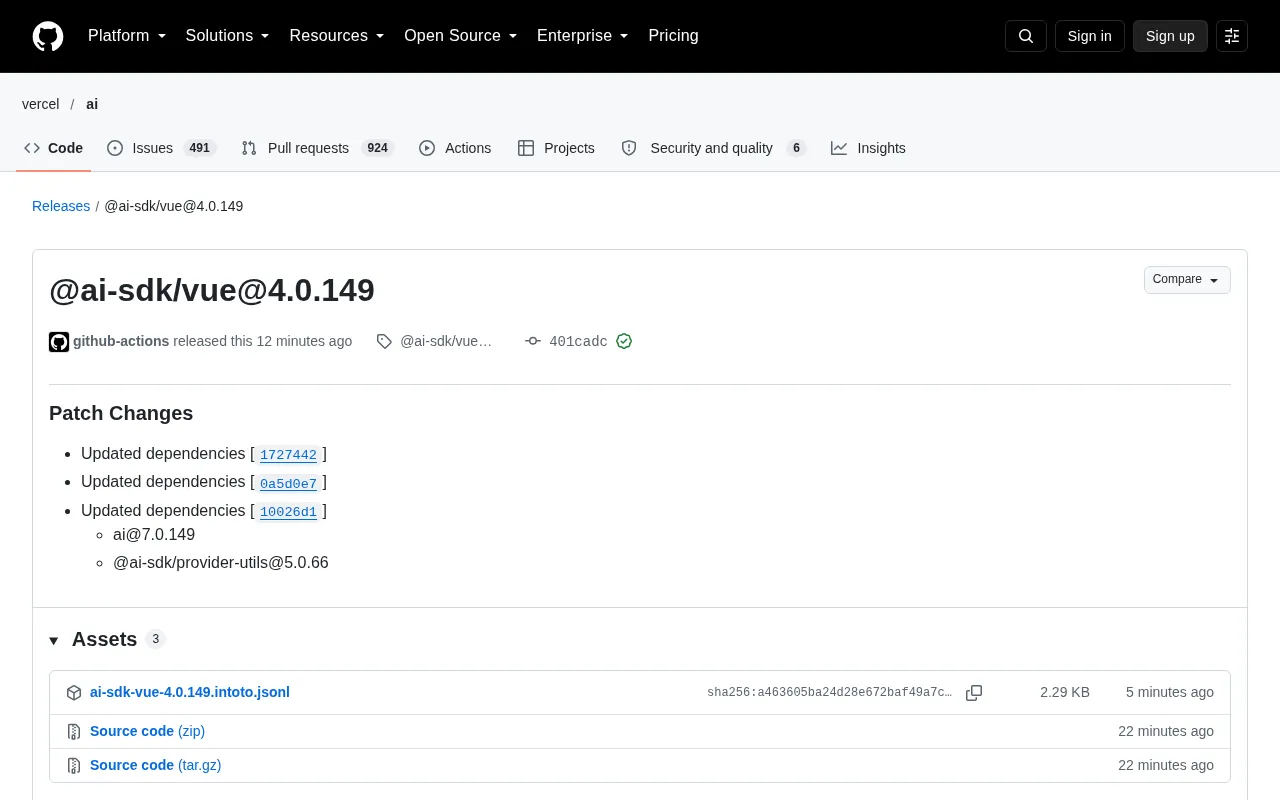
According to the GitHub release notes, the changes in @ai-sdk/vue@4.0.149 are focused on dependency updates, involving three commits: 1727442, 0a5d0e7, and 10026d1. Specifically, the version updates the ai package to 7.0.149 and @ai-sdk/provider-utils to 5.0.66.
These patch updates typically don't introduce new features, but fix issues or maintain compatibility with the core library. For Vue projects that depend on the AI SDK, upgrading to this version ensures behavior consistent with the latest core packages and avoids potential version conflicts.
Why Dependency Updates Matter
The AI SDK is maintained by Vercel and provides a unified interface for calling different large model services. @ai-sdk/vue is its adapter layer in the Vue ecosystem, encapsulating reactive state management and component integration logic. Iterations of the core package ai and the utility package @ai-sdk/provider-utils often bring adjustments to underlying protocols or utility functions, and the adapter must be updated in sync to ensure proper functionality.
If developers ignore these small version updates, they may encounter compatibility issues when subsequently upgrading the core packages. Therefore, keeping the adapter aligned with the core package versions is a routine practice for maintaining project health.
The Layered Architecture of AI SDK
The Vercel AI SDK uses a layered design: at the bottom is @ai-sdk/provider-utils, which provides shared utility functions and type definitions for model provider adapters; the middle layer is the core package ai, responsible for unified calling interfaces, streaming response handling, tool invocation, and other abstractions; the top layer consists of adapter packages for different frontend frameworks, such as @ai-sdk/vue and @ai-sdk/react. The significance of this layering is that changes to core protocols and utility functions only need to be modified once at the bottom layer, and framework adapters can receive fixes through dependency sync without having to rewrite logic individually. Therefore, the adapter version number's latter segment being consistent with the ai package (e.g., 4.0.149 corresponding to 7.0.149) is a deliberate design alignment, not a coincidence.
Semantic Versioning and Patch Updates
According to semantic versioning conventions, an increment in the patch position (third digit) indicates backward-compatible bug fixes, without breaking changes or new features. However, "patch" in the npm ecosystem doesn't mean it can be unconditionally ignored: when underlying dependencies are force-upgraded, the adapter may implicitly depend on the behavior of new utility functions. The article's recommendation to verify in a test environment before upgrading is precisely aimed at this risk. For projects with locked dependencies, you can use npm outdated or npm ls ai to check version consistency, avoiding duplicate instance issues caused by the adapter referencing an old version of ai while business code references a new version.
Practical Impact on Vue Developers
For teams currently using @ai-sdk/vue, this update does not involve API changes, and the upgrade cost is low. It's recommended to verify in a test environment before updating dependency versions. If the project also directly depends on the ai package, ensure both versions match to avoid duplicate dependencies or type incompatibilities.
From an ecosystem perspective, the frequent small version releases of the AI SDK reflect its active maintenance pace. The Vue adapter's timely follow-up shows that support for this framework in AI application development scenarios is continuous. For teams considering technology choices, this maintenance frequency is a positive signal.
Conclusion
@ai-sdk/vue@4.0.149 is a patch version primarily focused on dependency synchronization, with its core value being consistency with the main AI SDK package. Vue developers can upgrade with confidence and take this opportunity to check whether dependency versions in their projects are aligned.
Related articles

Uber Deploys ChatGPT Work Company-Wide: AI in the Workplace Enters the Scaled Implementation Phase
Uber deploys ChatGPT Work to 30,000+ employees, extending it from engineering to all roles. We analyze its expert-engineer pairing, end-to-end automation, and questions of AI control and power concentration—insights for scaling AI in the workplace.

Shift at Midnight Hands-On: When "ID Verification" Becomes Alien Hunting
Shift at Midnight blends ID verification with horror survival in a four-player co-op game. We break down its inspection mechanics and chaotic humor.

Zelensky Recounts the Outbreak of War: I Need Ammunition, Not a Ride
Zelensky recalls the first day of war in a YouTube interview: farewell to family, rejecting Biden's evacuation offer with "I need ammunition, not a ride," and how Bucha shaped his stance on compromise and peace talks.