@ai-sdk/vue 4.0.171 Released: Dependency Patch Update
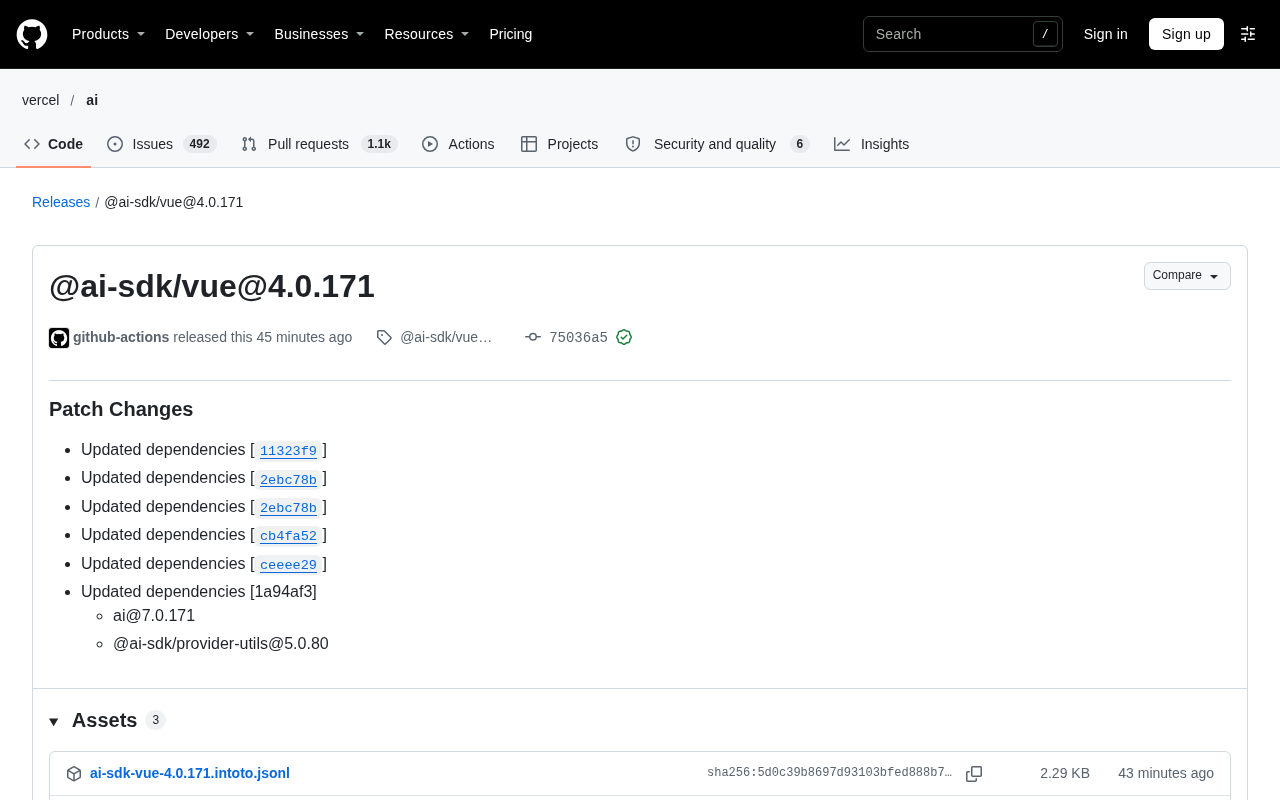
@ai-sdk/vue 4.0.171 patch released, only syncing ai core package and provider-utils dependencies.
Within the Vercel AI SDK ecosystem, @ai-sdk/vue has released patch version 4.0.171, with all changes concentrated on dependency synchronization involving the core package ai@7.0.171 and utility package @ai-sdk/provider-utils@5.0.80, introducing no new APIs or features. The article notes this pattern stems from the AI SDK's monorepo management, where the adaptation layer inherits improvements from the core package via dependency upgrades. For Vue developers, there are no breaking changes, so upgrading is safe and requires no code changes; however, to learn about specific fixes, one must check the commit records of the core and utility packages. The article also points out that the high version number 4.0.171 reflects a fast iteration cadence, and recommends production projects follow the core package's changelog rather than relying solely on the adaptation package's version number.
Within Vercel's AI SDK ecosystem, the @ai-sdk/vue package aimed at Vue developers has released version 4.0.171. This is a typical patch release (Patch Changes), with the core content centered around synchronizing dependency updates, and no new APIs or feature additions introduced.
Breakdown of the Version Update
According to the release record on GitHub, all changes in @ai-sdk/vue@4.0.171 are concentrated on updated dependencies, spanning multiple internal commits. The specific dependencies updated include the core package ai@7.0.171 and the utility package @ai-sdk/provider-utils@5.0.80.
This update pattern is quite common in the AI SDK's iteration cadence. As the adaptation layer for the Vue framework, @ai-sdk/vue's core logic and model invocation capabilities are primarily provided by the underlying ai package. Therefore, when patch fixes appear in the core package or utility packages, the upper-level framework wrappers inherit these improvements through dependency upgrades.
The Significance of Dependency Updates
For developers using @ai-sdk/vue directly, dependency updates are not a trivial matter to ignore. Utility packages like @ai-sdk/provider-utils@5.0.80 typically carry compatibility logic and utility functions for interfacing with different AI model providers. Patch-level updates often mean fixes for edge cases or compatibility adjustments, improving runtime stability without requiring developers to change their code.
The synchronized upgrade of ai@7.0.171 ensures that the Vue adaptation layer's behavior stays consistent with the core SDK. Since the AI SDK uses monorepo management, the various framework adaptation packages and the core package are tightly version-linked. Mixing versions across releases can lead to type definition mismatches or runtime behavior differences, so keeping dependency versions aligned is the recommended practice.
monorepo is an engineering practice of managing multiple related software packages within a single version-controlled repository. With the AI SDK adopting a monorepo, the ai core package, the framework adaptation packages (such as @ai-sdk/vue and @ai-sdk/react), and the @ai-sdk/provider-utils utility package share the same build and release pipeline, with version numbers bumped in sync via tools like changesets. The direct consequence is that a single patch commit to the core package triggers new patch releases for all adaptation packages that depend on it. Understanding this explains why @ai-sdk/vue's version number updates in lockstep with the ai package—the matching trailing numbers of 4.0.171 and 7.0.171 are no coincidence.
The practical implication for users is: in a monorepo ecosystem, mixing versions across packages can easily cause type mismatches or behavior differences, so you should try to keep @ai-sdk/vue aligned with the ai version it depends on, rather than pinning a single package's version in isolation.
Practical Impact on Vue Developers
From a functional standpoint, this release contains no breaking changes and is a patch version that can be safely upgraded. Vue projects using @ai-sdk/vue to build AI chat interfaces or streaming response components require no business code changes after upgrading to 4.0.171.
However, since the release notes only list dependency updates without a more detailed changelog, developers who want to know which underlying issues were specifically fixed need to further check the commit records for the corresponding versions of the ai package and @ai-sdk/provider-utils. This information delivery approach is fairly common in automated release pipelines, and it also means the community needs to rely on the core package's release notes to get the full context.
@ai-sdk/provider-utils is an internal utility package in the AI SDK used to unify the interfacing logic for model providers, providing capabilities such as streaming response parsing, tool calling parameter validation, error normalization, and common adaptation functions across providers. It is not directly exposed to business code but is depended upon by the ai core package and various provider packages (such as @ai-sdk/openai and @ai-sdk/anthropic).
Therefore, a patch update to this utility package typically means a fix for some edge case—for example, a non-standard response format returned by a certain provider, boundary conditions in streaming chunk parsing, or compatibility adjustments to tool call parameters. Such fixes are transparent to end users, and developers benefit without changing code. Conversely, since the changes don't land in the business layer, looking only at the @ai-sdk/vue release notes won't tell you what was specifically fixed—you need to trace back to the commit records for the corresponding version of provider-utils to get the full context.
Observations on the Release Cadence
Judging from the version number 4.0.171, @ai-sdk/vue iterates at a fairly high frequency. Frequent patch releases typically reflect the active development state of the upstream core package—whenever the ai package or provider utility package has new commits merged, the framework adaptation packages release accordingly. For production projects, it's advisable to follow the core package's changelog rather than relying solely on the adaptation package's version number to determine whether fixes have been introduced.
Overall, this is a maintenance-oriented release that reflects the AI SDK's engineering practice of coordinated multi-package updates. Vue developers can treat it as a routine dependency sync and upgrade as needed.
Related articles

Gemini 4 Neon Review: Benchmark Scores Rival Carbon, API Pricing and Quota Breakdown
Google Gemini 4 Neon is now live, benchmark scores closely tracking Carbon, API pricing 3/15 at twice Hydrogen's rate. This article compiles Bilibili creator testing: Neon can replace 90% of Carbon scenarios, AntiGravity quota consumption is only one-third of Carbon, plus subscription channel restrictions and 2API ban risks.

Gemini 4 Helium Coming Soon? Signals of Google Loosening Subscription Restrictions
Google team member hints releases will continue; community speculates Gemini 4 Helium (Flash Lite) may be next. Subscription ban controversy gets a response as product lead says "Soon," suggesting restrictions may be lifted. This article covers Gemini developments, OpenAI Coding Agent and risk management, Doubao real-time audio-video API, and compute business dynamics.

AI-Assisted React Development in Practice: Optimizing a Video App and Handling Errors
A 14-year veteran developer demonstrates AI-assisted React video app optimization: compressing video from 80MB to 5MB (~94%) via ImageKit, plus reliable error handling and retry mechanisms. Includes planning, code understanding, and verification methods for working with AI.