AI SDK Workflow 2.0.109 Patch Update Analysis

@ai-sdk/workflow 2.0.109 is only a dependency patch update; evaluate in periodic batches rather than tracking each one.
Vercel's @ai-sdk/workflow has released patch version 2.0.109. The core action is syncing the dependent ai core package to 7.0.177; the package itself introduces no new APIs or fixes for specific logic defects, and the version advancement is entirely driven by upstream patches. The article notes that such releases are very common in the AI SDK series, but the release notes lack a specific description of changes in ai 7.0.177, making it difficult for developers to judge whether underlying behavior has changed. Therefore, when upgrading, focus on three points: whether the resolved version of ai in the lockfile matches the team baseline, whether the sensitivity of workflow orchestration to error handling and retry logic causes behavioral regressions, and whether a manual review threshold is set for automated bot releases. The article ultimately recommends that production environments adopt a tiered upgrade strategy of batch-evaluating patches every two weeks, classifying pure dependency upgrades as a low-risk batch to be verified and brought in with regular releases.
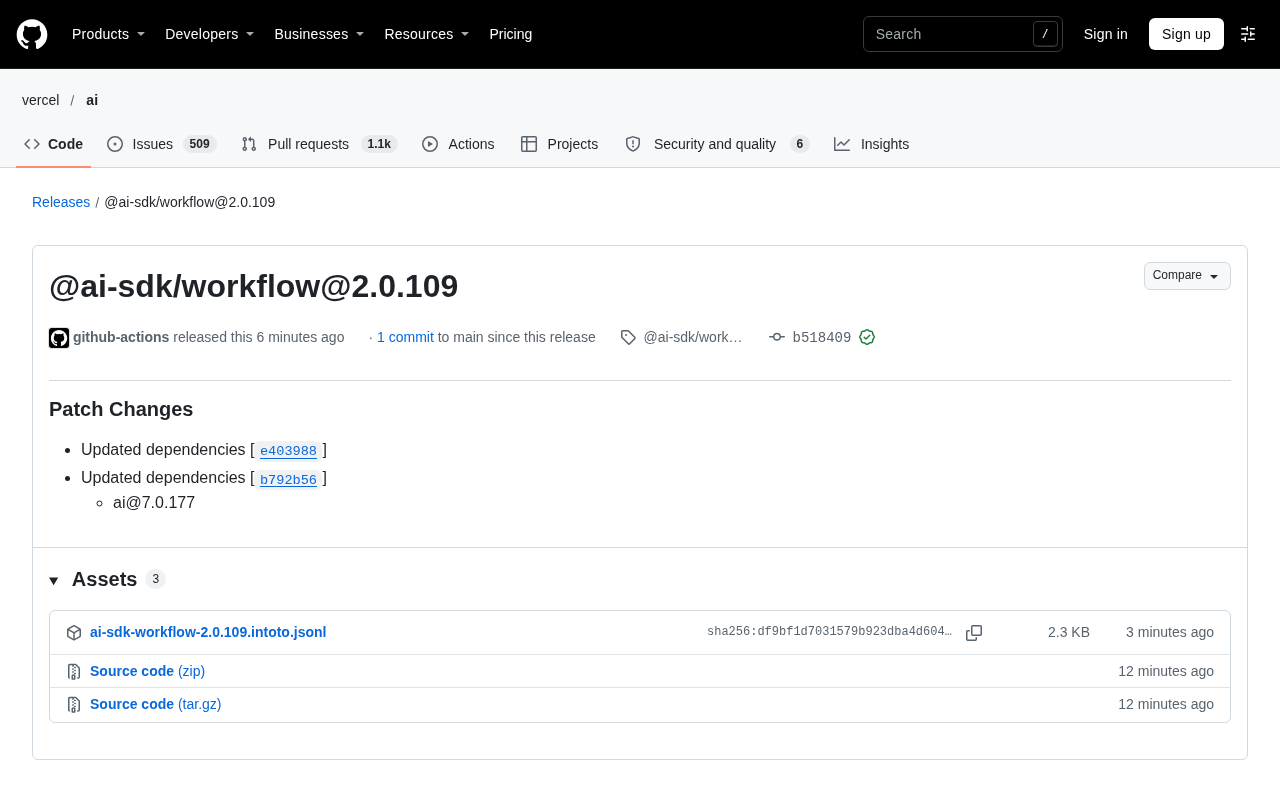
The @ai-sdk/workflow package in Vercel's AI SDK ecosystem has released version 2.0.109. This is a typical patch release, with the core focus on a batch upgrade of dependencies rather than functional changes. For developers using this workflow orchestration tool, understanding the real-world impact of such minor releases is more valuable than chasing version numbers.
The Core Action of This Release: Untangling the Dependency Chain
According to the GitHub release records, version 2.0.109 contains one commit, whose main work is updating the dependency version of the ai package. Specifically, the ai package was synced to version 7.0.177, along with two associated dependency commits (e403988 and b792b56). This "patch update + dependency sync" release pattern is very common in the AI SDK series maintained by Vercel.
One detail worth noting: @ai-sdk/workflow itself does not introduce new APIs or fix any specific logic defects. Its version number simply advances along the 2.0.x sequence, and its changes are entirely driven by patches to the upstream ai core package. This means that if you use both ai and @ai-sdk/workflow in your project, you need to ensure version compatibility between them when upgrading.
Semantic Versioning (SemVer) and Patch Numbers: SemVer splits a version number into three parts, MAJOR.MINOR.PATCH, corresponding respectively to breaking changes, backward-compatible new features, and backward-compatible bug fixes. @ai-sdk/workflow advancing from the 2.0.x sequence to 2.0.109 means the maintainers semantically promise no breaking changes and no new public APIs, so the risk surface of this upgrade is mainly concentrated on the actual behavior of transitive dependencies (especially the ai core package), rather than on this package's own interface contract.
Direct Dependencies and Transitive Dependencies: @ai-sdk/workflow declares ai as a dependency. When developers install the workflow package, the package manager resolves and pulls a specific version of ai—this layer is the transitive dependency. When upstream ai ships a patch, the workflow package only needs to bump its dependency declaration range to "follow" the upgrade. This is the mechanism behind what the original text calls "version advancement driven by upstream patches"—the package's own code may not have changed a single line, but the resolved version of ai in the installation result has already changed.
What ai 7.0.177 Brings
The original release notes do not detail the specific changes in ai 7.0.177; they are only indirectly reflected through the dependency update entry. This kind of incomplete information is fairly common in GitHub Release summaries captured via RSS. From an engineering practice perspective, patch-level updates to the ai package usually involve minor type definition adjustments, edge-case fixes, or stability improvements to internal utility functions, rather than breaking changes.
For teams building multi-step AI applications relying on workflow orchestration, it is advisable to review the complete commit history of the ai package around 7.0.177 before upgrading. Based solely on the release notes of @ai-sdk/workflow, it is impossible to determine whether there are microsecond-level changes in underlying behavior.
Practical Issues Developers Should Watch For
For this patch release, there are three things developers truly need to spend time confirming:
- Lockfile consistency: If you use pnpm or npm lockfiles, upgrading
@ai-sdk/workflowwill also pull in a newaiversion. Check whether the resolved version ofaiin the lockfile matches the baseline agreed upon by your team. - Behavioral regression in workflow nodes: Although patches usually do not change public interfaces, workflow orchestration is relatively sensitive to the error handling and retry logic of underlying AI calls. After upgrading, it is recommended to run your existing end-to-end workflow tests.
- Auto-update strategy: GitHub releases are automatically published by the
github-actionsbot, and commits are verified with GPG signatures (key ID B5690EEEBB952194). This kind of automated release cadence is fast, so if your project has enabled automatic merging by dependency bots, you need to assess whether to set a manual review threshold for patch versions.
How to Reasonably Handle High-Frequency Patch Releases
The iteration frequency of @ai-sdk/workflow reflects Vercel's strategy of rapidly polishing the entire AI SDK chain. A version number like 2.0.109 means the project has already reached a relatively stable 2.x stage, and patch releases are mainly to keep pace with the core package.
For production environments, there is no need to eagerly follow every patch number. A more pragmatic approach is to batch-evaluate patch updates on a fixed cycle (e.g., every two weeks), focusing on whether there are any fixes relevant to your own use cases; if the release notes only contain dependency upgrades without any behavioral description, you can classify them as a low-risk batch and bring them in with the next regular release after verification in the development environment.
This tiered upgrade strategy saves more team effort than chasing every patch, and also avoids introducing hard-to-diagnose regressions caused by minor changes in some indirect package within the dependency chain.
Lockfiles and Version Resolution: npm's package-lock.json and pnpm's pnpm-lock.yaml record the exact resolution results of the dependency tree, ensuring that the same lockfile installs an identical set of versions on different machines. When @ai-sdk/workflow upgrades and loosens or tightens its dependency range on ai, reinstalling may change the actual resolved version of ai, causing a diff in the lockfile. Teams typically commit lockfiles to version control and agree on baseline versions precisely to make such indirect changes auditable and rollback-able; if CI uses npm ci or pnpm install --frozen-lockfile, a lockfile mismatch will directly cause the build to fail, which is why the original text emphasizes "lockfile consistency."
One-line Summary
@ai-sdk/workflow 2.0.109 is only a dependency patch update; it is recommended to evaluate in periodic batches rather than tracking each one.
Paragraph Summary
Vercel's @ai-sdk/workflow has released patch version 2.0.109. The core action is syncing the dependent ai core package to 7.0.177; the package itself introduces no new APIs or fixes for specific logic defects, and the version advancement is entirely driven by upstream patches. The article notes that such releases are very common in the AI SDK series, but the release notes lack a specific description of changes in ai 7.0.177, making it difficult for developers to judge whether underlying behavior has changed. Therefore, when upgrading, focus on three points: whether the resolved version of ai in the lockfile matches the team baseline, whether the sensitivity of workflow orchestration to error handling and retry logic causes behavioral regressions, and whether a manual review threshold is set for automated bot releases. The article ultimately recommends that production environments adopt a tiered upgrade strategy of batch-evaluating patches every two weeks, classifying pure dependency upgrades as a low-risk batch to be verified and brought in with regular releases.
Related articles

Hands-On with the Genie 4 World Model: Directing Worlds in Real Time Like a Puppeteer
Google DeepMind's Genie 4 world model in depth: Special Guest X's hands-on demo of real-time scene direction via prompts, custom interactive apps in Project Genie, and prompts-as-seeds reproducibility.

Nvidia RTX Spark Mini PCs Go on Sale, Asus, Dell, and MSI Lead the Launch
Nvidia's RTX Spark N1X chip expands to desktops, with Asus, Dell, and MSI launching the first mini PCs, followed by Acer, Gigabyte, HP, and Microsoft's Surface Dev Box, accelerating the desktop AI PC ecosystem.

If Jensen Huang Steps Down, What Happens to Nvidia's AI Empire?
Is Nvidia's AI dominance overly dependent on Jensen Huang? This article analyzes Silicon Valley's CEO personality cult phenomenon, explores Nvidia's technical moat and organizational risks, and why the AI industry must shed the savior narrative.