@ai-sdk/workflow 2.0.75 Released: AI SDK Workflow Patch Update

Vercel releases @ai-sdk/workflow 2.0.75, a patch version syncing three underlying dependencies with no new features or breaking changes.
@ai-sdk/workflow releases version 2.0.75, a typical patch-level maintenance update whose core change is syncing underlying dependencies to ai@7.0.143, @ai-sdk/provider@4.0.29, and @ai-sdk/provider-utils@5.0.62 via three separate commits. The module is the workflow orchestration layer above the AI SDK core package, handling multi-step AI task chains. The upgrade risk is extremely low with no business code changes required, though compatibility with provider@4.0.29 should be checked if using specific provider packages.
Vercel's AI SDK ecosystem has seen a minor but noteworthy version iteration. @ai-sdk/workflow has released version 2.0.75, an update focused on synchronized dependency upgrades with no new features or breaking changes. For developers building agent workflows with the AI SDK, this is a routine but necessary maintenance release.
Dependency Sync: What Changed in This Update
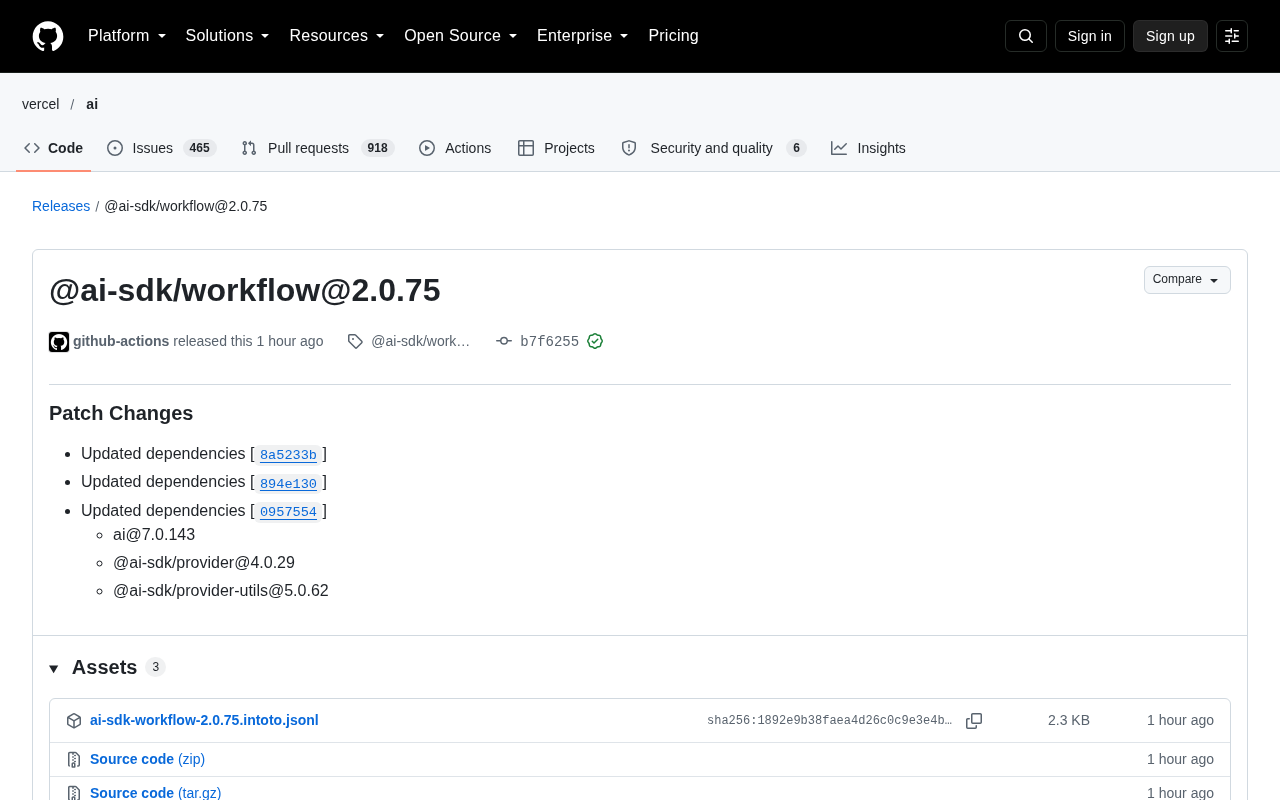
According to the GitHub release page, 2.0.75 is a typical Patch Changes release, with the core changes centered on version alignment of underlying dependencies. Specifically, three key dependencies are involved:
ai@7.0.143@ai-sdk/provider@4.0.29@ai-sdk/provider-utils@5.0.62
These dependency updates were completed through three separate commits (8a5233b, 894e130, 0957554), suggesting the maintainers may be doing batched dependency upgrade verification. As the workflow orchestration layer in the AI SDK system, @ai-sdk/workflow relies heavily on interface consistency between the ai core package and the provider abstraction layer, so this dependency synchronization is a prerequisite for ensuring downstream projects compile and run correctly.
The Role of the AI SDK Workflow Module
For readers unfamiliar with this package, a brief explanation of @ai-sdk/workflow's position in the overall AI SDK architecture is needed. The AI SDK itself is an open-source toolkit from Vercel that provides a unified model calling interface (such as generateText, streamText) and multi-provider adaptation capabilities. The workflow module is an orchestration layer built on top of this, used to handle multi-step AI task chains — for example, first having a model generate structured data, then calling tools based on the results, and finally aggregating the output.
The value of this module lies in abstracting complex multi-turn interaction logic out of business code, allowing developers to define AI processes in a more declarative way. Although this dependency update appears unremarkable on the surface, as the underlying ai package continues iterating through the 7.0.x series, the workflow module must stay in sync, otherwise type mismatches or runtime behavior differences may occur.
On the Division of Labor Between the ai Core Package and the Provider Abstraction Layer
The AI SDK uses a layered design. The lowest layer, @ai-sdk/provider, only defines abstract interface contracts — specifying which methods language models, embedding models, and image models each need to implement — and contains no concrete API calling logic. The ai core package depends on these contracts, exposing high-level functions like generateText, streamText, and generateObject to developers, and is responsible for message format conversion, tool calling loops, streaming response parsing, and other general logic. Concrete packages like @ai-sdk/openai and @ai-sdk/anthropic are the implementation layer that adapts each vendor's API to the provider contract.
Because of this layering, the versions of ai, provider, and provider-utils must be aligned with each other: the ai package internally references a specific version of the provider interface signature, and if the workflow module locks a provider version behind what the ai package expects, TypeScript type conflicts or missing runtime methods may result. This is why a single release of @ai-sdk/workflow needs to synchronize all three package versions simultaneously.
The Semantics of Patch Changes
@ai-sdk/workflow@2.0.75 occupies the Patch position in Semantic Versioning (SemVer). Under SemVer conventions, Patch indicates only backward-compatible bug fixes, containing no new features and no breaking changes (the latter corresponding to the Major position). The Patch position incrementing to 75 in this release indicates the series has accumulated a large number of small, rapid maintenance commits, consistent with Vercel's characteristic high-frequency release cadence. For users, Patch upgrades are usually safe, but in an ecosystem with tightly coupled dependency trees, it is still advisable to use npm ls or the lockfile to confirm the actual resolved transitive dependency versions.
The Provider Ecosystem's Continued Evolution
Worth discussing separately are the synchronized updates to @ai-sdk/provider and @ai-sdk/provider-utils. The former defines the abstract interface for model providers, while the latter provides utility tools for building custom providers. The version number changes for these two packages (to 4.0.29 and 5.0.62 respectively) reflect the AI SDK's rapid expansion of its supported model backends.
For developers building custom providers, each version advancement of provider-utils may bring adjustments to type definitions or new helper functions. Although this is a patch-level update that won't break existing code, it is advisable to run a round of type checking (tsc --noEmit) after upgrading to ensure that the model calling logic in workflow definitions is compatible with the new version.
Upgrade Advice for Developers
This update falls under routine maintenance, with extremely low upgrade risk. If your project is already using the 2.0.x series of @ai-sdk/workflow, simply updating to 2.0.75 is sufficient, with no need to modify business code.
Note that the version matrix across AI SDK modules is fairly tight. If you also use specific provider packages like @ai-sdk/openai or @ai-sdk/anthropic, it is advisable to check their compatibility with @ai-sdk/provider@4.0.29 as well. Vercel typically maintains backward compatibility within minor versions, but provider interface changes across major versions still warrant attention to migration guides.
Judging from the project's release cadence, the AI SDK team maintains high-frequency minor version iterations, meaning fast response times for bug fixes and provider adaptations. For production environment projects, it is advisable to lock specific version numbers or use a lockfile to avoid unexpected behavior changes from automatic upgrades.
Summary
@ai-sdk/workflow@2.0.75 is a standard patch release: dependency sync, no new features, low risk. Its significance lies not in what it changes, but in maintaining the consistency and compilability of the entire AI SDK dependency tree. For teams relying on the workflow module to build complex AI applications, keeping up with such updates is a basic practice for maintaining project health.
One-line Summary
Vercel releases @ai-sdk/workflow 2.0.75 patch version, syncing only three underlying dependencies with no new features or breaking changes.
Paragraph Summary
@ai-sdk/workflow has released version 2.0.75, a typical patch-level maintenance update whose core change is synchronizing underlying dependencies to ai@7.0.143, @ai-sdk/provider@4.0.29, and @ai-sdk/provider-utils@5.0.62, completed through three separate commits for verification. This module is the workflow orchestration layer above the core package in the AI SDK architecture, used to handle multi-step AI task chains, and its stability relies heavily on interface consistency between the core package and the provider abstraction layer. The article reminds developers that this upgrade carries extremely low risk and requires no changes to business code, but if you also use specific provider packages like @ai-sdk/openai or @ai-sdk/anthropic, you should check their compatibility with provider@4.0.29, and it is recommended to lock version numbers or use a lockfile in production environments.
Related articles

Random Pruning of the DPO Computation Graph: 1.4x Training Speedup and Lower Peak Memory
DPO training too slow and memory-hungry? This paper proposes a random pruning framework for the DPO computation graph, sampling independently across position, sequence, and branch dimensions; branch pruning achieves a 1.426x step-time speedup and cuts training time by about 30%, with in-depth attribution of memory and time gains.

Why Does JEPA Underperform MLM in Longitudinal EHR Representation Learning?
New study compares JEPA and MLM for longitudinal EHR representation learning on MIMIC-IV: three JEPA variants train stably without collapse but underperform MLM; target size, not heterogeneity, drives prediction error.

Transfer Learning + Visible Light Communication: A New Approach to Energy-Efficient Indoor Positioning
A study proposes a transfer learning-based visible light communication indoor positioning method, achieving 47% accuracy improvement on the BOSCH factory dataset, 67.5% model efficiency under high noise, and introducing the ME composite metric for energy-efficient positioning in energy-constrained industrial IoT scenarios.