AI SDK Workflow 2.0.85 Patch Release: Documentation Cleanup and Dependency Sync

AI SDK Workflow 2.0.85 patch released, focused on documentation cleanup and underlying dependency sync.
@ai-sdk/workflow released patch version 2.0.85 without introducing new interfaces or breaking changes. The core change is commit e729d58, which unifies formatting and removes duplication in README.md, while synchronizing three upstream dependencies: @ai-sdk/provider 4.0.34, ai 7.0.153, and @ai-sdk/provider-utils 5.0.68. These three packages handle model access abstraction, common utility functions, and the core call entry point respectively. The article notes that this bundled upgrade reflects the Vercel team's tightly coupled versioning strategy: the benefit is aligned interfaces across the ecosystem and fewer version mismatches, while the cost is that patch upgrades may also bring subtle changes in underlying behavior. It recommends checking dependency changelogs and using lockfiles or npm ls to inspect the dependency tree before upgrading in production to avoid conflicts caused by version hoisting.
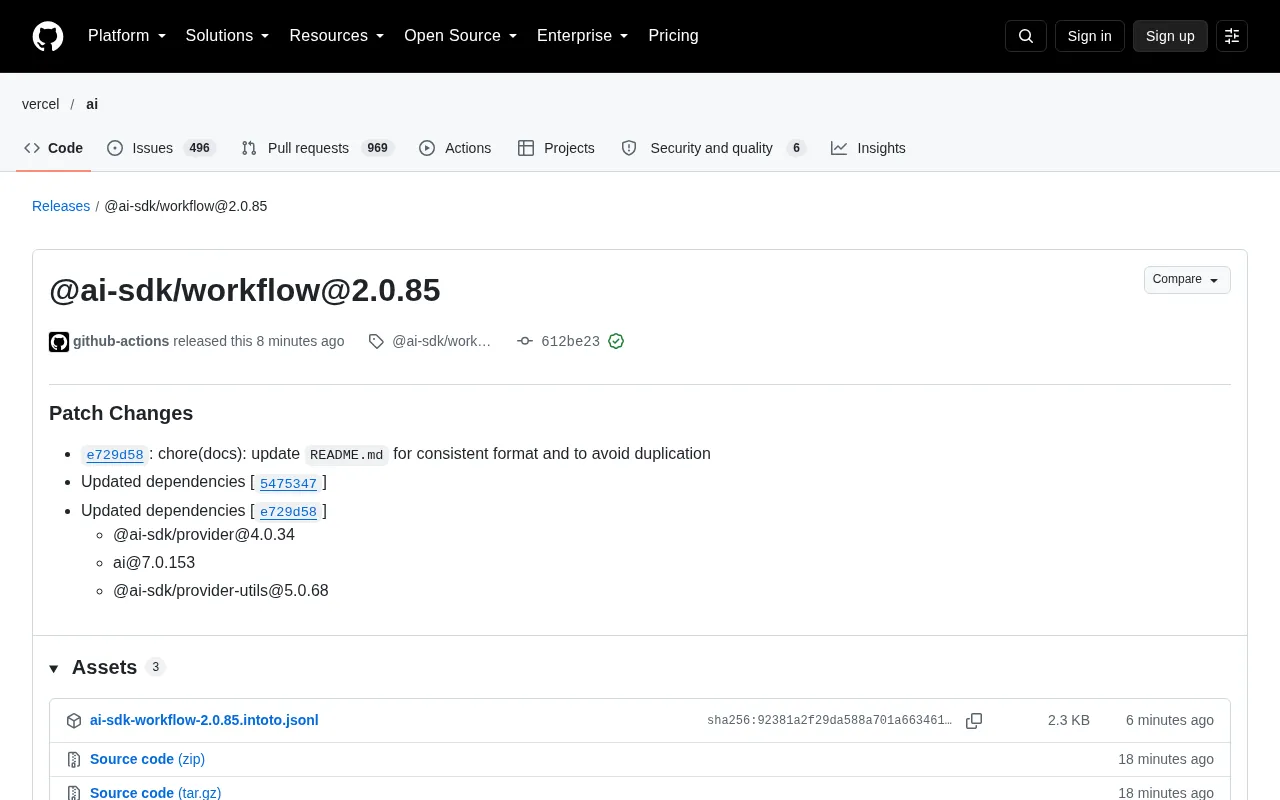
The AI SDK ecosystem has rolled out another version iteration. @ai-sdk/workflow has released patch version 2.0.85, with changes focused on documentation standardization and dependency synchronization—no new feature interfaces or breaking changes were introduced.
What Changed in This Update
According to the GitHub release record, the core change in 2.0.85 is a documentation maintenance task: commit e729d58 updated README.md with the goal of unifying formatting and eliminating duplicate content. For an AI development toolkit in a period of rapid iteration, documentation cleanliness directly affects how efficiently new users can get started. These seemingly trivial patches actually play a role in lowering the barrier to entry.
That said, this version also synchronized upgrades to three upstream dependencies: @ai-sdk/provider to 4.0.34, ai to 7.0.153, and @ai-sdk/provider-utils to 5.0.68. These three packages form the underlying support system of the AI SDK—provider handles model access abstraction, provider-utils provides common utility functions, and the ai package is the core entry point that developers most often call directly.
Why the Dependency Chain Matters
A patch version of a workflow package upgrading multiple underlying dependencies together shows that the Vercel team adopts a tightly coupled versioning strategy when maintaining the AI SDK. The benefit of this approach is that interfaces across packages in the ecosystem stay aligned, reducing the pitfalls developers encounter from version mismatches; the cost is that patch upgrades may also bring subtle changes in underlying behavior.
Compared with the loosely managed versioning common in the industry, this approach by the AI SDK is closer to the coordinated release model of a monorepo. For teams using @ai-sdk/workflow in production, it is advisable to check the changelogs of these three dependencies before upgrading, especially changes within the ai package's 7.0.x series.
Semantic Versioning (SemVer) is the basis for classifying this update as a patch. SemVer specifies version numbers in the form major.minor.patch: a major version change indicates incompatible API modifications, a minor version change indicates backward-compatible feature additions, and a patch change indicates backward-compatible bug fixes. Therefore, by convention, 2.0.85 should not contain breaking changes. However, note that SemVer constraints only cover the interfaces exposed by the package itself and do not guarantee that the behavior of its dependencies remains unchanged—this is why the article repeatedly emphasizes checking dependency changelogs.
Practical Impact of the Patch Version
2.0.85 is a patch-level update and, by semantic versioning convention, should not contain breaking changes. Documentation adjustments have no impact on runtime behavior, and dependency upgrades are theoretically only fixes and internal optimizations.
However, dependency upgrades always carry indirect risks. If other versions of @ai-sdk/provider or ai are also installed in the project, npm's dependency hoisting strategy may cause the actually loaded version to differ from expectations. Using a package manager lockfile or checking the dependency tree with npm ls is a worthwhile step before upgrading.
npm dependency hoisting and lockfiles are the background for understanding indirect risks. When npm installs dependencies, it hoists packages that satisfy version ranges to the top level of node_modules as much as possible for reuse. If the version ranges required by different packages for the same dependency overlap, only one copy is kept; when ranges do not overlap, multiple nested copies are installed. This can cause the runtime to load a version that differs from expectations, and singleton state (such as a provider registry) may be split across multiple copies. Lockfiles such as package-lock.json and pnpm-lock.yaml pin the exact versions of the entire dependency tree, and npm ls <package-name> can list all sources and versions of a package. Combining the two is the standard way to troubleshoot version conflicts.
How to Assess Whether to Upgrade
For developers tracking the latest progress of the AI SDK, such patch versions can usually be followed directly; for production projects prioritizing stability, it may be better to observe one or two versions before upgrading in batches. In either case, paying attention to README updates has practical value—documentation unification often means example code is more reliable, which can reduce the time spent debugging against outdated docs.
This release was completed automatically by GitHub Actions, and the commit carries a GitHub-verified signature (GPG key ID: B5690EEEBB952194). The process is standardized and transparent, which is also an example of the traceability of open-source project releases.
GitHub Actions automated releases and commit signing form the process foundation of this release. GitHub Actions uses workflow files in the repository to automatically execute steps such as building and publishing npm packages when tags are pushed or PRs are merged, making the release process reproducible and less dependent on manual intervention. The GitHub-verified signature on the commit comes from a GPG (GNU Privacy Guard) key. GitHub attaches signatures to web-based commits or automated workflows configured with keys, allowing other users to confirm that the commit indeed came from that account and that the content has not been tampered with. The GPG key ID appearing in the release record is used for this verification, providing a basic guarantee for the traceability of the open-source supply chain.
Conclusion
AI SDK Workflow 2.0.85 is a routine maintenance update focused mainly on documentation cleanup and dependency synchronization. It reminds us that the maturity of an AI toolchain is reflected not only in new features but also in documentation quality and consistency in version management.
Related articles

New Trailer for 'Everest: The Other Side' Released: Ski Mountaineers Take On Ski Descent of the North Face
National Geographic's 'Everest: The Other Side' trailer follows pro ski mountaineers attempting Everest's Direct North Face and the first ski descent, with rare North Face footage and life-or-death avalanche moments.
Building Automotive Crash AI Surrogate Models with NVIDIA PhysicsNeMo
An analysis of the NVIDIA PhysicsNeMo crash analysis workflow: how to train a Transolver surrogate model with simulation datasets and package it as an inference API via NIM, covering the complete four-step process of geometry parameterization, data splitting, and error validation.

LangGraph in Production: The Pain of Silent API Changes
Explores the challenge of silent external API changes affecting LangGraph agents in production, analyzes monitoring and testing limits, and proposes semantic validation and regression testing defenses.