@ai-sdk/workflow 2.0.88 Released: The Continued Evolution of the AI SDK Ecosystem
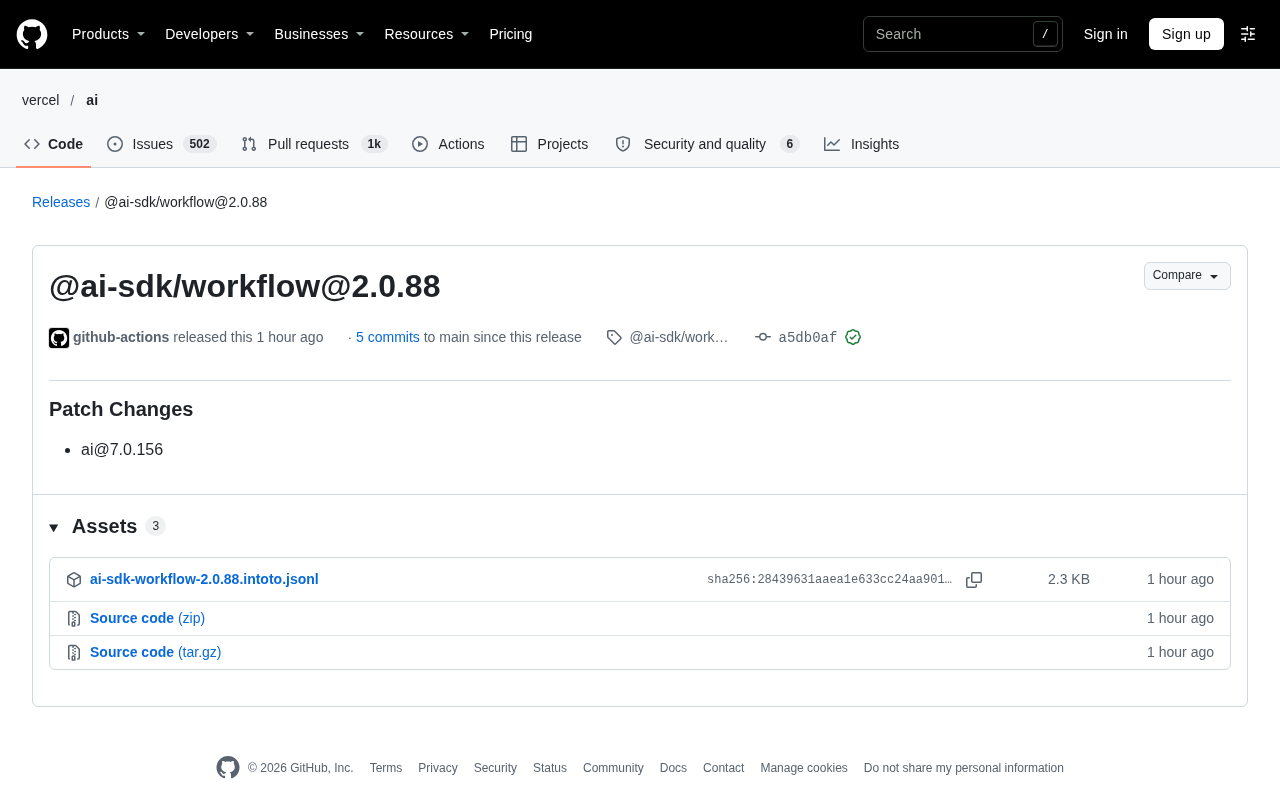
@ai-sdk/workflow releases 2.0.88 patch, with the only core change being alignment with ai@7.0.156.
The article reports the release of @ai-sdk/workflow 2.0.88, noting it's a patch update whose only core change is bumping the ai dependency to 7.0.156. The author explains that the workflow package is built on the ai core package, sharing type definitions, tool calling protocols, and streaming response mechanisms, so sub-packages and core packages must maintain version alignment or risk type mismatches or runtime errors. This release was automated by github-actions with 5 commits and a verification signature, reflecting the team's automated, high-frequency iteration engineering culture. For developers, the article recommends upgrading projects already locked to ai@7.0.156 to avoid version conflict warnings, while those who haven't upgraded should verify compatibility in a test environment, since AI applications are sensitive to prompts and tool calls.
The AI SDK ecosystem is getting another update. @ai-sdk/workflow has released version 2.0.88, a patch update that primarily aligns with the core package version of ai@7.0.156. For developers heavily using Vercel AI SDK to build agent and workflow applications, these version iterations often signal synchronization of underlying dependencies and fixes for potential issues.
Version Positioning: The Engineering Cadence Behind Patch Updates
From the release notes, @ai-sdk/workflow@2.0.88 falls under Patch Changes, with the core change being bumping the ai package dependency to 7.0.156. Patch version numbers typically represent backward-compatible bug fixes and minor improvements rather than breaking changes. This fits the AI SDK team's consistent release cadence—using frequent minor version iterations to quickly respond to community feedback and maintain version consistency across sub-packages.
Interestingly, this release was automatically completed by the github-actions bot, containing 5 commits with a GitHub verification signature. This automated release process ensures the reliability and traceability of version releases, and is a typical engineering practice for mature open-source projects.
@ai-sdk/workflow is an extension package in the AI SDK ecosystem for orchestrating multi-step agent flows. Typical use cases include organizing tool calls, model reasoning, and conditional branches into reusable workflows rather than hand-writing control flow in business code. It doesn't provide model capabilities itself but reuses the calling protocols, message formats, and streaming mechanisms provided by the core package ai, so its dependency on ai is tightly bound. This also explains why patch versions of this package appear frequently: it's mostly not fixing its own business defects but following the core package's release cadence for dependency alignment. For teams using the workflow package to build multi-agent or complex toolchains, tracking its version number changes is essentially indirectly tracking the evolution state of the core package.
Ecosystem Synergy: Why ai Package Version Alignment Matters
@ai-sdk/workflow doesn't exist in isolation—it's built on top of the ai core package, sharing type definitions, tool calling protocols, and streaming response mechanisms. When the core package ai updates to 7.0.156, synchronously upgrading the workflow package ensures that developers using workflow orchestration capabilities won't encounter type mismatches or runtime errors due to underlying API differences.
This tightly coupled version strategy is very common in the AI SDK ecosystem. Developers only need to focus on the top-level package version, and the dependency resolver automatically pulls compatible sub-package combinations. But this also means that when the core package has regression issues, the workflow package may need to quickly follow up with a patch release. The release of 2.0.88 is exactly a manifestation of this synergy mechanism.
Vercel AI SDK is an open-source toolkit for large model application development, and its package structure roughly falls into two categories: the core package ai provides foundational capabilities such as unified model calling interfaces, streaming responses, tool calling, and structured output; peripheral packages like @ai-sdk/workflow and various model provider packages provide orchestration or adaptation capabilities on top of that. The cost of this layered design is a strict version contract between packages—once the core package's type definitions or protocol details change, dependent sub-packages must be upgraded synchronously, otherwise problems may occur in TypeScript type checking or at runtime. AI SDK uses semantic versioning (SemVer): major version changes mean breaking API adjustments, minor versions correspond to backward-compatible new features, and patch numbers are only for bug fixes. Understanding this makes it clear why sub-package minor version numbers continuously track the core package version numbers.
Practical Impact on Developers
For most developers using @ai-sdk/workflow, this update is recommended but not urgent. If your project has already locked ai@7.0.156, then upgrading to 2.0.88 can avoid potential version conflict warnings and ensure workflow execution logic stays consistent with the core package's behavior.
If you haven't upgraded the core package yet, you can follow subsequent official release notes or verify compatibility in a small-scale test environment. Patch versions typically don't introduce behavior changes, but in AI applications—systems sensitive to prompts and tool calls—any version change is worth covering with test cases for verification.
Summary
@ai-sdk/workflow@2.0.88 is a routine patch maintenance update, with its core value being maintaining version synchronization with ai@7.0.156. It reflects the AI SDK team's automated, high-frequency iteration engineering culture, and also reminds developers to pay attention to the version alignment relationship between sub-packages and the core package.
Related articles

Gemini 4 Carbon Tops Global Rankings as AI Productivity and Open-Source Ecosystems Surge
Google DeepMind's Gemini 4 Carbon tops global benchmarks, built for complex agents and system security. ByteDance launches Doubao Work integrated with Feishu, Anthropic's AI autonomously breaches 5 system-level attack chains, and ModelBest and Fudan open-source on-device multimodal and image generation models.

Overseas Creator Breaks Down N8n AI Agent Business Playbook: From Tooling to Monetization
An overseas creator breaks down the N8n AI agent business playbook: comparing Zapier, Make, and N8n, detailing four monetizable automation categories—lead capture, WhatsApp follow-up, booking, and content pipelines—plus agency pricing and a sales playbook.

Empacer: The Voice-First AI Assistant for Small Business Owners That Topped Product Hunt
Empacer is a voice-first AI assistant for small business owners: three-question setup, voice requests turned into customer replies, social posts, and invoices—all owner-approved. It won #1 Product of the Day on Product Hunt with 231 upvotes and 47 comments.