AI SDK Workflow 2.0.96 Patch Analysis: A Signal of Stable Iteration in Vercel's Workflow Ecosystem

AI SDK workflow package releases 2.0.96 patch, syncing ai core dependency and reflecting a high-frequency small-step release cadence.
This article analyzes the release of Vercel's @ai-sdk/workflow@2.0.96. It is a patch-level update automatically published by github-actions with a GPG signature, and its core action is synchronously upgrading the dependent ai package to 7.0.164 without introducing new orchestration capabilities. The article notes that the patch number has reached 96, reflecting high-frequency small-step iteration, and that the workflow package is tightly coupled with the core ai package, so upgrade benefits mainly come from underlying improvements. For developers, this update is not an urgent reason to upgrade, but it is a reminder to watch version matching between the two packages, use lock files, and upgrade periodically in batches, incorporating minor versions into routine dependency inspection rather than following every version.
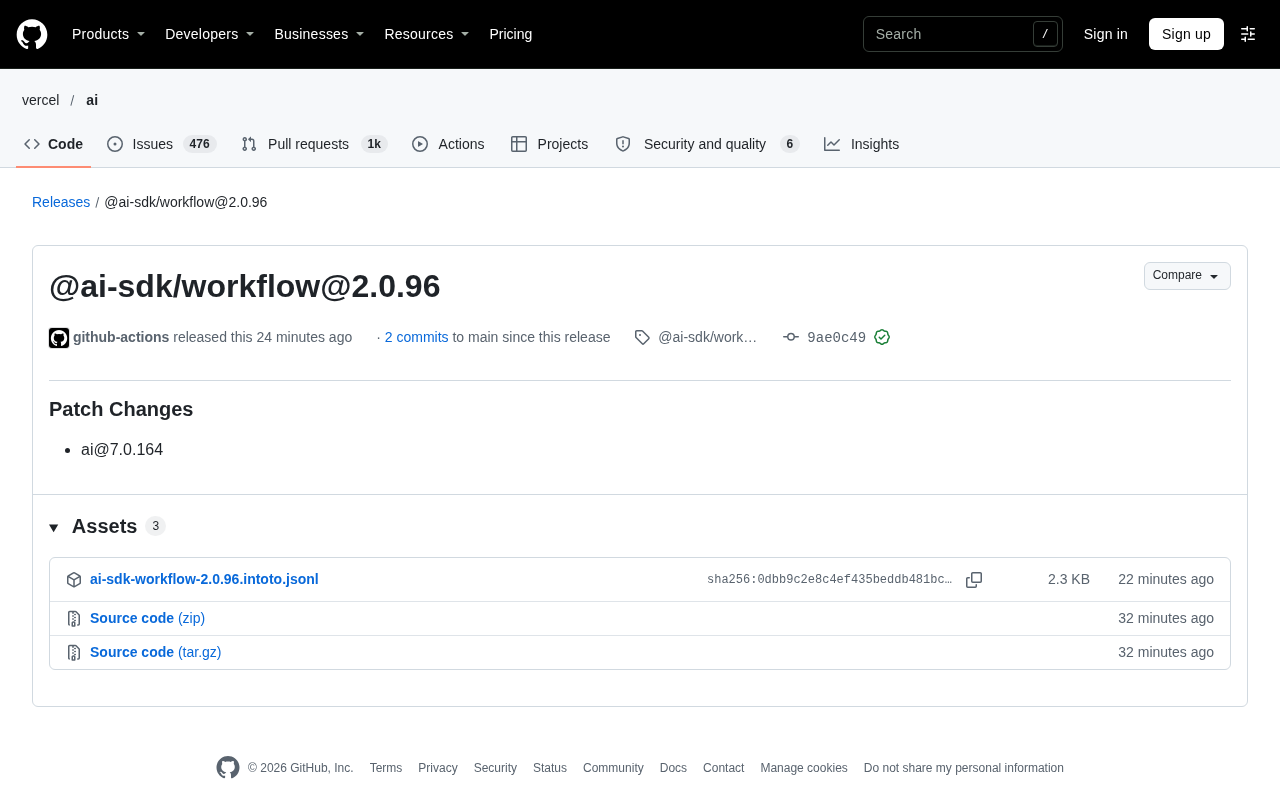
Vercel's AI SDK ecosystem has received another version update. @ai-sdk/workflow@2.0.96 was released as a patch version, which on the surface looks like a routine dependency upgrade, but against the backdrop of AI applications moving from "single-turn conversations" to "multi-step execution," such minor version updates often reflect the evolution pace of the entire workflow orchestration layer.
Release Information and Changes
According to the release record on GitHub, @ai-sdk/workflow@2.0.96 was published by github-actions on 06 Nov 19:46, corresponding to 2 commits synced to the main branch, with commit hash 9ae0c49. The commit carries a GitHub-verified signature (the last eight characters of the GPG key ID are B5690EEEBB952194), indicating this is a formal release driven by an automated pipeline.
The changelog is very concise: Patch Changes, i.e., a patch-level update, associated with the ai@7.0.164 package version. In other words, the core action of this @ai-sdk/workflow release is to synchronously upgrade its dependency on the ai package.
What a Patch Version Means
In the semantic versioning (SemVer) system, the patch number increasing from 2.0.x to 2.0.96 means this package has gone through a large number of small, rapid-fire fixes and adjustments. The number 96 itself indicates that the workflow package is in a state of high-frequency iteration, and the team prefers to control change risk through small-grained releases.
For developers building multi-step agents or tool-calling chains with AI SDK, patch versions typically do not involve breaking API changes, so the upgrade cost is low—but it also means the functional increment from a single update is limited. It is more about "consolidating the foundation" than "building new floors."
Semantic Versioning (SemVer) is a widely adopted version numbering convention with the format major.minor.patch. By convention: a major version increment indicates incompatible API changes (breaking updates); a minor version increment indicates new functionality added in a backward-compatible manner; a patch increment indicates backward-compatible bug fixes. Packages in the AI SDK ecosystem basically follow this rule, so the patch number of @ai-sdk/workflow increasing from 2.0.x to 2.0.96 can be understood as a series of small fixes, dependency syncs, and internal adjustments that do not affect the public API. It should be noted that SemVer is only a community convention, not a mandatory standard; some toolchains (such as changesets) automatically determine version numbers based on commit types, which is one reason the patch number of this package can quickly climb to 96.
The Position of the Workflow Package in AI SDK
The core value of AI SDK lies in abstracting large model calls into a unified interface, and the workflow package further extends this abstraction to multi-step orchestration scenarios. Developers can use it to define flows with sequential execution, dependencies, and tool calls, upgrading "a single Q&A" into "a reusable task pipeline."
Dependency Relationship with the Core ai Package
This release includes ai@7.0.164 as part of the patch changes, indicating that the stability of the workflow package is tightly coupled with the core ai package. Any subtle correction in the core package regarding session management, streaming output, or tool-calling protocols will be transmitted to the workflow layer through version synchronization. This pattern of "core package carries the patch, upper-layer package follows" is a common practice for Vercel in maintaining the AI SDK series. The benefit is clear version alignment; the cost is that the upper-layer package's own capability evolution is partially constrained by the core package's pace.
For developers, upgrading @ai-sdk/workflow to 2.0.96 actually delivers the underlying improvements brought by ai@7.0.164, rather than new orchestration capabilities added by the workflow package itself. Understanding this helps distinguish between "workflow logic issues" and "underlying call issues" when troubleshooting.
Dependency version locking and version drift are key background for understanding the impact of this release. In the Node ecosystem, version ranges in package.json (such as ^7.0.164) allow resolution to the latest version satisfying the range at install time, while lock files (package-lock.json, pnpm-lock.yaml, yarn.lock) record the exact installed versions. If a project does not commit lock files or does not enable strict modes such as --frozen-lockfile, CI and production environments may silently upgrade to different patch versions when reinstalling dependencies, causing drift issues where "it works locally but fails online." Packages with high-frequency patch releases like AI SDK are more likely to trigger such phenomena, so it is recommended to pin exact versions on both the workflow and ai packages, and to advance upgrades in batches and in a controlled manner through tools like Dependabot and Renovate.
Engineering Practices Behind Automated Releases
From the release record, this version was automatically completed by the github-actions bot and carries a verified signature. CI-driven, signature-verified, and dual commits synced to main—this process indicates that the repository has relatively strict governance over the release pipeline.
Trade-offs of Small-Step Releases
High-frequency patch releases are a double-edged sword for downstream projects. On one hand, fixes quickly reach users, and security and compatibility issues are not left backlogged for long; on the other hand, projects with insufficiently strict dependency locking may face frequent version drift. It is recommended to use lock files for workflow-related dependencies and upgrade in batches periodically, rather than following every version, to reduce integration noise.
GPG signature verification is an important means of ensuring the trustworthiness of release sources. Git allows committers to sign commits with a GPG private key, and hosting platforms (such as GitHub) verify the signature with the corresponding public key and display a Verified badge next to the commit. The last eight characters of the GPG key ID appearing in the release record, B5690EEEBB952194, are a fingerprint fragment of the signing key and can be used to audit the publisher's identity. In CI automated release scenarios, keys are usually injected into the pipeline as encrypted secrets, and the bot account completes signed commits and tagging. For downstream users, signature verification does not prove the code is absolutely secure, but it can confirm that the release came from a controlled pipeline and was not tampered with by a third party—it is a foundational element of supply chain security.
Practical Advice for Developers
If you are building multi-step AI applications with AI SDK, this update itself is not an urgent reason to upgrade, but it reminds you to pay attention to two things: first, confirm whether the ai core package version pinned in your project matches the workflow package; second, if you encounter anomalies in tool calls or streaming output within workflows, prioritize checking whether they are caused by a lagging core package version.
The value of a patch version is not in the release announcement, but in the version consistency it maintains. For teams relying on AI SDK to build production-grade workflows, incorporating such minor versions into a routine dependency inspection process is more meaningful than chasing every update.
FAQ
Does this update contain breaking changes? From the change type, it is Patch Changes, a patch-level update that typically does not include breaking API changes.
Must I upgrade immediately?
There is no mandatory requirement. If the current version runs stably, you can upgrade together during your next dependency cleanup; if you encounter call anomalies related to the ai core package, you can try upgrading to this version first.
Why is the version number already 2.0.96? A high patch number indicates the package has gone through a large number of small-step fix iterations and is in a high-frequency maintenance state; it does not mean high functional complexity.
Related articles
 Tech Frontiers
Google Omni 1.2 Flash: 15-Second AI Video at Just $0.07 per Second
Google DeepMind releases Gemini Omni 1.2 Flash: 15-second video, 720p at $0.07/sec (30% cheaper), multi-turn editing without regeneration, draft upscaling to 4K.
 Tech Frontiers
No AI Ghostwriting: Writer's Quarter Reinvents Novel Writing with a Visual Workbench
The Writer's Quarter is an AI-free novel writing and planning tool that unifies character building, story planning, and manuscript writing in one visual workbench. This article analyzes its positioning, target users, and differentiated value amid the rise of AI writing tools.
 Tech Frontiers
Fleeep: A Unified Inspiration Collection Notes App for Creatives
Fleeep is a notes app for creatives that unifies screenshots, bookmarks, saved posts, and inspiration into one calm, cross-device, offline-capable space. This article analyzes its positioning, differentiation, and target users.