AI SDK workflow-harness 1.0.162 Patch Release

@ai-sdk/workflow-harness releases patch version 1.0.162 with no breaking changes.
The @ai-sdk/workflow-harness package in the AI SDK ecosystem has released version 1.0.162, a routine patch-focused iteration. The release was automated via GitHub Actions with GPG signature verification, merging only 2 commits since the previous version and classified as Patch Changes. Per semantic versioning, it contains no breaking changes and focuses on bug fixes and internal adjustments. Since the package's version number stays in sync with @ai-sdk/harness, upgrades require attention to dependency alignment to avoid runtime issues from version mismatches. The article recommends reviewing the full commit diff before upgrading and verifying workflows on a test branch before merging to main.
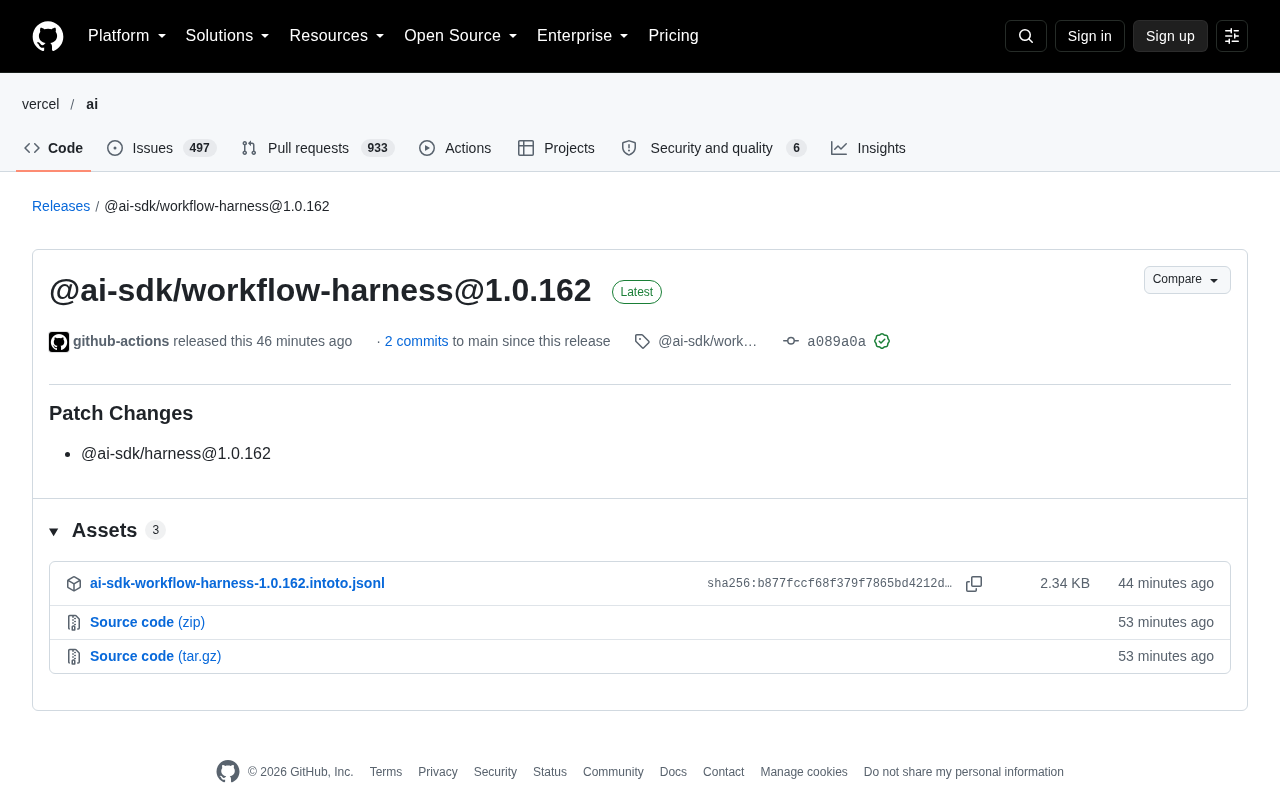
The @ai-sdk/workflow-harness package in the AI SDK ecosystem has released version 1.0.162. This is primarily a patch update, and the increment of the third digit in the version number confirms its iterative nature. For developers who depend on this package, this type of release typically means that several detail-level issues have been fixed without changing the external interface contract.
Release Overview and Version Positioning
According to the release record on GitHub, this version was automatically published by github-actions, and the commit message carries a GitHub verified signature (GPG key ID B5690EEEBB952194), indicating that the release process followed the repository's existing automation and signature verification mechanisms. A total of 2 commits have been merged since the previous version, representing a small update scope.
From the release notes, the change entry points directly to @ai-sdk/harness@1.0.162 and falls under the Patch Changes category. According to semantic versioning conventions, this means the update contains no breaking changes and focuses on bug fixes or internal implementation adjustments.
Semantic Versioning (SemVer) is the most widely adopted versioning convention in the npm ecosystem, with the format MAJOR.MINOR.PATCH. A MAJOR increment indicates incompatible breaking changes, a MINOR increment indicates new features added in a backward-compatible manner, and a PATCH increment contains only backward-compatible bug fixes or internal adjustments. Therefore, a third-digit change such as 1.0.161 → 1.0.162 signals to dependents that it is "safe to upgrade."
GitHub Actions and GPG-Signed Releases: github-actions is GitHub's official CI bot account, and repositories can be configured to automatically build and publish to npm when a tag is pushed. The Verified badge next to a commit comes from GPG signature verification; GitHub marks it as Unverified if verification fails or the signature is missing. The signing mechanism allows downstream users to trace that a release genuinely came from the repository's automated pipeline rather than a locally forged tag.
Practical Implications of the Patch Update
For projects using @ai-sdk/workflow-harness to build workflows, the value of a patch version is often reflected in stability. Since this package keeps its version number in sync with @ai-sdk/harness, upgrades require attention to dependency alignment between the two to avoid runtime issues caused by version mismatches.
The release page provides version comparison (Compare) and tag filtering features, but due to abnormal page resource loading, some areas did not display properly. This does not affect the availability of the version itself; developers can still pull this version via npm or package management tools.
Dependency alignment refers to maintaining compatible version combinations among packages whose release cadences are bound together and whose version numbers advance in sync. When @ai-sdk/workflow-harness and @ai-sdk/harness share the same version sequence, upgrading only one of them may lead to unsatisfied peer dependencies or inconsistent assumptions about internal APIs. npm's peerDependencies constraints and lock files (package-lock.json, pnpm-lock.yaml) are the first place to look when troubleshooting such issues. It is recommended to update both at the same time and regenerate the lock file when upgrading.
Upgrade Recommendations
If your project is currently pinned to an earlier 1.0.x version, the cost of upgrading to 1.0.162 is usually low. Before upgrading, it is recommended to review the full commit diff and confirm that the fixes are relevant to your use case. For production environments, a safer approach is to first verify workflow behavior on a test branch before merging into the main branch.
Summary
This release itself carries limited information and is a routine patch iteration. Its significance lies more in reminding users to keep dependencies updated and to promptly follow the release cadence of the @ai-sdk series of packages.
Related articles

LLaMA-Factory in Practice: A Complete No-Code Guide to Fine-Tuning Large Models
An introduction to LLaMA-Factory, the open-source fine-tuning tool: its 60.1K-star background, supported models and algorithms, local vs. cloud deployment, and CUDA setup steps.

Zeng Ming's Deep Retrospective: Why OpenAI May Not Be the Ultimate Winner — and Why the Corporate System Will Disappear
Zeng Ming's deep retrospective on the AI endgame: model companies are just infrastructure, OpenAI and Anthropic won't be the final winners; the next battle is the Agent entry point standard; the corporate system will disappear as AI restructures collaboration, and only mission-driven companies can survive the cycle.

OpenHands v1.28.0: OpenCode and PI Added as Built-in Agents, API Keys Requestable In-Conversation
OpenHands ships 5 releases in 21 days: v1.27.0 adds OpenCode and PI as built-in agents, v1.28.0 enables in-chat key requests. ACP integration, credential reuse, model list changes, and upgrade advice.