AI SDK xAI 3.0.144 Version Update Analysis

@ai-sdk/xai releases patch 3.0.144, upgrading only the OpenAI-compatible dependency—a low-risk maintenance update.
@ai-sdk/xai releases patch version 3.0.144, with the only change being an upgrade of the dependency @ai-sdk/openai-compatible to 2.0.86, introducing no new features or fixes. This compatibility package provides an OpenAI protocol abstraction reused by providers such as xAI, so the upgrade may bring subtle improvements to request handling, error mapping, or type definitions. For developers, this is a low-risk operation that does not affect existing API usage. However, they should synchronize the lockfile and check whether direct dependency versions are aligned. The article uses this to illustrate how the AI SDK's modular package structure allows each provider to be updated independently while sharing core abstractions, and notes that such maintenance updates reflect the project's activity. It recommends paying attention to dependency changelogs and GitHub updates.
Vercel's AI SDK project recently released version 3.0.144 of @ai-sdk/xai. This is a patch release that primarily updates the dependency @ai-sdk/openai-compatible to version 2.0.86. Although the update appears simple, it reflects the continuous evolution and modular design philosophy of the AI SDK ecosystem.
Core Changes in the Version Update
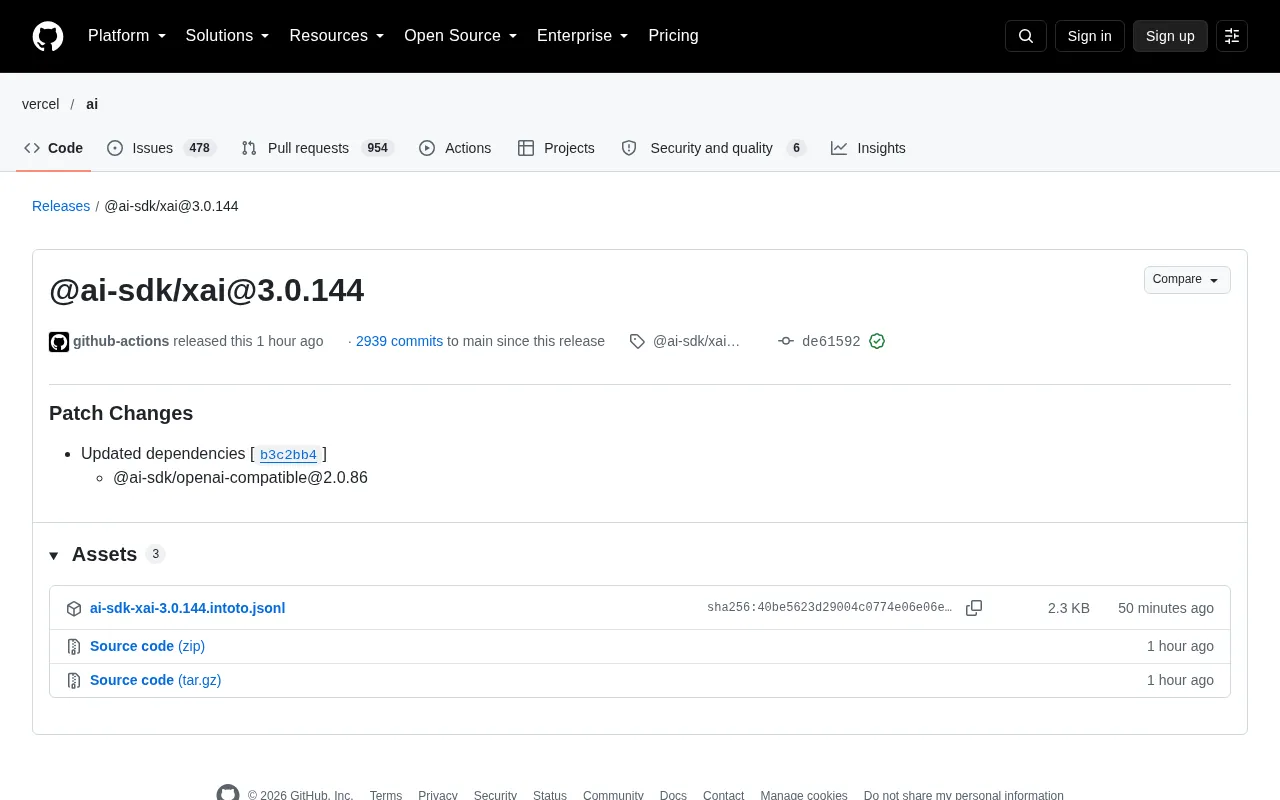
According to the release notes on GitHub, @ai-sdk/xai@3.0.144 is a Patch Changes release, and its only listed change is updating the dependency: @ai-sdk/openai-compatible@2.0.86. This means the version itself does not introduce new features or fixes, but rather maintains compatibility with other components through a dependency upgrade.
Such dependency updates are common in modular SDKs, usually to synchronize the latest improvements in the underlying compatibility layer, ensuring that the xAI provider can take advantage of optimizations in the OpenAI-compatible interface.
Semantic Versioning (SemVer) is the foundation for understanding this type of patch update. SemVer divides a version number into three parts: major.minor.patch. A major version change represents incompatible API modifications, a minor version indicates backward-compatible feature additions, and a patch number is used only for backward-compatible bug fixes. The upgrade of @ai-sdk/xai from 3.0.x to 3.0.144 is at the patch level and, by convention, should not include breaking changes or new features. In the npm ecosystem, range declarations like ^3.0.144 allow automatic retrieval of the latest patch within the same major version, which is why such maintenance releases can be distributed quickly.
Lockfile refers to package-lock.json, pnpm-lock.yaml, or yarn.lock, which precisely records the actual version and integrity hash of every package in the dependency tree. If the lockfile is not committed after running npm update or pnpm up, the CI environment may install different versions of transitive dependencies, leading to the classic "works locally, fails in production" problem. Therefore, the article's recommendation to "ensure the lockfile is synchronized" is essentially a key step in guaranteeing build reproducibility.
Significance of the Dependency Update
@ai-sdk/openai-compatible is a key package in the AI SDK. It provides an interface abstraction compatible with the OpenAI API, allowing different providers (such as xAI) to reuse the same protocol. Updating it to version 2.0.86 may include subtle adjustments to request handling, error mapping, or type definitions, thereby improving the stability and consistency of the xAI integration.
Although the release notes do not describe the specific changes in detail, developers should pay attention to the dependency's changelog to understand whether any behavioral changes are involved. Typically, patch-level dependency updates do not introduce breaking changes, but it is still recommended to verify them in a test environment.
The OpenAI-compatible interface is a de facto standard: many model providers (xAI, DeepSeekAd, Together, Groq, etc.) choose to expose a REST contract similar to OpenAI's /v1/chat/completions, so that existing client SDKs can connect without modification. @ai-sdk/openai-compatible abstracts this contract into a reusable provider base class. The xAI package only needs to override the baseURL, authentication headers, and a few provider-specific fields on top of it to reuse request construction, streaming parsing, and error mapping logic.
This layering introduces a trade-off: a single fix in the compatibility layer benefits all downstream providers at once, but subtle behavioral changes in the compatibility layer also propagate horizontally. Therefore, when @ai-sdk/openai-compatible is upgraded from 2.0.85 to 2.0.86, it is worth checking its changelog to confirm whether the change involves type definitions, retry strategy, or boundary handling of SSE streaming chunks—the latter may affect the parsing stability of long responses.
Impact on Developers
For developers using @ai-sdk/xai, upgrading to version 3.0.144 is a low-risk operation. As a patch version, it does not affect the usage of the existing API. Developers can update directly through a package manager (such as npm or pnpm) and ensure the lockfile is synchronized.
If the project has a direct dependency on @ai-sdk/openai-compatible, it is also necessary to check whether its version is compatible with 2.0.86. Typically, the various packages in the AI SDK maintain version alignment to avoid conflicts.
Ecosystem Context and Outlook
AI SDK is an open-source tool library launched by Vercel, designed to simplify the integration of AI features. It supports multiple providers, including OpenAI, Anthropic, Google, and xAI. Through a modular package structure, each provider can be updated independently while sharing core abstractions. This design enables emerging providers like xAI to quickly integrate into the ecosystem.
Although this update is minor, it demonstrates the active maintenance of the project. As xAI models continue to iterate, more feature-enhanced versions are expected in the future. Developers can follow the AI SDK's GitHub repository to stay up to date.
Conclusion
@ai-sdk/xai@3.0.144 is a maintenance release that primarily updates the underlying compatibility dependency. It ensures that the xAI provider works in concert with other SDK components and is suitable for smooth upgrades by developers. For teams building AI applications, keeping dependencies updated is an important practice for maintaining project health.
One-line Summary
@ai-sdk/xai releases patch version 3.0.144, upgrading only the OpenAI-compatible dependency—a low-risk maintenance update.
Paragraph Summary
@ai-sdk/xai releases patch version 3.0.144, with the only change being an upgrade of the dependency @ai-sdk/openai-compatible to 2.0.86, introducing no new features or fixes. This compatibility package allows providers such as xAI to reuse the OpenAI protocol abstraction, so the upgrade may bring subtle improvements to request handling, error mapping, or type definitions. For developers, this is a low-risk operation that does not affect existing API usage, but they should synchronize the lockfile and check whether direct dependency versions are aligned. The article uses this to explain how the AI SDK's modular package structure allows each provider to be updated independently while sharing core abstractions, and notes that such maintenance updates reflect the project's activity. It recommends paying attention to dependency changelogs and GitHub updates.
Related articles

T3 Code: The Open-Source AI Coding Assistant's Comeback Story
T3 Code is an open-source AI coding assistant that unifies subscriptions like Codex and Claude, with powerful remote control and parallel task management.

Never Elected, Yet Ruled New York for 30 Years: The Ultimate Case Study in the Mechanics of Power
Robert Caro's biographies reveal how unelected Robert Moses ruled New York for 30 years through legal drafting and public authorities, and how Lyndon Johnson built leverage as a "powerless" Senate Majority Leader. Unpacking the underlying logic of accumulating and sustaining power.

The CPython 3.10 Recursion Trap and Synthetic Recovery in TokenGuard, an LLM Circuit Breaker
TokenGuard's author recounts a recursion crash caused by OrderedDict.pop in CPython 3.10 and introduces v0.3.0's Loop Nudge synthetic recovery, inline DLP scanning, and other new LLM agent circuit-breaker capabilities.