@ai-sdk/xai 5.0.23 Patch Release: Dependency Chain Update Breakdown
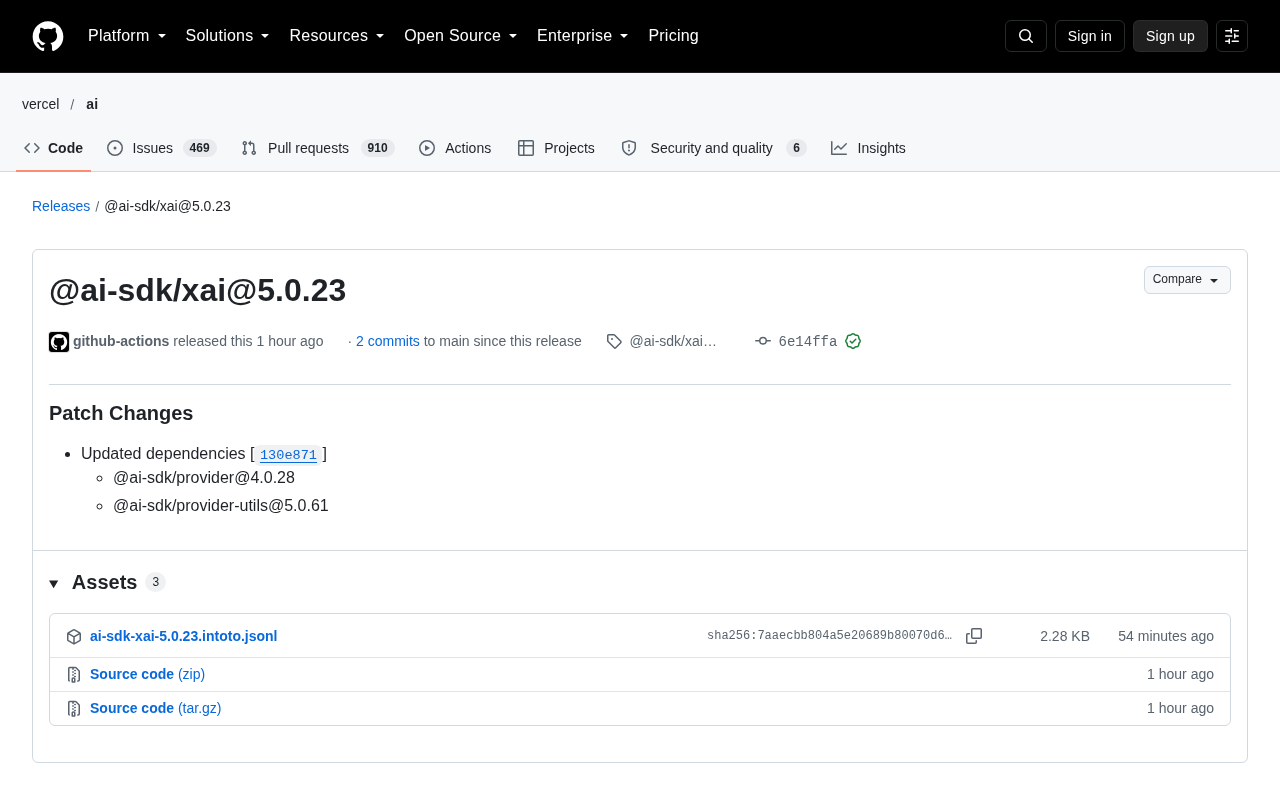
@ai-sdk/xai@5.0.23 is a patch release synchronizing only upstream provider dependencies, no feature changes, low upgrade risk but watch for dependency consistency.
@ai-sdk/xai@5.0.23 is a typical patch-level release, automatically completed by GitHub Actions, containing 2 commits with GPG verified signatures. This update has no new APIs or breaking changes; the only substantive content is synchronizing upstream dependencies: updating @ai-sdk/provider to 4.0.28 and @ai-sdk/provider-utils to 5.0.61. These two packages are the common foundation for AI SDK provider adaptation layers, handling interface definitions, streaming parsing, error wrapping, etc., so synchronizing them helps the xAI package maintain consistency with SDK mainline behavior. For most users, upgrade risk is very low, but for projects mixing multiple provider packages or with lockfiles locking older dependency versions, the dependency tree should be checked after upgrading to avoid type conflicts or runtime differences from multiple versions coexisting.
Version iterations in the AI SDK ecosystem rarely attract as much attention as large model releases, but for developers using the xAI interface, every patch update can affect build stability. @ai-sdk/xai@5.0.23 is a typical patch-level release, with the core action being synchronization of upstream provider dependencies.
What This Update Actually Changed
According to the GitHub release record, @ai-sdk/xai@5.0.23 contains 2 commits, automatically published by github-actions, with commits carrying GPG verified signatures (key ID: B5690EEEBB952194). The change type is explicitly marked as Patch Changes, which means no new APIs, no breaking changes—it's a maintenance update.
The actual content is just one item: updating dependencies @ai-sdk/provider to 4.0.28 and @ai-sdk/provider-utils to 5.0.61. The corresponding commit reference is 130e871.
Patch Changes is the change type corresponding to the third-level version number (the z in x.y.z) in Semantic Versioning (SemVer). SemVer conventions: major version changes represent incompatible API breaking changes, minor versions represent backward-compatible feature additions, and patch versions represent backward-compatible bug fixes. The AI SDK ecosystem widely adopts the changesets tool to manage this process—developers describe the impact level of each change by submitting declarative changeset files, and CI automatically calculates the next version number for each package and generates changelogs after merging. Therefore, when you see a release marked only as "Patch Changes," you can confirm it won't introduce new public APIs or change existing function signatures or behavioral contracts, making the likelihood of breaking existing code during upgrades extremely low.
Why Provider Dependency Updates Are Worth Attention
@ai-sdk/provider and @ai-sdk/provider-utils are the common foundation layer for all AI SDK provider packages (such as xAI, OpenAI, Anthropic). provider-utils typically handles streaming parsing, error wrapping, request retries, and other common logic.
When the xAI package follows up on these two dependencies, the actual operation is aligning xAI's interface adaptation layer with the SDK mainline behavior. If you mix multiple AI SDK providers in your project, inconsistent dependency versions may cause type conflicts or runtime behavioral differences. This synchronization helps reduce such issues.
Practical Impact on Users
For the vast majority of users, upgrading to 5.0.23 is a low-risk operation. Patch versions don't change public interfaces; pnpm update @ai-sdk/xai or adjusting the version number in package.json is sufficient.
What needs attention is indirect dependencies: if your lockfile locks an older version of @ai-sdk/provider, after upgrading the xAI package, multiple versions of the same dependency may coexist. It's recommended to check the dependency tree after upgrading to confirm no duplicate installations.
@ai-sdk/provider and @ai-sdk/provider-utils don't have exactly the same division of labor. The former mainly defines the abstract interfaces and specification types that all provider packages must implement, such as LanguageModelV1, EmbeddingModelV1 model interfaces, and unified request/response data structures; the latter provides utility functions repeatedly used when implementing these interfaces, such as SSE parsing for streaming responses, parameter fragment assembly for tool calls, standardized error type wrapping, retry and timeout handling, etc. Any provider package (xAI, OpenAI, Anthropic, etc.) is built on these two layers, so their version changes directly determine whether the provider adaptation layer can maintain consistency with the SDK mainline behavior. When internal implementations of these two foundation packages change (even at patch level), provider packages can only obtain upstream parsing fixes or behavioral alignment after following up.
AI SDK Maintenance Model from a Release Cadence Perspective
This release was automatically completed by github-actions on October 15th, representing a typical monorepo automated release process. AI SDK uses changesets to manage versions, with each package's patch updates published independently, and dependency changes linked through commit references.
The advantage of this model is that each provider package can quickly follow up on underlying fixes, at the cost of faster version number growth, with users seeing frequent patch changes in lockfiles. For production projects, it's recommended to focus on changelogs for minor and above versions, while patch versions can be followed up in batches.
Monorepo refers to an engineering organization approach that places multiple interrelated packages in the same code repository for unified management. AI SDK adopts this structure, placing @ai-sdk/provider, @ai-sdk/provider-utils, and various specific provider packages in the same repository. The direct impact is: a single fix to the underlying common package can be quickly consumed by all upstream provider packages that depend on it within the same CI process. Combined with changesets, each package independently increments its version number based on its own change level, rather than unified repository-wide releases. GPG signatures (such as the key ID mentioned: B5690EEEBB952194) are integrity guarantees at the Git level, used to verify that commits were indeed signed by the publisher holding the corresponding private key (in this case, the GitHub Actions bot), preventing commits from being forged or tampered with.
Should You Upgrade Immediately
The judgment criterion is simple: if your current version of @ai-sdk/xai has compatibility issues with @ai-sdk/provider@4.0.28, or if you're using other already-upgraded provider packages in the same project, then this update is worth following up on.
Conversely, if the existing version runs stably and you're not mixing multiple providers, there's no compelling reason to upgrade. When patch versions don't fix specific bugs, the main benefit of upgrading is dependency consistency.
Key Points Recap
@ai-sdk/xai@5.0.23is a patch release, only synchronizing dependencies, no feature changes- Updated
@ai-sdk/provider@4.0.28and@ai-sdk/provider-utils@5.0.61 - Automatically published by GitHub Actions with GPG verified signatures
- Low upgrade risk, but need to pay attention to indirect dependency version consistency
Related articles

Qwen 4 First Test Leaks: Performance Rivals Opus 5.5, DeepSeek V4 Series Surfaces
Early Qwen 4 test outputs leak, with front-end generation said to rival Opus 5.5; DeepSeek V4 Mini, Flash, and Pro names appear in a code repo; Ant Group's Ling-3.1-flash surfaces too. Here's the latest on model tiering and on-device lightweight models.

OpenCode Makes DeepSeek V4.1 Flash Free, AI Daily Roundup
AI daily roundup: OpenCode makes DeepSeek V4.1 Flash free, StepFun Step5 Preview and Ling 3.1 Flash open-sourced, Grok Voice 3.0 tops speech leaderboard, Matrix Game 4.0 open-sourced, and the EU opens its first AI Act enforcement probe into OpenAI and Anthropic.

DeepSeek V4.1 Flash 1017 Released: Reasoning and Coding Upgrades, Search and Fetch API Now Available
DeepSeek releases V4.1 Flash 1017 with major gains in reasoning, coding, and agentic tasks, plus web search and fetch APIs at 5 yuan per 1,000 requests. Tencent Hunyuan open-sources High Memory 2.0, Perplexity open-sources multimodal decision models, and MOFCOM seeks comments on AI export catalog.