@ai-sdk/zai@1.0.5 Released: A Patch Update for Vercel AI SDK

Vercel AI SDK's Zhipu GLM provider releases v1.0.5 patch, syncing internal dependencies only.
`@ai-sdk/zai@1.0.5` is a patch-level update to the Vercel AI SDK provider package for integrating Zhipu's GLM model series. The release introduces no new features or breaking changes — it simply syncs `@ai-sdk/provider-utils` to 3.0.39 and `@ai-sdk/openai-compatible` to 1.0.56 to maintain version compatibility across SDK modules. This cascading upgrade pattern is common in Vercel AI SDK's monorepo architecture. Upgrading is safe for existing users with no business logic changes required.
The @ai-sdk/zai package in the Vercel AI SDK ecosystem has released version 1.0.5. This is a patch-level update focused on syncing internal dependencies. While small in scope, these kinds of updates are an essential part of keeping projects stable for developers using this provider.
What's in This Update
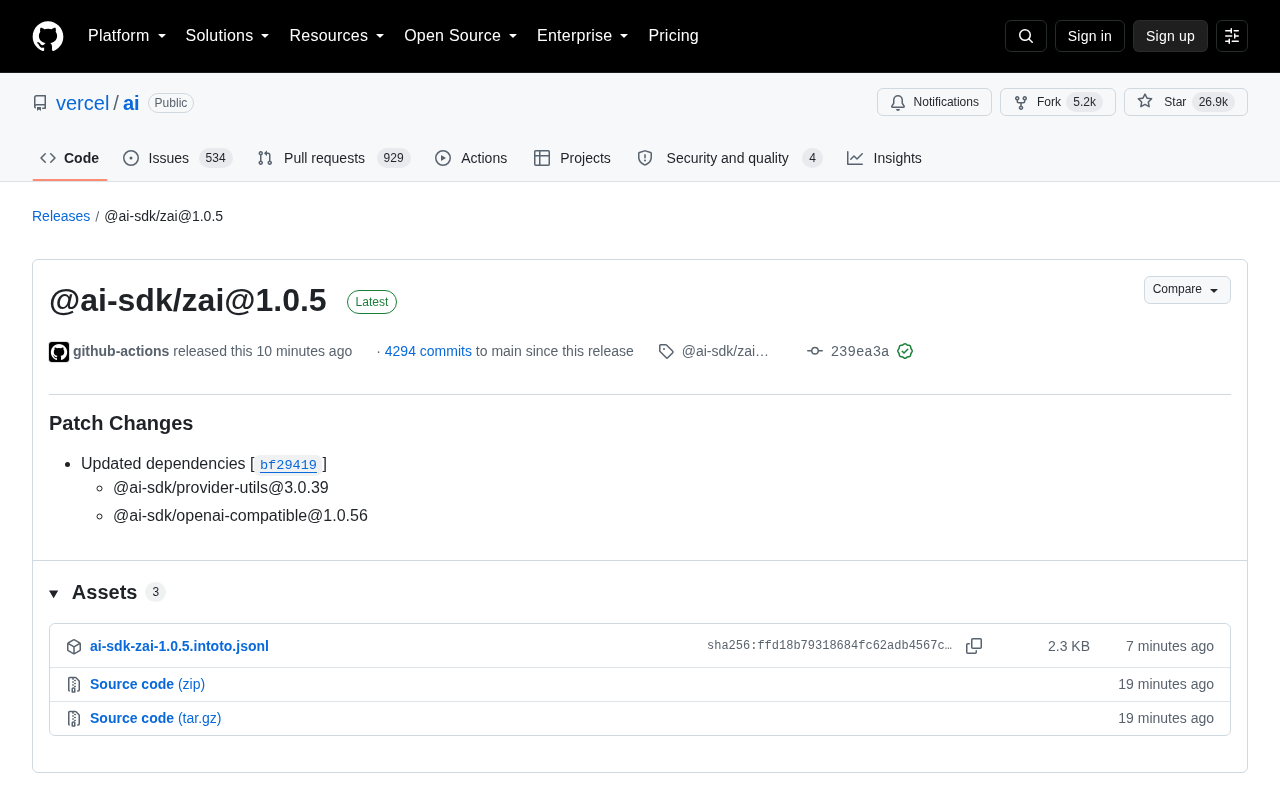
According to the GitHub Release page, @ai-sdk/zai@1.0.5 falls under Patch Changes, with the core changes being upstream dependency version syncs:
@ai-sdk/provider-utils@3.0.39@ai-sdk/openai-compatible@1.0.56
This means the release introduces no breaking changes and adds no user-facing features. It's essentially a "cascading upgrade" that follows the dependency chain — when the underlying provider-utils was updated via commit bf29419, the packages that depend on it were also bundled and released to maintain compatibility across all SDK modules.
What Is @ai-sdk/zai
@ai-sdk/zai is a provider package within the Vercel AI SDK family, used to integrate with Zhipu AI's (Z.ai / GLM series) large language model services. The Vercel AI SDK follows a modular design, splitting the integration logic for different model providers into standalone packages — OpenAI, Anthropic, Google, and others each have their own modules, allowing developers to install only what they need.
Notably, this update includes @ai-sdk/openai-compatible as a dependency. This indicates that the zai provider reuses the OpenAI compatibility layer — a common engineering practice in today's AI toolchain, as many domestic and third-party model services offer interfaces compatible with the OpenAI API format, and the SDK uses a unified compatibility layer to reduce integration overhead.
Zhipu AI is a Chinese large language model company spun out of Tsinghua University. Its GLM (General Language Model) series — including GLM-4 and ChatGLM — supports text generation, function calling, multimodal capabilities, and more. Z.ai is Zhipu's externally accessible API service platform, and its API design is highly compatible with the OpenAI format. That's why
@ai-sdk/zaican directly reuse@ai-sdk/openai-compatiblewithout building a full request/response adapter from scratch.@ai-sdk/openai-compatibleis itself a general-purpose adapter base package provided by Vercel AI SDK — any third-party service following the OpenAI API spec (such as Together AI, Fireworks, or Zhipu) can build its own provider on top of it quickly, significantly lowering the cost of ecosystem expansion.
What This Means for Developers
For teams that have already integrated @ai-sdk/zai into their projects, upgrading to 1.0.5 is generally safe and recommended. As a patch release following Semantic Versioning (SemVer), it should not affect existing API call patterns.
npm install @ai-sdk/zai@1.0.5
After upgrading, there are two things worth checking: first, confirm that @ai-sdk/provider-utils and @ai-sdk/openai-compatible in your dependency tree are also synced to their corresponding versions to avoid version mismatches; second, run your existing test suite to verify that model call workflows are functioning as expected.
Looking at the overall activity of the Vercel AI repository (the project has earned over 26.9k stars, 5.2k forks, and accumulated more than 4,200 commits to the main branch), the SDK's iteration pace is quite frequent. This pattern of high-frequency, small-step updates is a hallmark of mature open-source infrastructure: continuously syncing dependencies and fixing minor issues to ensure long-term reliability.
Semantic Versioning (SemVer) defines version numbers in a three-part
MAJOR.MINOR.PATCHstructure: the Patch segment is used only for backward-compatible bug fixes or internal dependency syncs; Minor is for new backward-compatible features; Major signals breaking changes that may require updates to calling code.@ai-sdk/zai@1.0.5is a Patch-level release — per SemVer conventions, upgrading will not affect existing API call signatures or behavior, making it the lowest-risk type of update in day-to-day maintenance. In a monorepo setup, individual packages frequently publishing Patch versions to sync the dependency tree is standard practice for maintaining overall compatibility.
Summary
@ai-sdk/zai@1.0.5 is a patch release focused primarily on dependency synchronization, with no significant functional changes. It reflects the tight coupling between individual providers and the underlying utility libraries within Vercel AI SDK's modular architecture. For users, keeping up with these updates helps maintain project health — and no changes to business logic are required.
Related articles

Qwen 4 First Test Leaks: Performance Rivals Opus 5.5, DeepSeek V4 Series Surfaces
Early Qwen 4 test outputs leak, with front-end generation said to rival Opus 5.5; DeepSeek V4 Mini, Flash, and Pro names appear in a code repo; Ant Group's Ling-3.1-flash surfaces too. Here's the latest on model tiering and on-device lightweight models.

OpenCode Makes DeepSeek V4.1 Flash Free, AI Daily Roundup
AI daily roundup: OpenCode makes DeepSeek V4.1 Flash free, StepFun Step5 Preview and Ling 3.1 Flash open-sourced, Grok Voice 3.0 tops speech leaderboard, Matrix Game 4.0 open-sourced, and the EU opens its first AI Act enforcement probe into OpenAI and Anthropic.

DeepSeek V4.1 Flash 1017 Released: Reasoning and Coding Upgrades, Search and Fetch API Now Available
DeepSeek releases V4.1 Flash 1017 with major gains in reasoning, coding, and agentic tasks, plus web search and fetch APIs at 5 yuan per 1,000 requests. Tencent Hunyuan open-sources High Memory 2.0, Perplexity open-sources multimodal decision models, and MOFCOM seeks comments on AI export catalog.