@ai-sdk/zai 3.0.35 Update Analysis: The Evolution of the Compatibility Layer for Z.ai in Vercel AI SDK
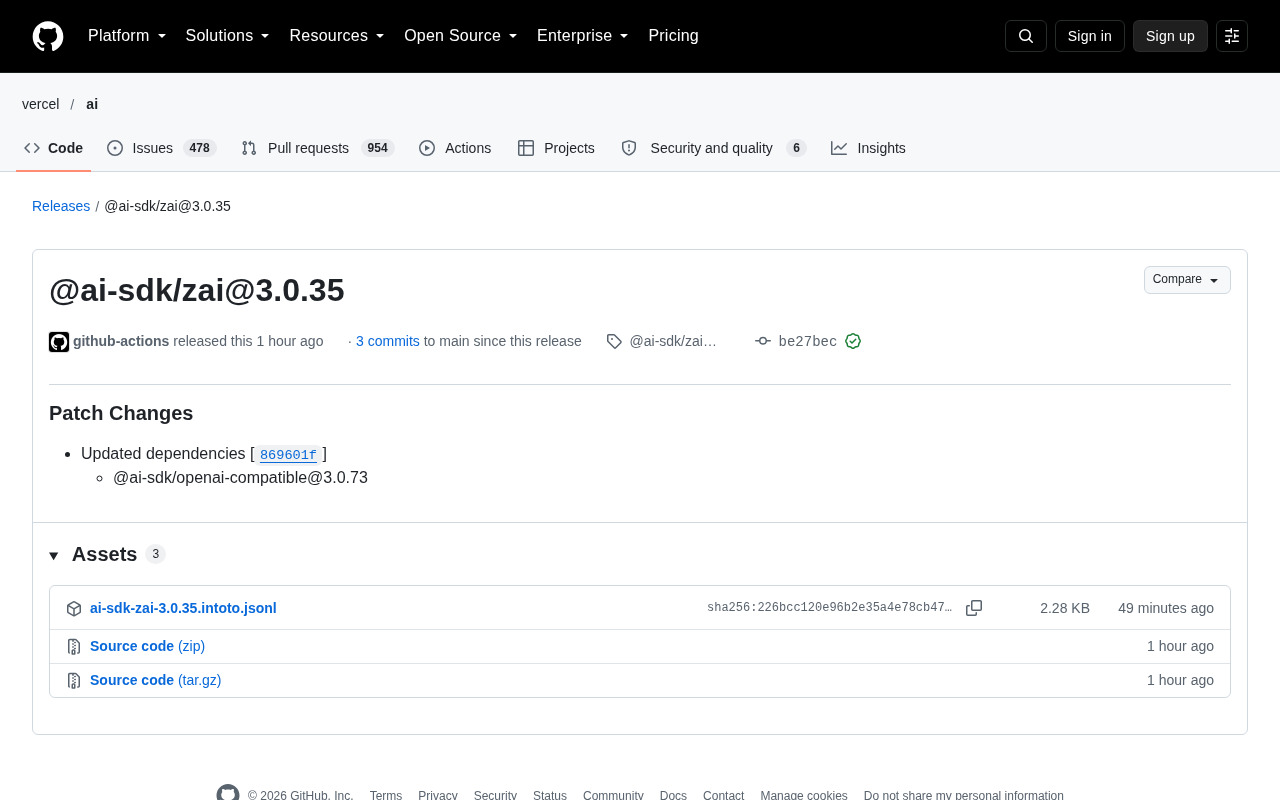
@ai-sdk/zai releases 3.0.35, only syncing the dependency @ai-sdk/openai-compatible to 3.0.73, with no new features.
@ai-sdk/zai has released version 3.0.35. This is a patch-level update whose only change is upgrading the underlying dependency @ai-sdk/openai-compatible to 3.0.73, with no new features or breaking changes. The article clarifies the relationship among Vercel AI SDK, the @ai-sdk/zai provider package, and the openai-compatible adapter, and points out that this update is essentially a small step forward for the compatibility-layer foundation, with the Z.ai provider following along the dependency chain. For developers, the upgrade risk is low, but it is still advisable to cover edge-path test cases such as streaming output and tool calls in CI. The high-frequency, small-step releases reflect the modular strategy of the AI SDK ecosystem and show that Z.ai is actively maintained in that ecosystem.
A seemingly simple patch update that reflects ongoing refinement of the compatibility-layer ecosystem
@ai-sdk/zai has released version 3.0.35. Judging from the version number and the changes, this is a standard patch-level update: it was released only in tandem with the upgrade of its dependency @ai-sdk/openai-compatible (to 3.0.73), with no new features and no breaking changes.
For readers unfamiliar with this toolchain, the relationship among the three components should be clarified first: Vercel AI SDK is the abstraction layer that provides a unified way to call various large models from the frontend and Node.js side; @ai-sdk/zai is the provider package that connects Z.ai (the Zhipu-family model service) to this abstraction layer; and @ai-sdk/openai-compatible is the general-purpose adapter for "OpenAI API compatibility"—any service that provides an OpenAI-style /chat/completions endpoint can reuse it for integration.
The essence of this update is that the compatibility-layer foundation has moved forward a small step, and the Z.ai provider has followed suit along the dependency chain.
The dependency-chain logic behind the version number
Why a patch update is worth noting
On its own, the number 3.0.35 conveys limited information. But the release record explicitly states the dependency change: Updated dependencies [869601f] → @ai-sdk/openai-compatible@3.0.73. This means that all the "content" of this release comes from fixes or adjustments in the upstream compatibility package.
This release pattern is common in the provider ecosystem: each model vendor has its own package, and they share a compatibility adapter. When the upstream changes, downstream providers must release a version as well; otherwise, users may encounter version mismatches during installation. For users, understanding this dependency chain is more important than remembering specific version numbers—it explains why a provider package frequently gets new versions with "no substantive changes."
Under semantic versioning (SemVer), an increment to the patch version usually indicates a backward-compatible bug fix, without new features or breaking changes. However, in the npm ecosystem, a patch release of a package may be triggered solely by a dependency change rather than by modifications to its own code. In this case, the version number is more a marker of dependency-chain synchronization than a signal of feature evolution. Understanding this helps developers distinguish "substantive updates" from "synchronized releases" and avoid overinterpreting patch versions.
The role of openai-compatible
@ai-sdk/openai-compatible is the most easily underestimated part of the whole system. It abstracts OpenAI's request/response format into a reusable adapter, so that providers like Z.ai that offer compatible endpoints do not have to implement an SDK from scratch. The cost is that any behavioral change in the compatibility layer—such as field mapping, streaming response handling, or error-code conversion—propagates to all downstream providers through dependency updates.
Therefore, it is accurate to understand 3.0.35 as "a dependency synchronization," but it also reminds developers that when locking versions, they should pay attention to the version combination of both the provider package and the compatibility package, rather than focusing only on the top-level package number.
OpenAI-compatible endpoints generally refer to services that implement endpoints such as /v1/chat/completions and /v1/models and follow OpenAI's request/response JSON structure (such as the messages array, the choices field, and streaming data: {...} events). As an adapter, @ai-sdk/openai-compatible has core responsibilities including: converting AI SDK's unified call parameters into OpenAI format, parsing responses and mapping them back to AI SDK's standardized results, and handling chunking and errors in streaming responses. Because different vendors may have subtle differences in field defaults, error codes, and streaming termination conditions, the compatibility package needs continuous fine-tuning to cover these edge cases—one reason why it frequently releases patches.
Practical impact on developers
Upgrade recommendations
This is a low-risk update. If your project already uses @ai-sdk/zai, simply upgrade it through your regular dependency update process; if you have not integrated it yet, this release record alone should not be a basis for selection—refer instead to the official Z.ai documentation and the AI SDK's provider configuration instructions.
One reminder: although the patch version is small, it is still advisable to run test cases involving streaming output and tool calls in CI—small changes in the compatibility layer sometimes show up on edge paths rather than in the main flow.
Ecosystem observations
From a broader perspective, this kind of high-frequency, small-step provider release reflects the modular strategy of the AI SDK ecosystem: vendor differences are confined to a thin provider layer, while commonalities are pushed down into the compatibility adapter. The benefit is that the cost of integrating new model services continues to decline; the cost is that the version matrix becomes more complex, and dependency management requires more care.
For content creators and toolchain maintainers, this kind of release record has low information density, but it is an observable signal: Z.ai is actively maintained in the Vercel AI SDK ecosystem, and the compatibility layer continues to iterate.
FAQ
Does 3.0.35 have any new features? No. This is a patch release for dependency synchronization, and the change is updating @ai-sdk/openai-compatible to 3.0.73.
Do I need to upgrade immediately? Not mandatory. It is recommended to follow up within your regular dependency update window and pay attention to the changelog of the upstream compatibility package.
What is the relationship between @ai-sdk/zai and openai-compatible? The former is the provider package for Z.ai, and the latter is the OpenAI API compatibility adapter it depends on at the底层. The former integrates with the AI SDK through the latter.
Related articles

Build an AI Super Employee System at Zero Cost: A Full Breakdown of Automated Agent Workflows
A deep breakdown of the AI super employee system demoed on Bilibili: agent orchestration, digital human voiceovers, map and enterprise lead generation, 24/7 customer service, and legal modules. We analyze the business logic and compliance risks behind zero-cost signup to help entrepreneurs judge the real ROI of this AI digital employee system.

The Essential Difference Between Chatbots and AI Agents: Crossing from Conversation to Execution
What's the difference between a chatbot and an AI agent? Based on the MCP series on the Learn Tech channel, this article uses examples like booking flights and summarizing notes to explain: a chatbot only gives answers, while an agent actually completes tasks through a think-act-observe loop. It breaks down the four core components—model, tools, memory, and goal—as well as MCP's role as a bridge, and discusses agents' applicable boundaries and permission risks.

Free GitHub Repo: 342 Hours of AI Courses, from Math to MCP Servers
A free GitHub repo offers 342 hours of AI courses: 523 lessons across 20 phases, from math fundamentals to agent building and MCP servers. Nearly 100,000 learners have started.