@ai-sdk/zai 3.0.39 Patch Release: What a Dependency Chain Upgrade Means
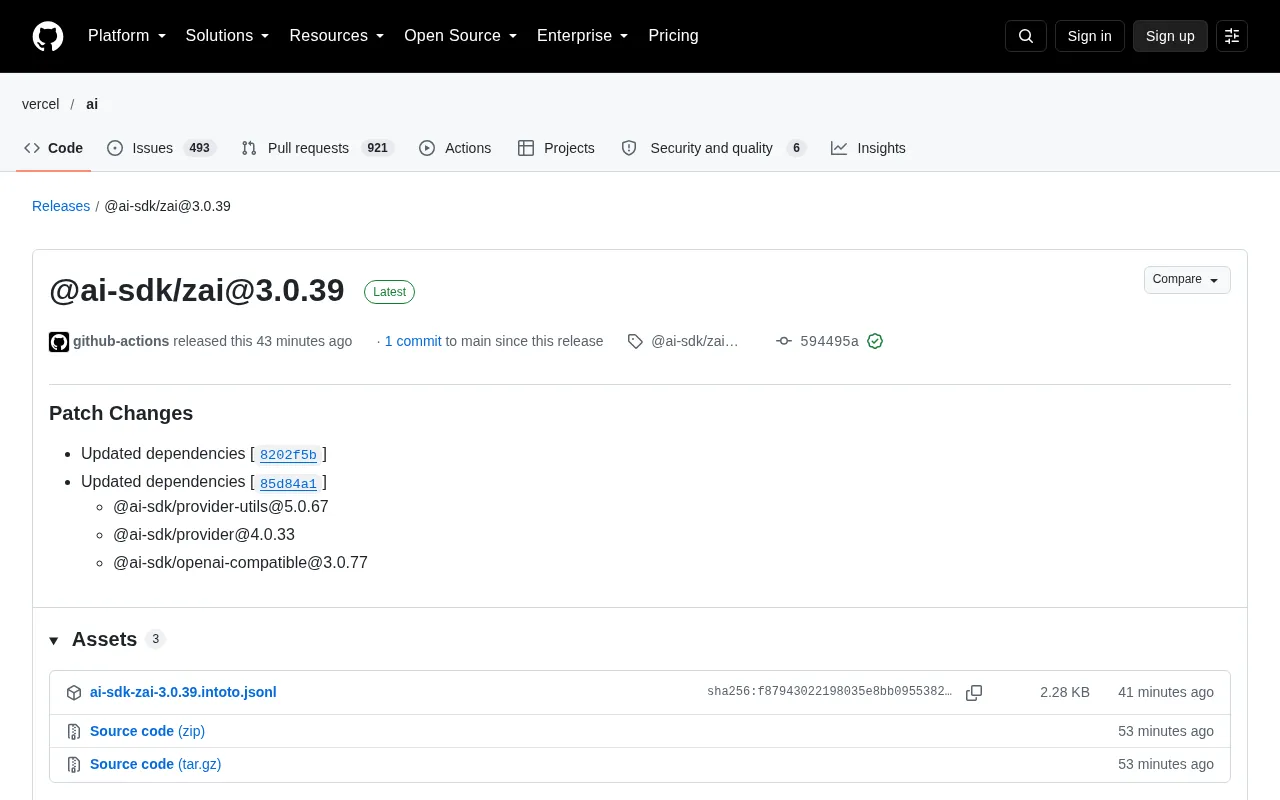
@ai-sdk/zai 3.0.39 is a pure dependency-sync release that reflects the AI SDK's layered architecture and chained release logic.
The article analyzes the seemingly unremarkable patch release @ai-sdk/zai 3.0.39. Published automatically by github-actions, it has no new features or API changes and only syncs upgrades to three upstream dependencies: provider-utils 5.0.67, provider 4.0.33, and openai-compatible 3.0.77. It clarifies the division of labor among the three packages: provider is the stability-oriented provider abstraction interface layer, provider-utils is the fast-moving shared utility set that adapts to API differences, and openai-compatible distills OpenAI-spec compatibility logic for reuse—embodying a layering strategy of "stability for interfaces, speed for utilities, reuse for compatibility." Upgrade risk is low, but developers should watch for potential effects of provider-utils minor version changes on streaming parsing and retry strategies, and should run regression checks on streaming scenarios and dependency version constraints after upgrading. The article concludes that the AI SDK follows a fast, incremental chained release cadence, and tracking upstream foundational package changelogs is more valuable than following each provider patch.
The AI SDK ecosystem has another seemingly unremarkable version iteration. @ai-sdk/zai@3.0.39 was released on GitHub as a patch version, and the commit record shows this update does just one thing: sync the versions of three upstream dependency packages. For developers who build applications with the Vercel AI SDK day to day, release notes like this often fly by—but what they reflect is the operating logic of the entire AI SDK modular architecture.
A patch release that is a "pure dependency update"
According to the GitHub release page, @ai-sdk/zai@3.0.39 was automatically published by github-actions, with commit hash 594495a and a GitHub-verified signature (GPG key ID: B5690EEEBB952194). The Patch Changes section is very brief and lists only two items: updating dependencies 8202f5b and 85d84a1.
The dependency versions involved are: @ai-sdk/provider-utils@5.0.67, @ai-sdk/provider@4.0.33, and @ai-sdk/openai-compatible@3.0.77. No new features, no API changes, and no breaking changes—this is a typical maintenance release.
From the release process perspective, the automation tool committed directly to the main branch and tagged the release, which indicates the project uses a standardized CI/CD pipeline, with version numbers and dependency locking ensured by the toolchain. This pattern has become the norm in fast-iterating open-source projects such as the AI SDK.
Semantic Versioning (SemVer) and patch releases: Semantic Versioning specifies major.minor.patch, where an incremented patch number indicates backward-compatible bug fixes or purely internal maintenance that introduces no new features and does not break existing APIs. In the version number of @ai-sdk/zai@3.0.39, 3 is the major version, 0 is the minor version, and 39 is the patch number; therefore, this update is a backward-compatible maintenance release. Note that SemVer only constrains the package's own public API and does not guarantee that the transitive behavior of its dependencies remains unchanged—after dependencies are upgraded in sync, changes in the underlying implementation may in theory still affect runtime behavior. This is also why the article recommends running tests after upgrading, rather than assuming zero risk based solely on the "patch number".
Commit hash and GPG signature: 594495a is the short hash of the Git commit object, used to uniquely identify a code change; a GPG signature (here the key ID is B5690EEEBB952194) uses a private key to cryptographically sign a commit or tag, allowing verifiers to use the public key to confirm that the commit was indeed produced by a trusted source and has not been tampered with. In automated release scenarios, having a CI bot sign and commit lets downstream users verify the source integrity of release artifacts.
What role does each of the three dependency packages play?
To understand the significance of this update, it is first necessary to clarify where the three upgraded packages sit in the AI SDK architecture.
@ai-sdk/provider: The capability abstraction layer
@ai-sdk/provider is the provider abstraction interface layer of the AI SDK, defining the standard protocol required for model invocation. At version 4.0.33, this package has clearly gone through multiple rounds of iteration, and its interface has become stable. All concrete model provider adapters (including zai) are built on top of this layer.
@ai-sdk/provider-utils: The shared utility set
@ai-sdk/provider-utils@5.0.67 provides the common utility functions required by provider implementations, such as streaming response handling, request wrapping, and error formatting. Its version number is the highest (5.x), meaning this layer evolves faster than the interface layer, because it must continuously adapt to differences among various APIs.
@ai-sdk/openai-compatible: Compatibility layer reuse
@ai-sdk/openai-compatible@3.0.77 deserves separate attention. Many third-party model services (including some providers such as zai) are compatible with the OpenAI specification in terms of API shape; this package extracts the compatibility logic for reuse, avoiding every adapter having to reinvent the wheel. The zai package depends on it, indicating that its interface design overlaps with the OpenAI style.
From the release cadence of the three dependencies, we can see the AI SDK's layering strategy: the interface layer prioritizes stability, the utility layer prioritizes speed, and the compatibility layer prioritizes reuse. This layering allows releases of a single provider to remain lightweight.
The significance of OpenAI-compatible APIs: Interface shapes such as OpenAI's Chat Completions have become a de facto industry convention. A large number of third-party model services (inference platforms at home and abroad, self-hosted gateways, aggregation proxies, etc.) provide "OpenAI-compatible" endpoints, meaning that request and response structures, field naming, and streaming event formats are aligned with the OpenAI specification as much as possible. The benefit is that clients only need one set of invocation logic to connect to multiple services. @ai-sdk/openai-compatible distills this alignment logic (request construction, response parsing, streaming incremental handling, error mapping) into a reusable base class, so concrete provider adapters only need to override the differing parts. zai's dependence on this package means that its integration reuses the OpenAI-style protocol rather than implementing a private invocation stack from scratch.
What this means for developers
For the vast majority of users, upgrading to 3.0.39 carries extremely low risk. A patch version, no API changes, and dependency sync only—all three signals point to "safe to upgrade."
Still, two points are worth noting. First, transitive updates in the dependency chain may indirectly introduce behavioral changes from upstream packages—if provider-utils jumps from one 5.0.x minor version to another and involves fine-tuning of streaming parsing or retry strategies, it could in theory affect runtime behavior. After upgrading, it is recommended to run the existing test suite, especially scenarios involving streaming output. Second, if your project directly depends on @ai-sdk/openai-compatible or provider-utils, you need to confirm whether the version constraints are compatible with the combination after this upgrade, to avoid multiple versions coexisting in the same dependency tree.
For teams using pnpm or npm, the lockfile will automatically lock the new versions; for production environments with strict locking, such patch updates can usually be merged in batches without reviewing each one individually.
The AI SDK's maintenance philosophy as seen from its release cadence
@ai-sdk/zai has reached 3.0.39, with the major version number staying at 3.x for some time while the patch number keeps climbing. This "small steps, fast pace" release cadence is quite common in AI toolchain projects: upstream foundational packages such as provider-utils and provider update frequently, and downstream adapters sync accordingly, forming chained releases.
The advantage of this pattern is that fixes and adaptations can quickly propagate to end users; the cost is that version numbers balloon rapidly, release notes become formulaic, and developers find it difficult to judge the actual impact of an update from the title alone. For a release like this one that "only has dependency changes," if there is no accompanying CHANGELOG explaining what changed upstream, it is almost impossible to assess the impact by looking at the zai package alone.
This also suggests a practical recommendation: when managing versions in the AI SDK ecosystem, paying attention to the changelogs of upstream foundational packages (provider, provider-utils, openai-compatible) is more informative than tracking the patch releases of each provider adapter one by one. This zai update is essentially a downstream projection of an upstream change.
FAQ
Does this update require an immediate upgrade?
There is no mandatory requirement. As a patch version that is purely a dependency sync, it can be upgraded together with the next routine dependency maintenance. If the zai adapter in your project is running stably, there is no need to issue a separate release for this.
Could the dependency update introduce behavioral changes?
It is possible but unlikely. The risk mainly comes from minor version changes in @ai-sdk/provider-utils; after upgrading, it is recommended to perform regression verification for streaming calls and error-handling paths.
Where can I see the specific changes in the upstream packages?
You need to check the separate release records of the three packages @ai-sdk/provider-utils, @ai-sdk/provider, and @ai-sdk/openai-compatible. The zai package's notes only list the upgraded dependencies and their hashes.
Background supplement
Monorepo and chained releases: The AI SDK ecosystem manages provider, provider-utils, openai-compatible, and the various adapters in the same monorepo, with each package having its own version number and release. When a foundational package is released, downstream packages that depend on it are often automatically upgraded by tooling and triggered to publish patch releases, thus forming a chained rhythm of "upstream releases, downstream patches follow." This is exactly why releases like zai 3.0.39 that "only have dependency changes" appear frequently. Understanding this makes it clear why, when assessing the actual impact of a provider adapter update, the real source of information is the release records of the upstream foundational packages, not the adapter's own brief change notes.
Related articles

New Trailer for 'Everest: The Other Side' Released: Ski Mountaineers Take On Ski Descent of the North Face
National Geographic's 'Everest: The Other Side' trailer follows pro ski mountaineers attempting Everest's Direct North Face and the first ski descent, with rare North Face footage and life-or-death avalanche moments.

Building Automotive Crash AI Surrogate Models with NVIDIA PhysicsNeMo
An analysis of the NVIDIA PhysicsNeMo crash analysis workflow: how to train a Transolver surrogate model with simulation datasets and package it as an inference API via NIM, covering the complete four-step process of geometry parameterization, data splitting, and error validation.

LangGraph in Production: The Pain of Silent API Changes
Explores the challenge of silent external API changes affecting LangGraph agents in production, analyzes monitoring and testing limits, and proposes semantic validation and regression testing defenses.