AI Security 101: A Complete Guide from Prompt Injection to Agent-Based Attack and Defense

A comprehensive beginner's guide to AI security from prompt injection to Agent-based attack and defense.
This article provides a systematic overview of AI security fundamentals for security professionals and enthusiasts. It covers how large language models work, the mechanics of prompt injection attacks, AI-assisted vulnerability discovery and code auditing, using LLMs for CTF competitions, and the evolving landscape of AI Agent security — offering a clear, progressive learning path into this emerging field.
Introduction: When Large Models Meet Security
Since ChatGPT burst onto the scene in late 2022, large language models (LLMs) have experienced explosive growth. From simple chat assistants to AI Agents capable of autonomously executing tasks, the boundaries of what large models can do continue to expand. However, as capabilities grow and applications proliferate, the accompanying security risks become increasingly prominent.
This article systematically covers the foundational knowledge of AI security — from understanding how large models work, to prompt injection, code auditing, CTF competitions, and AI's own security defenses — providing security professionals and tech enthusiasts with a clear learning path.
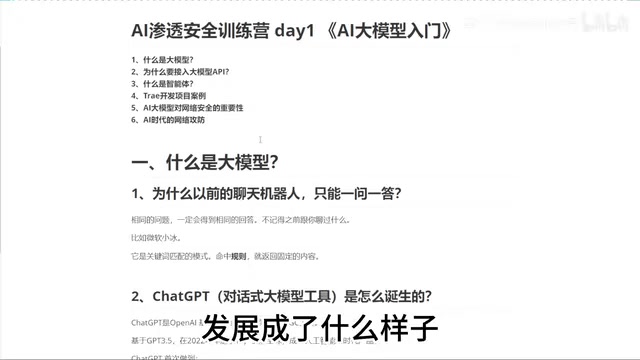
What Exactly Are Large Models?
From Keyword Matching to Semantic Understanding
To understand the security issues surrounding large models, you first need to understand what fundamentally distinguishes them from earlier chatbots.
Before ChatGPT, we encountered various chatbots — web-based dialogue programs, QQ chat bots, and even flagship products like Microsoft Xiaoice. But they all shared one common trait: ask the same question, and you'll always get the same answer. They also couldn't remember what you said earlier, and there was no easy way to "feed" them your information to form a memory.

The reason behind this is that traditional chatbots relied on a keyword matching model. The system had large numbers of pre-configured keywords and trigger rules; when your input matched a rule, it returned a fixed piece of content. This mechanism was essentially "table lookup," lacking any real language comprehension. From a technical architecture standpoint, these traditional systems were typically built on AIML (Artificial Intelligence Markup Language) or finite state machines, requiring developers to manually write extensive pattern-matching rules. For example, early versions of Microsoft Xiaoice used a retrieval-based dialogue system that selected the best-matching response from a pre-built candidate reply library based on keyword similarity. The ceiling of such systems was obvious: they couldn't handle questions not covered in the training data, nor could they reason or provide creative answers — their "intelligence" was entirely limited by how many rules the developer could predefine.
The Revolutionary Breakthrough of Large Models
Large models are fundamentally different. Trained on massive text datasets, they learn statistical patterns and semantic relationships in language through neural networks. They can understand context, generate coherent responses, and even "remember" previous exchanges across multi-turn conversations.
The technical foundation for all of this is the Transformer architecture, introduced in Google's landmark 2017 paper Attention Is All You Need. The core innovation of the Transformer is the self-attention mechanism, which enables the model to capture dependency relationships between any two positions in an input sequence, fundamentally breaking through the bottleneck that traditional recurrent neural networks (RNNs) faced in modeling long-range dependencies. The GPT series uses the Decoder portion of the Transformer, generating text token by token in an autoregressive manner — at each step, it predicts the next token based on the probability distribution of all previously generated tokens. This generation method is inherently stochastic (controlled by sampling parameters like temperature), meaning the model may take different generation paths during each inference. This is both the source of its creativity and flexibility, and the root of security risks: precisely because output is non-deterministic, attackers can potentially guide the model toward unintended behavior through carefully crafted inputs.
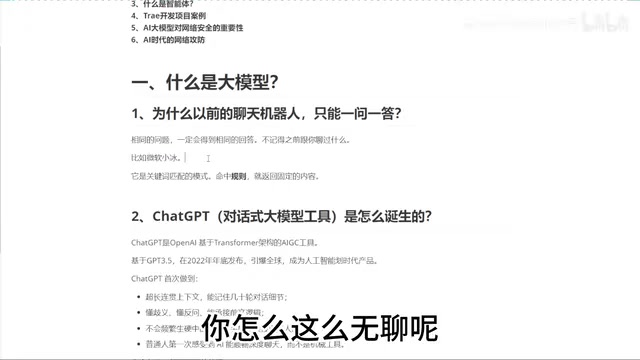
It is precisely this shift from "rule-driven" to "data-driven," from "keyword matching" to "semantic generation," that gives large models their powerful capabilities while also planting entirely new security risks — because their behavior is no longer a completely predictable fixed output, but can be "guided" or even "manipulated" by carefully crafted inputs.
The Six Core Dimensions of AI Security
Understanding these six dimensions forms the foundation for entering the field of AI attack and defense:
Understanding the Nature of Large Models
Grasping how large models work is a prerequisite for identifying their vulnerabilities. Only by understanding how a model "thinks" and generates content can you find attack entry points or design effective defense strategies.
Prompt Injection Attacks
Prompt injection is one of the most prominent security threats facing large models today. Attackers embed malicious instructions within their input to trick the model into ignoring its original system configuration and performing unintended operations. This is analogous to SQL injection in traditional web security, except the attack vector has shifted from code to natural language.
The fundamental reason prompt injection works is that large models cannot architecturally distinguish between "instructions" and "data". In traditional computer security, SQL injection occurs because user input is directly concatenated into SQL statements for execution; the principle behind prompt injection is highly similar — the system prompt and user input are processed by the model within the same text stream, and the model has no built-in mechanism to differentiate which parts are trusted system instructions and which are untrusted user data. Common attack techniques include: direct instruction override (e.g., "ignore all instructions above"), role-play bypass (e.g., the famous DAN jailbreak — "Do Anything Now"), encoding obfuscation (using Base64 or multilingual mixed text to bypass content filters), and indirect injection (embedding malicious instructions in web pages, PDF documents, or other external data sources, waiting for the AI Agent to retrieve and execute them during retrieval-augmented generation). Indirect injection is especially dangerous because users may be completely unaware they are triggering an attack.
AI-Assisted Vulnerability Discovery
Large models can serve as powerful assistants for security researchers, enabling automated scanning and discovery of software vulnerabilities. Compared to manual auditing, AI can rapidly process large volumes of code to identify potential security flaws.
AI-assisted vulnerability discovery is profoundly changing the working paradigm of security research. Traditional vulnerability hunting primarily relied on two methods: fuzzing triggers abnormal program behavior through random or semi-random inputs, while manual code auditing depends on security experts reviewing code logic line by line. The introduction of large models has significantly enhanced both approaches: for fuzzing, LLMs can generate more targeted test cases based on their semantic understanding of code, significantly improving code path coverage and vulnerability discovery efficiency; for code auditing, models can understand complex cross-function call chains, trace taint data flow, analyze business logic flaws, and discover deep vulnerabilities that manual auditing might miss. Google's Project Zero team has experimentally validated the ability of LLMs to discover real CVE vulnerabilities, with the most notable case being the use of a large model to find a memory safety vulnerability in the SQLite database that had gone undetected for years.
AI Code Auditing
Applying large models to code auditing can significantly improve the efficiency of discovering security issues. Models can understand code logic and identify potential injection points, privilege escalation risks, logic vulnerabilities, and other problems.
AI for CTF Challenges
CTF (Capture The Flag) is a classic competition format in the security field. With the reasoning capabilities of large models, participants can get help analyzing challenges, generating solution strategies, and even automating parts of the solving process.
CTF competitions typically cover multiple categories including Web security, Reverse Engineering, Cryptography, PWN (binary exploitation), and Misc, each requiring very different knowledge bases and skill sets. Large models perform unevenly across different challenge types: for Web and Cryptography challenges, LLMs can often quickly identify the knowledge points being tested and suggest viable solution approaches — such as recognizing common web vulnerability patterns or known weaknesses in cryptographic algorithms — thanks to their vast knowledge base and code generation capabilities; however, for complex PWN challenges (which require precise memory layout construction and ROP chain writing) and Reverse Engineering challenges requiring dynamic debugging, models tend to play more of a supporting analytical role. Since 2024, multiple research teams have developed automated CTF-solving systems based on LLM Agents (such as NYU's LLM CTF Agent). These systems have achieved beginner-level performance on some jeopardy-style challenges, but still show clear limitations on high-difficulty problems requiring deep reasoning, creative thinking, and adversarial techniques.
Securing AI Itself
This is the most easily overlooked yet critically important dimension. Large models themselves can become attack targets — including model jailbreaking, data poisoning, privacy leakage, and Agent privilege abuse. As AI Agents gain the ability to invoke tools, execute code, and access systems, protecting their security boundaries becomes especially crucial.
The Evolution from Prompt Injection to Agent-Based Attack and Defense
The Continuously Expanding Attack Surface
As large models evolve from "conversational tools" into autonomous "Agents," the battlefield of security attack and defense continues to expand. Early prompt injection primarily affected the model's text output, but today's Agent-based attacks can lead to far more severe consequences:
- Tool invocation abuse: Agents can call external APIs and execute system commands. Once manipulated by a malicious prompt, they can cause real system damage.
- Privilege escalation: Attackers use carefully designed instructions to make Agents break through their preset permission boundaries.
- Multi-step attack chains: Leveraging the Agent's autonomous planning capabilities to execute complex multi-stage attacks.
Agent Security Defense Strategies
Facing these threats, defenders need to establish multi-layered security mechanisms:
- Input filtering and sanitization: Performing security checks on user input before it reaches the model
- Instruction-data separation: Ensuring external data cannot be treated as system instructions for execution
- Principle of least privilege: Limiting the Agent's operational scope to the minimum necessary permissions
- Output inspection: Applying security filtering to model outputs
- Real-time behavior monitoring: Performing anomaly detection on the Agent's tool calls and execution behavior
The security architecture design of AI Agents can draw extensively from traditional operating system security models. For example, the "instruction-data separation" principle directly corresponds to the isolation of code segments and data segments in operating systems — similar to DEP (Data Execution Prevention) / NX (No-Execute) technology used to prevent buffer overflow attacks, with the core idea being "data should not be executed as instructions." The "principle of least privilege" is a cornerstone of classical security design — each component should only possess the minimum set of permissions needed to complete its task, so that even if the component is compromised, the damage an attacker can cause is confined to the smallest possible scope.
Cutting-edge defense approaches currently being actively explored in the industry include: using a separate, independent LLM as an LLM Guard, dedicated to security review and malicious content detection of inputs and outputs; employing formal verification methods to ensure Agent behavior strictly complies with predefined security policies; and introducing Human-in-the-Loop mechanisms that require human confirmation before executing sensitive operations (such as file deletion, system command execution, or database writes). In its 2025 Top 10 for LLM Application Security report, OWASP (Open Web Application Security Project) listed prompt injection as the top security risk and excessive agency as a major threat category, providing the industry with a systematic security assessment framework.
AI Security Learning Path
For those looking to enter this field, a progressive learning path is recommended:
Step 1: Master the fundamentals of large models — Understand their working principles and limitations, as this is the foundation for everything that follows. Start with the basic concepts of the Transformer architecture, learn about the self-attention mechanism, the tokenization process, the difference between pre-training and fine-tuning, and how alignment techniques like RLHF (Reinforcement Learning from Human Feedback) shape model behavior boundaries.
Step 2: Practice prompt injection attacks — Try basic attack techniques in controlled environments to experience the vulnerabilities of large models firsthand. Platforms like Gandalf and HackAPrompt are recommended for practice, as they offer progressively challenging levels from simple to complex that help learners systematically master various injection techniques.
Step 3: Leverage AI tools for real-world security work — Apply AI to practical scenarios such as code auditing, vulnerability discovery, and CTF competitions.
Step 4: Dive deep into Agent security research — Keep up with the latest developments in the rapidly evolving field of AI Agent security.
Conclusion
AI security is a rapidly maturing interdisciplinary field that demands both traditional cybersecurity knowledge and a deep understanding of large model technology. From prompt injection to Agent-based attack and defense, the adversarial game between attackers and defenders has only just begun.
For security professionals and tech enthusiasts, now is the perfect time to enter this field. Understanding the nature of large models and mastering fundamental attack and defense techniques will become an invaluable core competency.
Key Takeaways
Related articles

Fable 5.1 Real-World Test: The Truth About Generating a Medieval 3D Town in 5.5 Hours — Results and Costs
A Reddit developer tests Fable 5.1 generating a full medieval 3D town, revealing multi-wave sub-agent coordination, two-round iteration, and 5.5 hours consuming 30% of weekly budget.

The Truth Behind AI Agent Memory System Failures in Production: Seven Pain Points and Governance Strategies
An in-depth analysis of 7 critical issues AI Agent memory systems face in production, including stale info, entity deduplication, and memory bloat, with practical governance strategies.

RealSense SDK v2.58.4 Released: GPU Zero-Copy and AI Perception Framework Major Upgrade
RealSense SDK v2.58.4 introduces GPU zero-copy frame access for Jetson, unified Perception AI framework, per-detection distance reporting, GMSL multi-camera support, and ROS2 H.264 streaming.