AI Subscription Limits Unexpectedly Lifted: Technical Glitch or Marketing Ploy?
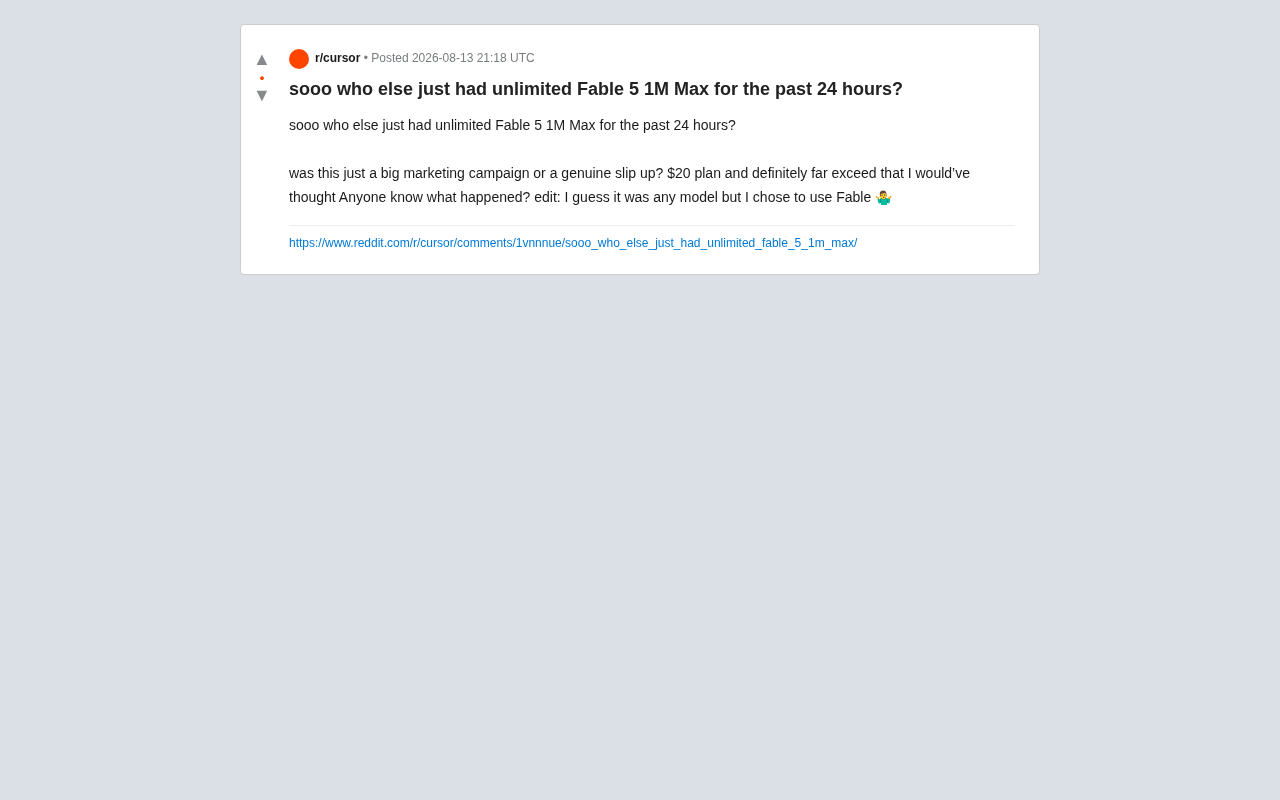
A $20 AI subscription briefly unlocked unlimited premium access — was it a bug or a strategy?
A Reddit user discovered that their $20 AI subscription suddenly provided unlimited access to premium models including Fable 5 1M Max for roughly 24 hours. The incident sparked debate over whether it was a deliberate marketing ploy or a billing system glitch. This article explores both possibilities, examines the fragile cost-pricing balance underpinning AI subscription models, and offers takeaways for users and providers navigating the AI subscription economy.
The Incident: 24 Hours of "Unlimited" Access
Recently, a Reddit user sparked a heated discussion with a post: "Who else has been enjoying unlimited Fable 5 1M Max over the past 24 hours?" The user explained that they had only purchased the $20 subscription plan, yet their actual usage far exceeded the quota limits that plan was supposed to enforce.
Some context is helpful here. Fable is one of the premium model series offered by Google's AI platform, and "1M Max" refers to the model's support for a context window of up to 1 million tokens. Tokens are the basic units that large language models use to process text — in English, one token is roughly equivalent to 0.75 words, while in Chinese, a single character typically maps to 1–2 tokens. A 1-million-token context window means the model can process the equivalent of a full-length novel — or even multiple novels — in a single conversation, which is enormously valuable for tasks like code analysis, long-document summarization, and complex reasoning. However, the tradeoff for ultra-long contexts is extremely high computational cost: as context length grows, the GPU memory and compute time required for inference scale non-linearly. This is precisely why platforms typically impose strict usage quotas on these top-tier models.
What made the post even more intriguing was an offhand remark the user added: "I think all models were actually unlocked — I just chose to use Fable." This implies the unexpected "quota meltdown" may not have been limited to a single model but could have extended across multiple premium models on the platform.
For any user who has long been constrained by subscription quotas and forced to carefully ration their use of premium AI models, suddenly gaining 24 hours of unlimited access to top-tier models was nothing short of a windfall. And it immediately raised a central question within the community: Was this a carefully designed marketing campaign by the platform, or a pure technical mishap?
The Core Question: Deliberate Marketing or Technical Failure?
The original poster posed this key question directly: "Is this a massive marketing push, or a genuine slip up?" The two possibilities point to fundamentally different business logics.
Hypothesis 1: An Intentional Marketing Strategy
If this was a deliberate marketing move, the logic isn't hard to follow. Giving paying users a brief taste of "unlimited" access to top-tier models is a highly persuasive conversion tactic. Once users get accustomed to high-frequency, worry-free access to the most powerful models, the contrast when quotas snap back into place often drives them to upgrade to higher-priced plans.
This "give them a taste, then reel them in" strategy is far from uncommon in SaaS (Software as a Service) and subscription-based products. In the industry, it falls under the classic playbook of Product-Led Growth (PLG), with specific tactics including free trials, freemium models, and limited-time upgrade experiences. For example, Spotify regularly pushes "3 months of Premium for just $0.99" promotions to free users; Adobe has offered 7-day free trials of the full Creative Suite. From a psychological perspective, this leverages the "endowment effect" — once people have owned or experienced something, they assign it higher value, and the prospect of losing it triggers strong loss aversion, making them more willing to pay to retain the experience. By temporarily opening premium features, platforms build usage habits and dependencies, thereby boosting paid conversion rates.
Hypothesis 2: A Billing System Misconfiguration
However, a more intuitive explanation is that this was simply a configuration or billing system bug. The cost of AI model inference is extremely high, especially for top-tier models like "1M Max" that support ultra-long contexts (million-token scale) — every single call represents real money spent on compute.
To understand why such a failure might occur, you need to appreciate the technical complexity of modern AI platform billing systems. These systems are highly complex distributed architectures that must track, in real time, each user's API call count, tokens consumed, specific models used, conversation turns, and more — all while cross-referencing against the user's subscription tier to decide whether to allow each request. The entire stack typically involves the coordinated work of multiple microservice components, including rate limiters, quota managers, auth middleware, and more. Historically, similar billing failures are not uncommon: in 2023, OpenAI experienced an incident where ChatGPT Plus users briefly gained unrestricted access to GPT-4 Turbo; cloud giant AWS has also seen billing system delays that allowed users to consume resources beyond their limits without being throttled in time. A common failure pattern is "fail-open" design — when the billing check service goes down, the system defaults to allowing requests rather than denying them to maintain continuity of user experience, but at the cost of temporarily losing cost controls.
If the platform truly opened these models to all $20-plan users without limits, the costs incurred over 24 hours could easily be astronomical. From a business rationality standpoint, no company would voluntarily absorb such massive and uncontrollable costs as routine marketing. This makes the technical explanation — "billing limit logic accidentally failed" — actually seem more plausible.
A Deeper Look: The Fragile Balance of the AI Subscription Economy
This seemingly minor community incident actually reflects a deep structural tension in today's AI subscription economy.
The Risk of Cost-Pricing Imbalance
For AI service providers, a $20 monthly subscription price is fundamentally built on an actuarial model that assumes "most users won't max out their quotas." This pricing logic follows a business model similar to airlines overselling tickets or gyms selling annual memberships — known in the industry as "overprovisioning" or "statistical multiplexing." If platforms priced based on every user consuming their full quota, monthly fees would likely need to be hundreds or even thousands of dollars. It's precisely because a large number of "light users" subsidize the costs of a few "heavy users" that platforms can maintain seemingly affordable prices. Platforms use multiple gatekeeping mechanisms — call limits, token caps, model access tiers — to keep the average per-user cost within a profitable range.
Once these limiting mechanisms develop a crack — whether intentionally or accidentally — the fragile cost balance can be shattered in an instant. This also explains why such "quota meltdown" events typically last only a short time (about 24 hours in this case) — once the platform detects the issue, it's usually patched quickly.
The Instant Reaction Pattern of User Communities
What's particularly interesting is the community's reaction pattern. The poster's first instinct wasn't to question what happened, but to seek out others who had the same experience — "Who else got this too?" This behavior of seeking group validation speaks to how extremely sensitive AI subscription users are to quota changes. Even the slightest hint of a "bonus" spreads and amplifies rapidly within these communities.
Notably, platforms like Reddit, Twitter/X, and Telegram have already developed a highly active ecosystem of AI tool "deal hunters." These users closely monitor pricing changes, quota anomalies, and promotions across AI platforms, and share any discovered "loopholes" with their communities at the first opportunity. The speed of information propagation is remarkable — a Reddit post can go from published to viral in just a few hours. For platform operators, this means the "window" of any billing anomaly is extremely dangerous: even if a bug only existed for 24 hours, viral community spread may have already driven thousands of users to exploit it, potentially causing compute cost losses in the hundreds of thousands or even millions of dollars. This is why leading AI companies have now assembled dedicated Trust & Safety teams to monitor abnormal usage patterns.
This serves as a reminder to platform operators: users are extraordinarily sensitive to changes in quotas and permissions. Any billing system anomaly can be widely discovered and exploited in a very short time, leading to unpredictable cost losses.
Practical Takeaways for Users and Providers
For everyday users of AI products, incidents like this are a reminder that so-called "unlimited" experiences are often fleeting and unsustainable. Taking a rational view of subscription plan value and understanding the real costs behind different models leads to better purchasing decisions. For a million-token context model, for example, the inference cost of a single long-document processing task can reach several dollars — far more than a $20 monthly fee can sustain long-term.
For AI service providers, this incident is a warning about system robustness. In high-cost model inference scenarios, the reliability of billing and access control systems is directly tied to the company's financial security. A single configuration error can cause irreversible losses in an extremely short timeframe. Specifically, providers need to carefully weigh the tradeoffs between "fail-close" and "fail-open" approaches in system design, build multi-layered cost circuit-breaker mechanisms, and deploy real-time anomaly detection systems to quickly identify and respond to abnormal usage patterns.
As of now, the platform in question has not issued an official response, so the true nature of the incident — marketing or mistake — remains an open question. But regardless of the answer, these 24 hours of "unlimited access" offer a fascinating lens through which to examine how the AI subscription economy really works.
Note: This article is based on a single Reddit user's post. The details have not been officially confirmed by the platform. Readers are advised to interpret the information accordingly.
Related articles

AgentCore in Practice: Connecting Custom Tools and MCP Servers to Agents
DebuggerCafe tutorial shows how to connect custom tools and MCP servers to Amazon Bedrock AgentCore agents, covering tool contract design, MCP reuse, and production concerns.

816B Parameters Scores Only 39? The Real Cost-Effectiveness of the Open-Source LLM Parameter Race
Meta's 816B Muse Spark Open scores just 39 on Artificial Analysis, while 180B Qwen3.8-Flash-Next scores 40. This article analyzes 11 open-weight models' parameters vs. scores, exploring the real impact of activated parameters, quantized size, and deployment cost.

Aerial Manipulators: The Next Step for Drones from 'Seeing' to 'Changing'
Starting from a Reddit discussion, this article analyzes the technical challenges, potential applications, and deployment bottlenecks of aerial manipulators, exploring the key challenges for drones moving from environmental perception to physical manipulation.