Kira Community: How an AI Creation Tool Is Transforming Into a Creator Community

Kira Community transforms from an AI generation tool into a hashtag-driven creator community.
Kira Community, recently ranked #10 on Product Hunt, marks a strategic shift from AI image/video generation tool to creator community. Using hashtags as its core organizing mechanism, it helps creators tag, preserve, and share AI-generated works while discovering like-minded peers. As underlying AI models become commoditized, Kira bets that community belonging and network effects will be the new competitive moat, though it faces cold start challenges and competition from established platforms.
From AI Generation Tool to Creator Community
In an era where AI image and video generation tools are sprouting up everywhere, many products are grappling with a key question: how to move users beyond the isolated experience of "generating a single image" toward a sustained cycle of creation and sharing. Kira Community, which recently landed at #10 on the Product Hunt leaderboard, is offering its own answer.
The dominant technical approach in AI image generation today is the Diffusion Model, with representative products including Stable Diffusion, Midjourney, and DALL·E. Diffusion models work by gradually adding noise to an image until it becomes pure noise, then training a neural network to learn the reverse process — progressively restoring a clear image from noise. On the video generation front, products like OpenAI's Sora and Runway Gen-3 extend image generation capabilities into the temporal dimension using spatiotemporal diffusion architectures or Transformer architectures. These technologies experienced explosive growth between 2023 and 2024, resulting in hundreds of products built on similar underlying capabilities and increasingly fierce homogeneous competition at the tool level.
Kira originally started as a tool focused on content generation — you could upload a photo or enter a prompt to transform it into a portrait, cinematic shot, or video. The launch of Kira Community marks a critical step from "tool" to "community." In the company's own words: "Kira Community is where your creations become 'moments.'"
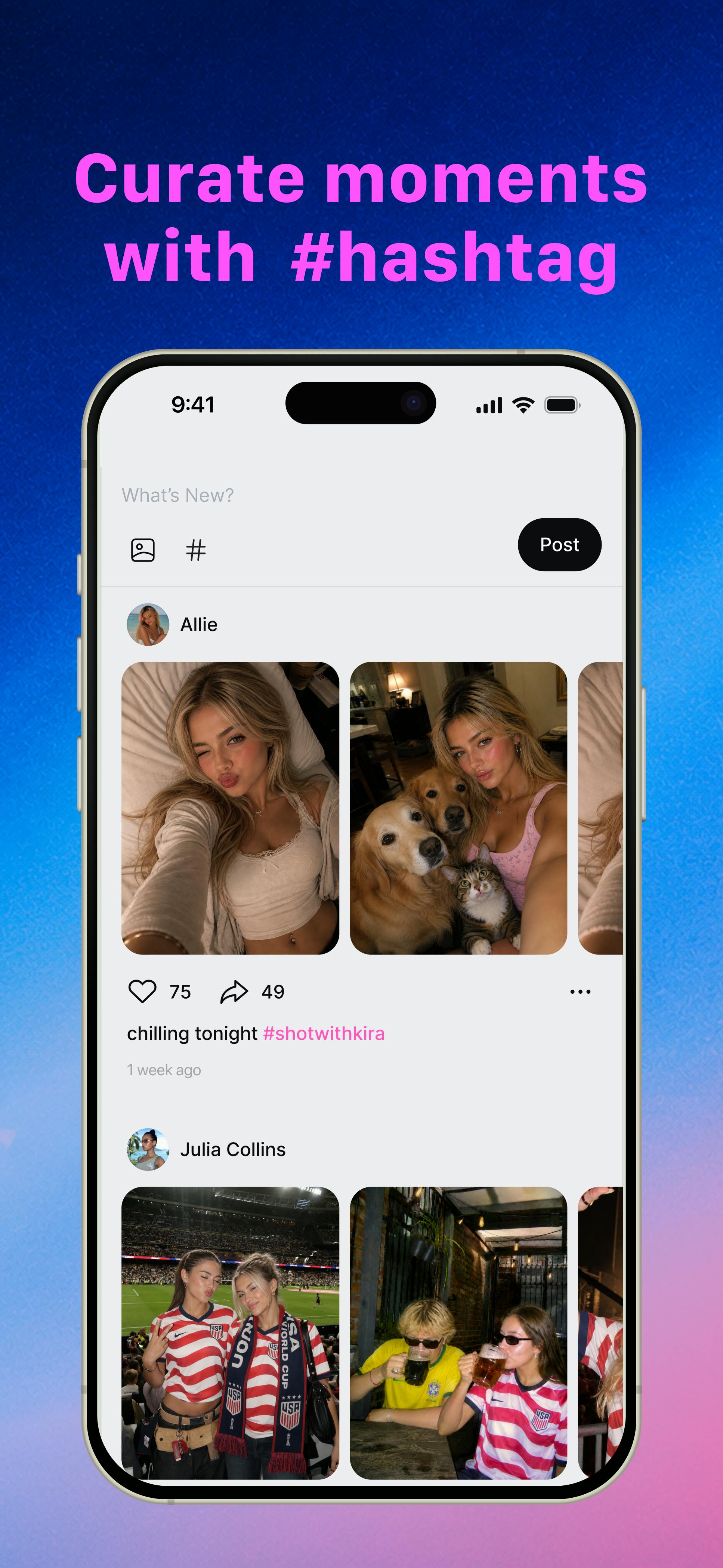
Organizing AI-Generated Content with #Hashtags
Kira Community's core mechanism revolves around #hashtags. This design concept borrows from the content organization methods of mature social platforms like Instagram and Twitter, but cleverly transplants them into the AI creation context.
The hashtag was first proposed by Twitter user Chris Messina in 2007, originally as a grassroots method of content organization. After 2010, Instagram developed it into a core content discovery mechanism, where users follow hashtags to receive content streams from specific interest areas. At its essence, the hashtag is a decentralized content classification system — it doesn't require the platform to predefine categories but instead lets users create and use them from the bottom up. This mechanism holds special value in the AI creation context: since AI-generated content is extremely diverse and nearly impossible to exhaustively categorize using traditional classification systems, the flexibility of hashtags is perfectly suited to the long-tail characteristics of this creative format.
Specifically, users can:
- Tag their AI-generated works with #hashtags by topic
- Keep works on their personal profile to build a creative portfolio
- Browse feeds organized around specific themes
This topic-based content aggregation approach addresses the pain point of AI-generated content being "generated and forgotten." When a creation is tagged with a topic label, it transforms from a one-time output into a content asset that can be searched, aggregated, and discovered by others. More importantly, what gathers around topics isn't just content — it's "people who actually care about these subjects."
The Value of Community: A New Moat for AI Creation Tools
Kira Community repeatedly emphasizes one key phrase in its product description — "people who get it." This reveals its understanding of the essence of AI creator communities: The moat for AI creation tools is shifting from model capability to community belonging.
As underlying generative models become increasingly homogeneous — with a large number of products calling on similar diffusion models or video generation capabilities — pure "generation quality" is becoming harder and harder to leverage as a differentiator. This homogenization means that many AI creation tools are built on similar open-source models (like the Stable Diffusion series) or provide generation capabilities by calling leading vendors' closed-source models via API (like OpenAI's DALL·E API). The open-sourcing of Stable Diffusion allows any developer to build an image generation service at extremely low cost, and fine-tuning techniques like LoRA (Low-Rank Adaptation) further lower the barrier for style customization. Against this backdrop, the competitive focus of AI products is undergoing three migrations: the first phase competes on model quality, the second on interaction experience and workflow design, and the third — the direction Kira is betting on — competes on community ecosystem and user network effects. Network effects mean that each new user creates value for all other users, a barrier that pure tool-based products struggle to establish.
Community — especially one that gives creators recognition, helps them find like-minded peers, and continuously motivates them — constitutes a far harder-to-replicate source of user stickiness.
Kira's strategy is: first use the tool to attract users to complete the "generation" action, then use the community to convert them through "sharing" and "belonging." The feed is built around "topics people genuinely care about" rather than algorithm-driven indiscriminate pushing, which to some extent resonates with the current user demand for "more authentic, more vertical interest communities."
Product Hunt Performance and Market Positioning
Looking at its Product Hunt performance, Kira Community received 112 upvotes and 11 comments, ranking 10th on the daily leaderboard. Product Hunt is one of the world's most influential new product launch platforms, with dozens of products going live each day, ranked by community users through an Upvote mechanism. For early-stage startup products, Product Hunt ranking performance is often a crucial springboard for acquiring seed users, media attention, and investor interest. In the AI space, competition on Product Hunt is particularly fierce — since 2023, AI-related products have frequently dominated the daily leaderboard, with top products receiving thousands of votes in a single day. Kira Community's 112 votes indicate that it successfully gained visibility in the attention-starved ocean of AI products, but it still has a gap to close before triggering viral spread.
Interestingly, Kira Community is categorized under Social Media, Artificial Intelligence, and Community. This cross-category positioning itself speaks to its ambition — it's not content being just an AI tool; it aims to become an "AI-native content social platform."
It's worth noting that Kira Community isn't the first product to attempt combining AI creation with community. Civitai has already built an active creator community around Stable Diffusion model and LoRA sharing; Leonardo.AI provides generation tools while also building a community layer for showcasing works and sharing models; and Midjourney, through its Discord server group creation model, has accidentally fostered an extremely sticky community culture. In a broader sense, traditional creator platforms like DeviantArt and ArtStation are also actively embracing AI-generated content, though this has created friction with human creators. Kira's unique positioning lies in its attempt to build a native social space where AI-generated content is a first-class citizen and topic-based interests serve as the organizing unit, rather than adding features on top of existing tools or communities.
Challenges Facing Kira Community
However, the road from tool to community is far from smooth, and Kira faces several real-world challenges:
- The Cold Start Problem: A community's value depends on the density of content and users. How to accumulate enough creators and quality content in the early stages to form a positive feedback loop is the key to success or failure. The Cold Start is a classic challenge faced by all community-type products, systematically described by Andrew Chen in his book The Cold Start Problem. The core dilemma is that a community's value depends on existing content and user density, but these are precisely what's lacking in the early stages. Successful community products typically employ several breakthrough strategies: first, entering from an extremely small vertical scenario to create high-density interaction in one niche first (like Instagram's initial focus on photography enthusiasts); second, ensuring creators' content has distribution value outside the community, driving traffic back through external links; third, generating content supply through officially operated topic activities (such as daily theme challenges). Kira's choice of the #hashtag mechanism is essentially a combination of the first and third strategies.
- Content Differentiation: When all works are AI-generated, how to prevent the feed from falling into monotonous "AI-look" aesthetic fatigue tests the platform's topic operations and recommendation mechanisms.
- Competing with Giants: Mature platforms like Instagram and Pinterest are rapidly integrating AI generation capabilities, and Kira needs to find its own unique value anchor.
A Typical Example of the AI Creation Community Trend
The launch of Kira Community is a microcosm of the "tool-to-community" trend in the AI creation space. It reminds us that in an era where generation capability is gradually becoming infrastructure, whoever can first build a creator community with a sense of belonging, clear themes, and genuine interaction is more likely to seize the initiative in long-term competition.
For creators, Kira offers a space to preserve AI works, share them, and find like-minded peers. For industry observers, it's an experimental sample worth ongoing attention — whether AI creation can truly evolve from isolated "generation actions" into a vibrant "community culture." The answer may well be hidden in the user growth curve that unfolds next.
Key Takeaways
Related articles

Hexel Editor: A Native macOS Hex Editor That Actually Understands File Structures
Hexel Editor is a native macOS hex editor for reverse engineers and security researchers, with built-in Mach-O, ELF, PE parsing, instant large file loading, entropy analysis, and real-time byte decoding.

Suno 2.0 Teaser Strengthens Creative Control, Cursor Origin Reimagines Programming Infrastructure
AI roundup: Suno Studio 2.0 teases stronger creator control, Cursor Origin adds code review & repo sync, Tencent launches HY3D World Claw for text-to-3D, Ant Group open-sources Ling 3.0 Tiny, Kimi K3 arrives on Databricks.

Techietribe AI Review: An All-in-One Online Presence Management Platform for Small Businesses
In-depth review of Techietribe AI, an all-in-one online presence platform for small businesses, covering AI website building, business profiles, and integrated directories.