AI 'Super Employee' System Breakdown: What Marketing Automation Tools Can (and Can't) Do
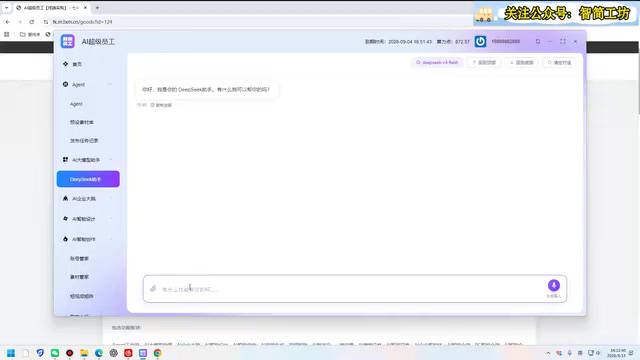
An 'AI Super Employee' marketing tool dissected: API integrations with real legal and security risks hiding in the fine print.
An 'AI Super Employee System' circulating on Bilibili wraps existing AI capabilities — video generation, voice/avatar cloning, AI agents, and bulk lead generation — into a single marketing automation workflow, promoted with a ¥1,980–¥3,980 price tag and a 'free giveaway' DM funnel. A module-by-module breakdown reveals that unauthorized voice and likeness cloning violates China's deep synthesis regulations; 'one-click viral replication' is bulk scraping of others' original content; and batch-harvesting phone numbers almost certainly breaches PIPL. The software's unknown-origin distribution also poses serious account and data security risks.
A marketing automation tool marketed as an "AI Super Employee System" has been circulating on Bilibili and similar platforms, claiming to "fully take over entry-level positions" — covering everything from content creation and multi-platform distribution to lead generation and customer service. Systems like this typically advertise a retail price of ¥1,980 to ¥3,980, yet are routinely offered for "free" as a lead-generation hook. Based on a Bilibili demo video, this article breaks down the system's claimed feature modules and flags the compliance and security risks worth watching out for.
Core Feature Modules the System Claims to Offer
At its core, the system is a marketing automation dashboard that integrates multiple AI capabilities — stitching together content creation, account management, distribution, and lead generation into a single workflow. Its feature coverage is genuinely broad, but every component is an integration of existing, commercially available capabilities rather than any underlying technical breakthrough.
The core modules include: automated short-video generation and multi-platform publishing (Douyin, Channels, Xiaohongshu, Kuaishou); a copywriting assistant powered by large models such as DeepSeek; AI enterprise agents with preset roles (customer service, sales, legal, etc.); AI image generation and graphic design; digital human avatars with voice cloning; batch short-video matrix production; and a "one-click viral video replication" feature.
The overall design philosophy is a closed loop of "enter prompt → AI generates → auto-distribute." For example, a user types "create a product introduction video for an oil-control face wash," and the system batch-generates videos around specified products, selling points, and quantities, then auto-publishes them via configured accounts. This assembly-line content production does reduce labor costs — but it also points directly to the problem platforms hate most: bulk low-quality content.
Content Production and Digital Human Cloning
The video generation module supports custom shot descriptions, on-screen action, sound effects, and subtitles. Once the user provides a topic, the large-model assistant generates a script, which then feeds into automated editing. The system also includes a built-in asset library where users can upload and reuse video clips and music.
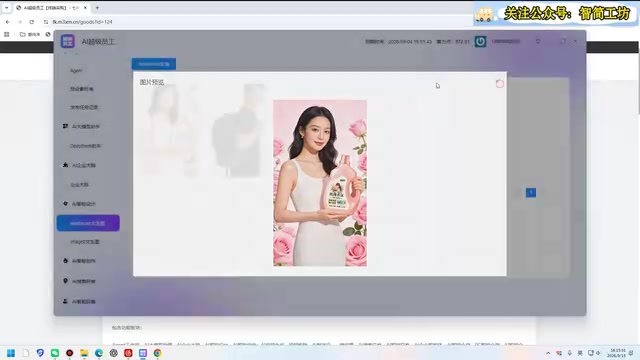
Digital human features are a common selling point for tools like this: upload 15 to 60 seconds of audio to clone a voice, upload appearance assets to customize a digital avatar, then combine these with a public avatar library, background music, and subtitle bubbles to produce talking-head videos. The technical barrier for voice and likeness cloning has dropped dramatically — but that's precisely why cloning someone else's voice or appearance without authorization carries clear legal risk, with potential liability ranging from copyright infringement to fraud.
The "one-click viral replication" feature deserves extra scrutiny. The logic is to grab links from trending videos on Douyin or Xiaohongshu, extract the script, rewrite it, swap in a new voice and digital avatar, re-edit, and re-publish. This is, in essence, bulk scraping and repurposing of other creators' original content — raising copyright concerns and violating the original-content and anti-scraping policies of every major platform.
Technical Background: Voice Cloning and Digital Human Synthesis
Voice cloning (Voice Cloning) and digital human synthesis have entered a "democratized" phase in recent years. The core approach involves extracting a speaker's timbre, intonation, and rhythm from a small audio sample — typically 15 seconds to a few minutes — and training a TTS (Text-to-Speech) model capable of unlimited generation. Mature services are already available via API from providers including ElevenLabs, Microsoft Azure Speech, and Alibaba CosyVoice, at very low per-clone cost. Digital human synthesis combines a driving audio track with a preset or custom facial model to produce a video with synchronized lip movement, facial expressions, and speech — with representative products including HeyGen, D-ID, and China's SiliconIntelligence.
Precisely because the technical barrier has fallen so sharply, China's Interim Measures for the Administration of Generative AI Services (2023) and Provisions on the Administration of Deep Synthesis Internet Information Services (2022) both explicitly require that using deep synthesis technology to generate or edit another person's likeness or voice must obtain that person's explicit consent, and that generated content must carry a prominent disclosure label. Cloning a real person's voice for commercial distribution without authorization exposes operators to civil infringement claims at minimum, and potentially makes them a party to criminal fraud liability.
Agent and Lead Generation Modules
The AI enterprise agent module lets users copy preset roles or build custom agents, configuring scripts, response logic, a knowledge base, and a model (the demo mentions Doubao 1.5, among others). These agents can handle sales, customer service, legal consultation, and similar scenarios. Combined with personal WeChat and enterprise WeChat automation, the system supports tasks like friend-request campaigns, aggregated chat management, keyword auto-replies, and manual takeover.
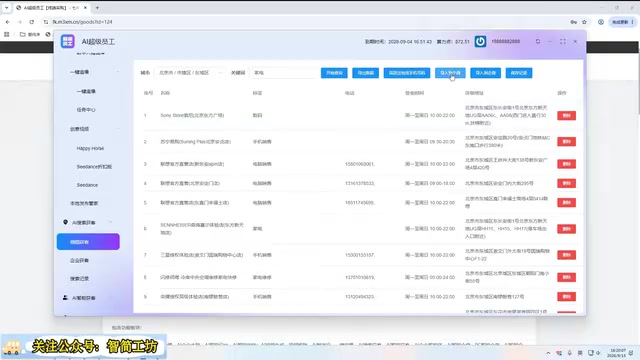
The module that most warrants a risk warning is "AI Search Lead Generation." In the demo, it can batch-search business listings by city and keyword (e.g., "Beijing + appliances"), filter for phone numbers, and import them directly into personal or enterprise WeChat. A corporate lead generation function can also bulk-query contact numbers by company name. Batch-scraping business and personal contact information without authorization is very likely to run afoul of China's Personal Information Protection Law (PIPL), and the bulk messaging that follows the import is readily classified as harassment.
Legal Background: PIPL and WeChat Platform Rules
China's Personal Information Protection Law (PIPL, effective 2021) designates phone numbers, email addresses, and other directly identifying information as "personal information," the collection of which must follow the principles of informed consent and data minimization. Bulk-scraping merchant phone numbers from public web pages via crawler or third-party data APIs — even when those numbers appear "publicly visible" — still constitutes unlawful collection if the data subjects have not separately consented to their use for marketing. In serious cases, Article 66 of the PIPL allows fines of up to ¥50 million or 5% of annual turnover, and responsible individuals may face criminal liability.
Additionally, WeChat's Terms of Service and Tencent's anti-harassment policies explicitly prohibit automated scripts for bulk friend requests and mass commercial messaging. Accounts identified as doing so face feature restrictions or permanent bans. Enterprise WeChat likewise enforces API rate limits and anomaly detection. The "batch-import phone numbers to auto-add friends" operation shown in the demo would, in practice, very likely trigger account suspension controls.
A Clear-Eyed Look at the "Free Giveaway" Marketing Playbook
The video repeatedly emphasizes "like, follow, subscribe — comment '6' in the comments and DM me for your free copy," using a stated market price of ¥1,980–¥3,980 as a contrast to manufacture scarcity. This is textbook traffic-funnel copy: the real value isn't the software — it's funneling viewers into a private channel, where follow-up paid upgrades, group memberships, secondary charges, or distribution of cracked software from dubious sources may follow.
For tools marketed as "all-in-one AI employee systems," a few baseline judgments are worth keeping in mind. First, the feature set — however broad — is a wrapper around publicly available APIs, with no way to verify stability or data security. Second, bulk content scraping, batch lead generation, and voice cloning all largely operate in gray zones between platform rules and legal boundaries. Third, source code or executables from unknown origins may carry security risks; the consequences of connecting your own accounts and customer data to such software are unpredictable.
The tools themselves reflect a genuine trend — AI-driven content automation is genuinely reshaping production economics. But treating an efficiency tool as a shortcut to rule-breaking is a poor trade: account bans and legal liability down the road cost far more than whatever labor hours were saved. The rational approach is to use compliant AI creation tools to raise the quality of individual pieces of content, rather than relying on bulk scraping to chase traffic.
Sidebar: The "High-Price Tag + Free Giveaway + DM Funnel" Pattern
The combination of inflated list price, "free" offer, and private-message conversion has become a fixed formula in China's knowledge-commerce and software sales ecosystem — commonly called a "private-domain viral funnel." The business logic: use content platforms (Bilibili, Douyin) for free exposure, use scarcity language to trigger action, and then settle users into a WeChat group or personal account for later monetization via membership upgrades, advanced courses, or one-on-one consulting.
For executable software or source code packages of unknown origin, data security risks should not be dismissed. Installation packages may embed keyloggers, account cookie stealers, or remote-access backdoors. Once a user logs into Douyin, WeChat, or enterprise WeChat in the same environment, account credentials, customer chat histories, and even payment information are all at risk of being stolen. Even if the software itself contains no malicious code, the security and regulatory compliance of data storage and transmission cannot be verified once large numbers of real accounts and customer records are connected.
Related articles

Andrew Ng on Agentic AI: Cutting Through the Hype to Find the Core Skills That Actually Matter
Andrew Ng's Agentic AI course cuts through industry hype to reveal the real skills that matter: systematic evals and error analysis for building reliable agent workflows.

Andrew Ng on Agentic AI: The Core Methodology for Building Intelligent Agent Applications
Andrew Ng's Agentic AI course decoded: from overhyped buzzword to real applications in customer support, research, legal, and healthcare — with evals and error analysis as the core methodology.

Free Gemini CLI Complete Tutorial: Full Setup Guide with OMini Router
Step-by-step guide to using Gemini CLI for free: install Node.js, start OMini Router, configure environment variables, and set Base URL, API Key, and Model fields.