AI Testing Implementation Guide: Three Major Pain Points and Cost-Effective Solution Selection

A practical guide to overcoming AI testing pain points with cost-effective "AI generation + code execution" strategies.
This article examines three core challenges of implementing AI in software testing: output randomness affecting test case consistency, ongoing Token cost pressure, and poor execution efficiency when fully delegating to AI. It advocates the mainstream "AI generation + code execution" approach that combines AI's creative capabilities with code's deterministic execution, and provides a framework for selecting the right AI tools based on enterprise needs and compliance requirements.
The Real Situation for Testers in the AI Wave
Since large models like DeepSeekAd became widely accessible, the entire IT industry's working methods have undergone profound changes. DeepSeek is an open-source large language model series developed by China's DeepSeek company, employing innovative technologies such as Mixture of Experts (MoE) architecture and Multi-head Latent Attention (MLA). It achieves reasoning capabilities close to top international models while dramatically reducing training and inference costs. Its open-source strategy allows small and medium enterprises to access large model capabilities at a lower threshold, making it an important catalyst for AI penetration across industries in China. A concerning phenomenon worth noting: more and more companies are requiring R&D and testing teams to adopt AI, and there are also reports of teams being downsized due to AI-driven efficiency gains.
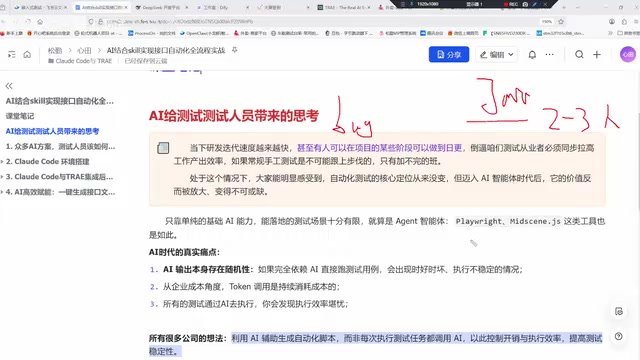
The essence of this disruption lies in the massive leap in development efficiency. In the past, a project's backend might require two to three engineers; now, keeping just one person who can use AI is sufficient, with larger projects needing only three to four people — at least halving labor costs. The skill requirements for developers themselves are also declining — as long as someone has certain AI capabilities and can write and optimize code, they can efficiently complete requirement coding and bug fixes.
This directly impacts the testing phase. A bug that previously took developers three days to fix can now be resolved in five to ten minutes with AI assistance. When development pace is accelerated by AI, testing personnel who still rely on traditional manual methods will struggle to keep up with iteration speed. It's fair to say that after AI platforms launch, many companies' "first cuts" often fall on testing teams, because testing roles in many enterprises are positioned as manual work with relatively weaker coding capabilities.
Three Real Pain Points of AI Implementation in Testing
Facing AI, the correct attitude for testers isn't blindly chasing trends, but recognizing its limitations in actual implementation. Here are three core pain points that AI testing implementation must confront.
Pain Point 1: Output Randomness Leads to Poor Test Case Consistency
AI output is inherently random. This randomness stems from the generation mechanism of large language models — at each step, the model samples the next Token based on probability distributions. The Temperature parameter controls the flatness of this distribution: higher temperature produces more random and diverse output, while lower temperature tends toward determinism. Except for objective questions like "1+1," any question with subjectivity or varying perspectives may yield completely different answers when asked today versus tomorrow. If you simply call a large model without optimization, the consistency of generated results will be poor.
A real comparison case illustrates this clearly: for the same interface functional test case, the test data before optimization was completely irregular and chaotic — "might as well not have been written"; after deep optimization, the test data could even automatically generate MD5-encrypted ciphertext, with both accuracy and standardization dramatically improved. Both used the same solution and the same project path, yet the results were worlds apart.
This explains why many people "lose confidence after trying AI" — the problem often isn't AI itself, but rather that users are making superficial calls without investing effort in prompt and workflow optimization. Prompt Engineering is the key factor determining AI output quality, including specifying output format requirements, providing Few-shot Learning examples, setting roles and constraints, and breaking complex tasks into multi-step reasoning (Chain of Thought). Research shows that the same model's output quality can differ by several times under different prompting strategies — this is the technical root cause behind the dramatic difference in results before and after optimization.
Pain Point 2: Token Consumption Creates Ongoing Cost Pressure
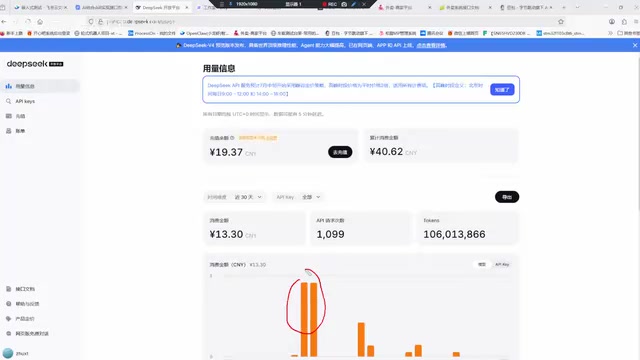
There's a popular view that "paying for Tokens is more cost-effective than paying employee salaries," making AI replacement of several headcounts seem like a bargain. But looking at actual bills: even light usage costs five to six yuan per day, and with long-term dependence, Token consumption is actually quite considerable.
Here we need to understand Token pricing mechanics: Tokens are the basic measurement unit for how large language models process text. In Chinese scenarios, one character is typically encoded as 1.5 to 2 Tokens. API billing is divided into input Tokens and output Tokens, with output Token pricing typically 2 to 4 times that of input. In testing scenarios, each test case generation requires sending complete interface documentation and context information as input, then generating lengthy test case code as output — a single call's Token consumption can reach thousands or even tens of thousands. If a project has hundreds of interfaces to cover, the accumulated cost is staggering.
Cost reduction and efficiency improvement happen in stages: enterprises first reduce labor costs, and after tasting success, they inevitably turn to optimizing AI costs themselves, thinking about how to accomplish the same tasks with fewer Tokens. If you don't know how to optimize AI solutions and rely on Tokens for the entire chain, the expenses will be painful.
Pain Point 3: Fully Delegating to AI Results in Poor Execution Efficiency
The third pain point concerns execution efficiency. Taking API testing as an example, a synchronous interface typically takes only milliseconds to a few seconds when run with code. But if test case execution is entirely delegated to AI, speed becomes extremely slow, because execution efficiency depends on the large model's response capability and various scheduling stages — each request involves network transmission, queue waiting, model inference computation, and other latency stages. A single response typically takes seconds to tens of seconds, completely incomparable to the millisecond-level execution of local code.
Mainstream Approach: AI Generation + Code Execution
Based on these three major pain points, the current pragmatic mainstream approach is: Use AI to generate automation scripts, test cases, and documentation; use code for execution.
The pain point of traditional automated testing is spending enormous time on coding, debugging, and running during the early stages. The new approach delegates the most time-consuming early-stage work — test case design, interface documentation, and code generation — to AI, while the execution phase returns to code. This essentially combines AI's creative generation capability with traditional programs' deterministic execution capability in an optimal way, leveraging the strengths of each. The benefits are very clear:
- Higher execution efficiency: Code execution speed far exceeds AI direct execution
- Stronger result consistency: Execution is guaranteed by deterministic code, not random AI output
- Lower overall cost: Tokens are mainly consumed in the generation phase, saving significantly compared to full AI dependence
The core philosophy is: don't pursue the newest or most high-end solution, but pursue the approach with the best cost-effectiveness, highest efficiency, and best fit for your own needs. When the industry is developing rapidly, blindly chasing the latest tools isn't wise, because the newest isn't necessarily right for you.
AI Solution Evolution Path and Selection Logic
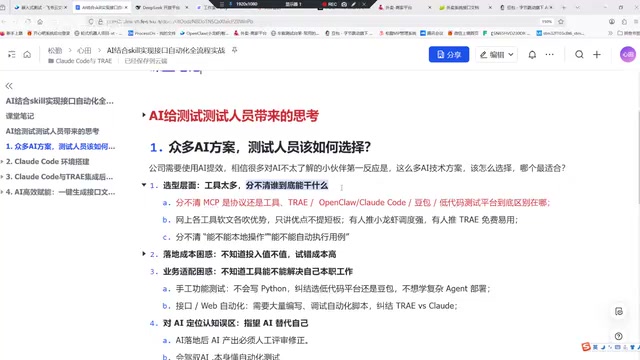
Current AI testing tools are incredibly diverse: from simple Q&A tools (Doubao, DeepSeek), to MCP which calls underlying tools, to IDE tools with interfaces, engineering-level Claude Code, and various low-code platforms and open-source solutions.
MCP (Model Context Protocol) is an open standard protocol released by Anthropic in late 2024, adopting a client-server architecture that provides large models with a unified interface for interacting with external tools and data sources. It enables AI models to invoke underlying capabilities such as browser operations, database queries, and file system access through standardized methods, without writing separate integration code for each tool, thereby extending models from pure text Q&A to actual operational execution.
From an industry evolution perspective, most people first encountered AI through Coze, then discovered Dify was more useful and supported local deployment. Dify is an open-source large model application development platform offering visual workflow orchestration, RAG (Retrieval-Augmented Generation) pipelines, and Agent construction capabilities. Unlike pure cloud platforms like Coze, it supports private deployment — enterprises can deploy it on their own servers with local models. Testing teams can build automated workflows for test case generation and defect analysis through drag-and-drop. Next came various OpenCloud tools, and now the mainstream has evolved to the Skill form factor — because it works cross-platform and across multiple tools.
Different solutions have distinctly different applicable scenarios:
- Simple technical Q&A: Directly ask Doubao or DeepSeek, such as troubleshooting errors or incorrect commands
- Calling underlying tools: Choose MCP for scenarios requiring browser operations
- Engineering-level code generation: Claude Code has higher code requirements and stronger capabilities
- Localization/offline needs: When companies don't allow internet access, use local deployment solutions like Ollama
Ollama is a lightweight local large model runtime framework that supports deploying and running open-source models like Llama, Mistral, and Qwen on personal computers or intranet servers without internet connectivity. It compresses model size through quantization techniques (such as GGUF format), enabling models with 7B to 70B parameters to run on consumer-grade GPUs or even CPU-only environments. For enterprises with data security and compliance requirements that don't allow business data to be uploaded to third-party servers, such local solutions are the only viable AI implementation path, despite their reasoning capability and response speed being somewhat inferior to cloud APIs.
The key to selection always starts from your own pain points and enterprise compliance requirements. For example, if a company doesn't allow solutions requiring internet access, you must immediately eliminate those options and turn to locally deployed offline models.
Embrace AI but Use It the Right Way
AI's impact on the testing industry is a foregone conclusion. Traditional purely manual testing positions will become increasingly rare, and skill requirements will continue rising. There are only two paths to breaking through: either find a better platform that matches your salary expectations, or build stronger skills in your current role.
For the vast majority of testers, the most practical path is: recognize the three major pain points of AI — randomness, cost, and efficiency — adopt the cost-effective "AI generation + code execution" approach, and choose skill-based forms like Skill that have low learning curves and are easy for enterprises to implement. Truly using AI well and correctly matters far more than chasing the latest tools.
Key Takeaways
Related articles

Apple HomeView Hands-On Review: Is the $300 Smart Home Hub Worth It?
Apple HomeView hands-on: a $300 smart home hub with facial recognition for quick account switching, but no App Store or voice recognition. Is the wall-mounted version worth it? Should you buy the first generation?

Meta Muse Wonder Launch: What It Means for Meta's Return to the Frontier AI Race
Meta releases Muse Wonder and WonderFull, benchmarks reach the frontier, community feedback is polarized. An in-depth look at Meta's return to the frontier AI race, its personal agent strategy, and Zuckerberg's different path.

Apple Home Smart Home Lineup Leaked: LG and Schneider Team Up, UWB Door Lock on Board
Apple Home ecosystem gains new LG and Schneider devices: UWB smart lock with proximity unlock, 2.5K dual-camera doorbell, privacy indoor camera, and AirPods-like seamless pairing.