AI Ticket Bot Hallucination Problem: How to Use Escalation Triggers for Human Handoff
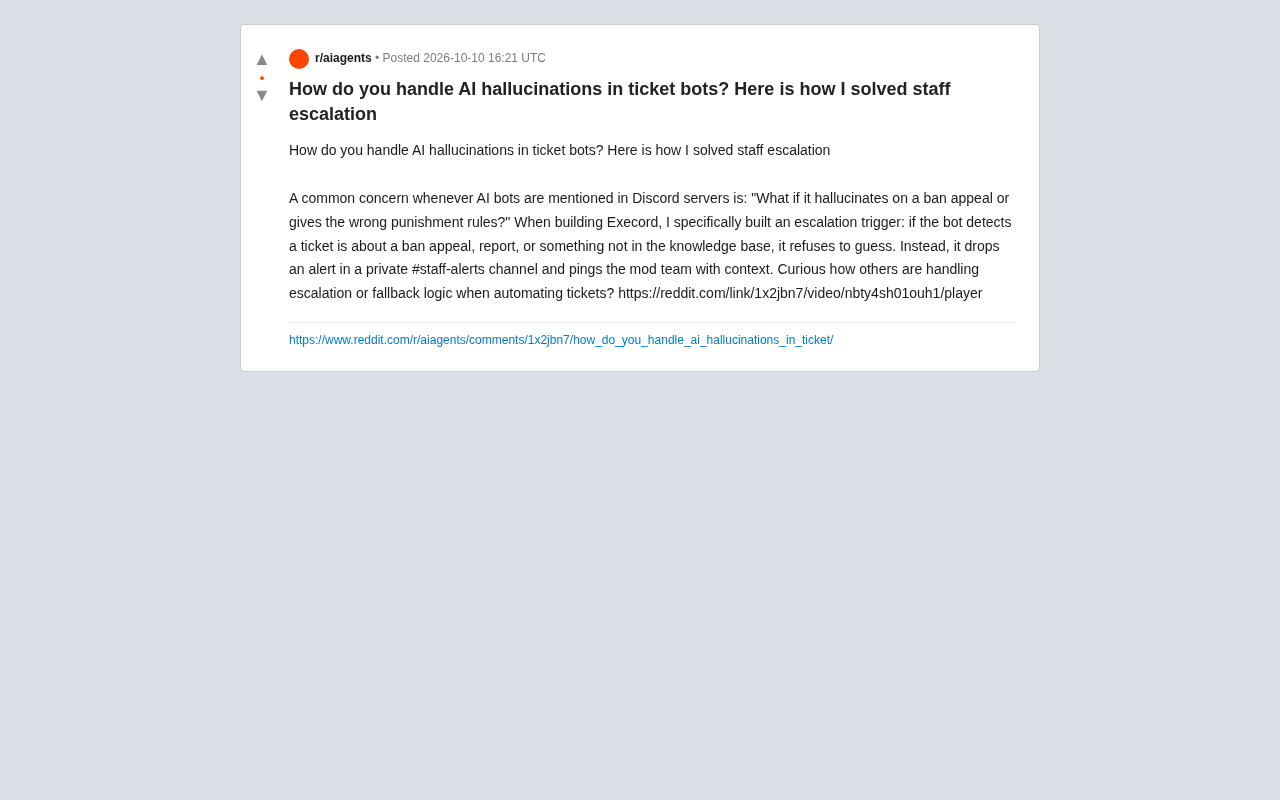
Execord's escalation trigger routes high-risk tickets like ban appeals to human staff, sidestepping AI hallucination risks.
When AI enters Discord ticket systems, hallucinations are especially dangerous in ban appeals and user reports. Execord's developer built a proactive escalation mechanism: preset triggers detect high-risk or out-of-scope tickets, the bot declines to answer, and instead notifies the moderation team in a private `#staff-alerts` channel with full context attached. The core insight is engineering away the blast radius of hallucinations rather than trying to eliminate them technically — and recognizing that a mature AI automation system's true mark is reliably knowing what it shouldn't handle.
The Hallucination Risk in AI Ticket Bots
When Discord communities introduce AI bots to handle tickets, one concern that keeps coming up is: what if the AI hallucinates during ban appeals or violation reports and cites incorrect penalty rules? This isn't an unfounded worry — in sensitive scenarios involving user rights and punishment decisions, an AI that "confidently makes things up" doesn't just mislead users; it can undermine the credibility of community moderation as a whole.
A Reddit developer building a ticket bot called Execord faced this problem head-on. His approach was straightforward: rather than forcing the AI to produce an answer when uncertain, design a clear mechanism for it to "admit ignorance and escalate."
LLM "hallucination" refers to when a model generates content that is factually incorrect but expressed fluently and confidently, as if it has no doubt whatsoever. This stems from how language models are trained — the objective is to predict "the next linguistically plausible word," not to verify factual accuracy. Models can't distinguish between "I know the answer" and "I'm plausibly completing this sentence," so even without any real basis, they tend to produce responses that sound authoritative. In the Discord ticket context, this is particularly dangerous: when a user asks "What was the reason for my ban?" or "Does this message violate the rules?", the model might cite rule clauses that don't exist or fabricate punishment precedents. Penalized users have no easy way to tell the difference and may file incorrect appeals or trigger unnecessary disputes as a result.
The Core Solution: Proactive Escalation Over Blind Guessing
Identifying High-Risk Tickets
The developer's approach was to configure an "escalation trigger" for the bot. When the bot detects that a ticket falls into any of the following categories, it proactively declines to answer on its own:
- Ban appeals
- User reports
- Any question outside the scope of the knowledge base
The essence of this classification logic is giving the AI a clear-eyed understanding of its own capability boundaries. Routine questions covered by the knowledge base (like "How do I change my nickname?" or "Where can I find the server rules?") are handled automatically; anything involving subjective judgment, punishment decisions, or information beyond what's known simply isn't guessed at.
Handing Off to the Human Team
Once an escalation condition is triggered, the bot doesn't attempt to fabricate an answer. Instead, it takes two actions:
- Posts an alert in the private
#staff-alertschannel - @mentions the moderation team with the ticket's full context attached
This design strips the highest-hallucination-risk scenarios directly out of the AI's hands and returns them to human decision-makers. The AI here plays the role of "intelligent triage" — filtering and classifying, rather than overstepping to make final judgments.
#staff-alerts is a private channel in a Discord server visible only to admins or moderators, inaccessible to regular members. Routing alerts to a dedicated private channel rather than popping up in a public one offers two practical benefits: first, it prevents sensitive ticket content (especially reports or appeals) from being exposed to other members; second, the moderation team can monitor this channel as a single "pending queue," reducing the risk of things slipping through due to scattered information. The step of attaching full context also deserves attention — many automated systems only pass a ticket ID or summary during escalation, forcing admins to manually look up the original records. Directly including the conversation history and user information can significantly reduce the response time required for human intervention.
Why "Knowing When to Stay Silent" Matters More Than "Knowing Everything"
The value of this case lies in the AI product design principle it surfaces — one that many overlook: for high-risk automation scenarios, teaching a model to "refuse to answer" is often more valuable than chasing higher answer coverage.
The hallucination problem in large language models fundamentally stems from their tendency to produce fluent, confident responses to any input, even without a real basis. In casual conversation, this is at worst awkward; but in ticket systems, customer service, compliance, and similar contexts, one confident mistake can cause real harm.
By pre-defining clear escalation rules, the developer sidestepped the near-unsolvable technical challenge of "how to make AI not hallucinate" and instead used engineering to control the blast radius of hallucinations. Since you can't guarantee the AI is always correct, ensure it only operates autonomously within the range where it's most likely to be right — and hand everything else to humans.
Implications for Ticket Automation
This kind of fallback logic and escalation mechanism is something any serious AI automation system should have. A few key takeaways worth borrowing:
- Define capability boundaries clearly: Use knowledge base hit-or-miss as the criterion for whether AI should intervene, rather than letting the model freelance.
- Tiered handling: Automate routine questions, route sensitive ones to humans — a clean division of responsibility.
- Preserve context: Pass the full context to human staff during escalation, so admins don't have to re-gather information and response costs stay low.
- Transparent alerting: Notify through a dedicated alert channel rather than handling things silently, ensuring the team can step in promptly.
The original poster also raised an open question to the community: how do others handle escalation and fallback logic when automating tickets? This actually reflects an emerging industry consensus — the mark of a mature AI automation system isn't how much it can handle independently, but whether it can reliably identify the work it shouldn't handle.
"Fallback logic" is a general concept in system design: when the primary flow can't execute normally, the system switches to a pre-defined alternative path rather than throwing an error or failing silently. In the AI automation context, this extends to: when model confidence is insufficient, the input falls outside known scope, or the scenario carries too much risk, the system should have a defined degradation behavior — typically routing to a human, requesting clarification, or declining to answer. This aligns with the "defensive programming" philosophy in traditional software engineering: rather than assuming all inputs will fall within expected ranges, explicitly design handling strategies for edge cases. AI systems lacking fallback logic tend to "push through" when they encounter inputs outside their training distribution — producing a plausible-sounding but actually incorrect result, without proactively informing the user that the response carries uncertainty.
Summary
When bringing AI into sensitive business processes, rather than chasing the ideal state of zero hallucinations, it's more practical to design a "safety valve" for hallucinations. Execord's escalation trigger provides a clean, practical template: identify high-risk tickets → decline to guess → escalate to humans with full context. This human-AI collaboration design philosophy — as opposed to simply stacking up more model capability — is what actually lets automation systems hold their ground in real-world environments.
Related articles

Free Unlimited Claude Code Solution: Agnes AI + CC Switch Setup Guide
No paid subscription needed — pair the free AI platform Agnes AI with the open-source tool CC Switch to provide a backend for Claude Code, enabling unlimited free calls to text, image, and video models. This guide covers the full setup, test results, and usage boundaries.

A Complete Zero-Cost Guide to Getting Started with Claude Code for Beginners in China
A beginner's guide to Claude Code for users in China: two installation methods (command line and IDE plugin), full configuration steps for replacing the official API with the free domestic LongCat model, and a hands-on demo of building a small tool with natural language, plus tips.

When the NSA Gets Involved: The AI Supply Chain Crisis Behind Open-Source CVEs and API Key Hijacking
Multiple open-source projects disclosed severe CVEs in one day, PHP flaws alarmed the FBI, and Railway and OpenCode were breached with API keys stolen. This article breaks down the vulnerability window, AI-accelerated exploitation, and the AI supply chain crisis behind the API key black market, with a developer defense checklist.