AI Usage Patterns in Software Teams: Real-World Practices from Frontline Developers

How software teams actually use AI: patterns, friction, and governance challenges from frontline developers.
This article analyzes real-world AI usage patterns in software teams based on a Hacker News discussion and industry observations. It covers the most common entry points (code completion tools like GitHub Copilot and Cursor), the shift from Stack Overflow to conversational AI for knowledge retrieval, the hidden costs of verification and trust, and organizational challenges teams face when scaling AI adoption including code standards, accountability, and data security compliance.
The Real Picture of AI Entering Software Development
When it comes to AI in software development, there's never a shortage of grand narratives — from "AI will replace programmers" to claims of "10x productivity gains." However, when we zoom in on real software teams, actual usage patterns are far more complex and nuanced than the marketing hype suggests.
A Hacker News discussion titled "AI usage patterns in software teams" (with 29 upvotes and 17 comments) focuses on how AI tools actually permeate day-to-day work in software teams. Compared to marketing rhetoric, discussions from frontline developer communities better reflect AI's true position in engineering practice. This article draws on that discussion and broader industry observations to outline several typical patterns of AI adoption in software teams and the deeper logic behind them.
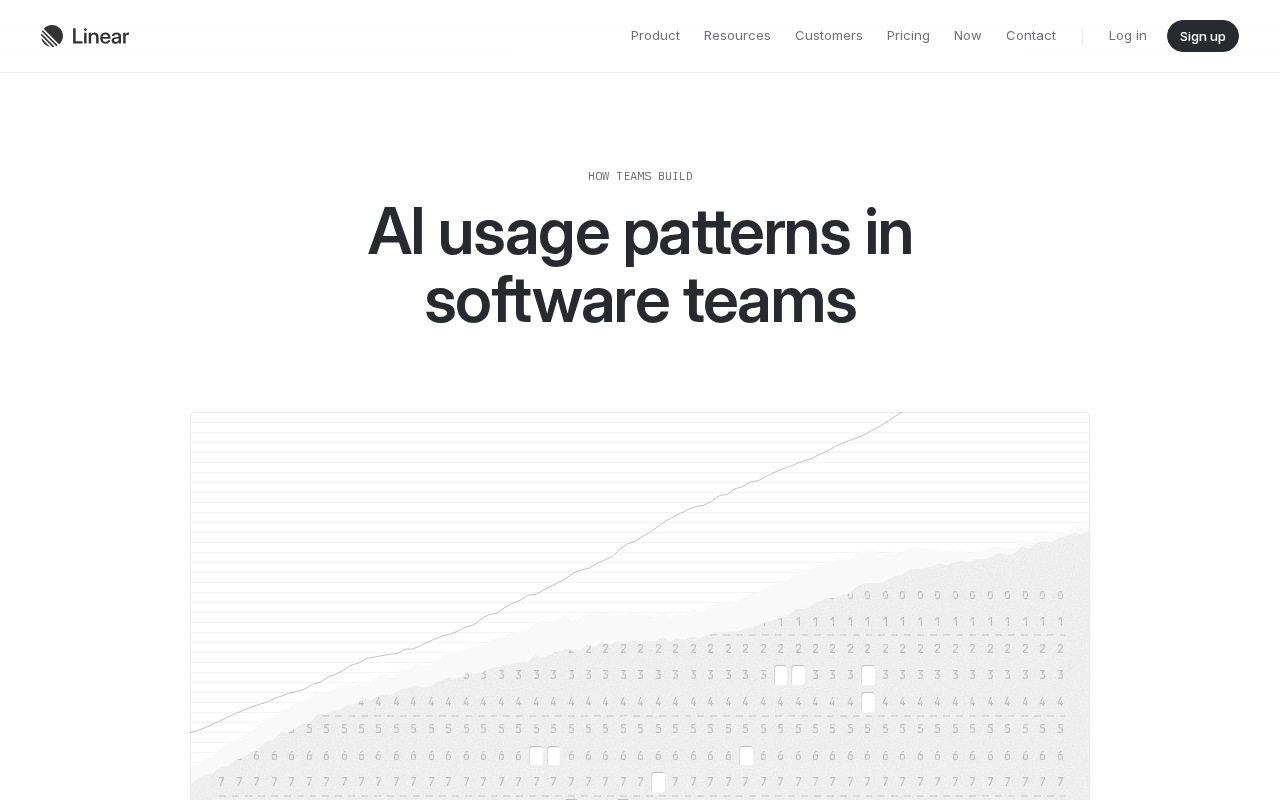
Typical AI Usage Patterns in Teams
Personal Productivity Tools: The Most Common Entry Point
The most widespread application of AI in software teams today still remains at the "personal augmentation" level. Developers use tools like GitHub Copilot and Cursor for code completion, boilerplate generation, function documentation, and similar tasks. The hallmark of this usage is that it's immediate, localized, and low-risk: AI suggestions are evaluated and accepted or rejected on the spot by the developer, without altering team collaboration workflows.
From a technical standpoint, GitHub Copilot is built on OpenAI's Codex model (a code-specialized variant of the GPT series), trained on billions of lines of public code, enabling it to predict upcoming code snippets based on the current editor context. Cursor is an emerging editor that deeply integrates large language models into the IDE, supporting multi-model switching (including GPT-4, Claude, etc.), offering not only line-level completion but also cross-file code understanding and refactoring suggestions. The core technical principle behind these tools is treating code as a special form of natural language, leveraging the attention mechanism of the Transformer architecture to capture patterns and dependencies in code. They differ fundamentally from traditional IDE intellisense (which relies on static analysis and type systems): traditional tools depend on deterministic rules, while AI completion tools rely on probabilistic inference — enabling them to handle more flexible scenarios but also introducing uncertainty.
This pattern became widespread first because it minimally intrudes on existing workflows. Developers don't need to change their habits; they simply gain a "smart copilot" in their editor. Adoption rates for code completion tools among professional developers are already quite substantial, but their value depends heavily on task type — they're highly effective for templated, repetitive code but offer limited help for core logic requiring deep architectural thinking.
Knowledge Retrieval and Troubleshooting: Replacing Some Search Behavior
The second high-frequency scenario is using AI as an "enhanced search engine." In the past, developers would turn to Stack Overflow or Google when encountering errors or API usage questions. Now, increasingly, they go directly to conversational AI like ChatGPT or Claude.
Behind this shift lies a profound transformation in information retrieval patterns. Stack Overflow was once the go-to platform for developers solving technical problems, with over 100 million monthly visits in 2022. However, since ChatGPT's launch, its traffic has declined significantly — reportedly dropping 35-50% in 2023. The traditional model is "search-filter-combine" (piecing together solutions from multiple answers), while the AI model is "ask-receive synthesized answer-verify." Stack Overflow's advantage lies in answers validated through community voting and continuously updated, while AI's advantage is synthesizing scattered knowledge points tailored to the user's specific context. The fundamental difference: Stack Overflow provides socially validated discrete knowledge points; AI provides unverified comprehensive responses.
The advantage of this shift is that AI can deliver context-aware, customized answers rather than forcing developers to sift through vast search results. However, a recurring warning in community discussions is: AI answers can be confident yet wrong (the "hallucination" problem).
LLM "hallucinations" stem from their fundamental working mechanism: models are essentially performing "next token prediction," optimizing for generating statistically plausible text sequences rather than guaranteeing factual accuracy. The model doesn't maintain a verifiable knowledge base but compresses patterns from training data into parameter weights. When asked about areas insufficiently covered or contradictory in training data, models tend to "creatively fill gaps" rather than acknowledge uncertainty. In programming contexts, this manifests as generating plausible-looking but nonexistent API calls, fabricated library function signatures, or algorithm implementations with subtle logical errors. The industry currently mitigates this through RAG (Retrieval-Augmented Generation), chain-of-thought reasoning, and tool-calling techniques, but hasn't fundamentally solved it.
Experienced developers can typically identify unreliable suggestions quickly, while newcomers may be misled. This explains why AI's value distribution within teams is uneven — senior engineers actually extract greater benefits from AI.
Real-World Friction in Adoption
The Cost of Trust and Verification
A recurring theme in the discussion is: AI hasn't truly "eliminated" work — it has shifted work from production to verification. Developers need to spend time reviewing whether AI-generated code is correct, conforms to project standards, or introduces hidden security vulnerabilities. For complex systems, this verification cost can sometimes offset the gains from generation speed.
In other words, AI excels at rapidly producing things that "look right," but the gap between "looks right" and "is actually right" still requires human engineers to bridge with professional judgment. This is especially critical in team collaboration — if AI-generated code enters the codebase without thorough review, the accumulation of technical debt can be insidious and long-term.
Notably, technical debt in AI scenarios has unique characteristics. The concept of Technical Debt was introduced by Ward Cunningham in 1992, referring to compromises in code quality made for short-term delivery speed. Debt introduced by AI-generated code is often "unconscious debt" — developers may not fully understand the implementation details of AI-generated code before merging it. Additionally, AI tends to generate "correct but suboptimal" implementations, lacking understanding of overall project architectural conventions, leading to gradual accumulation of style inconsistencies and confused abstraction layers. Because AI generates code extremely fast, the rate of debt accumulation can far exceed traditional development patterns, making code review more important than ever.
Organizational Challenges of Team-Level Adoption
Scaling from a personal tool to a team-level practice involves issues far beyond technology:
- How to maintain unified code standards?
- How to define accountability for AI-generated content?
- Should sensitive code be allowed to upload to third-party services?
The third question involves multiple security and compliance risks. Uploading code to AI service providers may pose intellectual property risks — whether code will be used for model training, or whether it might appear in other users' completion suggestions, which sparked widespread controversy and litigation in GitHub Copilot's early days. For code handling personal data (governed by GDPR, CCPA, etc.) or systems involving financial transactions (subject to SOX, PCI-DSS standards), uploading to third parties may violate regulatory requirements. Many enterprises therefore opt for self-deploying open-source models (like Code Llama or StarCoder) or require AI vendors to sign Data Processing Agreements (DPAs) and provide SOC 2 compliance certifications. These considerations make enterprise-level AI adoption decisions far more complex than individual use.
These are governance issues that teams must address when scaling AI adoption. Many teams currently exist in a "bottom-up" spontaneous adoption state: individual developers adopt first, with no unified team-level policy. This approach is flexible and efficient early on, but as usage deepens, the lack of standards can introduce consistency and security risks.
Deeper Observation: AI Changes the Rhythm, Not the Essence
Looking at the big picture, the real landscape of AI adoption in software teams can be summarized as: it's a powerful accelerator, not a replacement. AI excels at reducing startup friction for certain tasks, speeding up prototyping, and aiding the learning of new technologies. But the most essential parts of software engineering — understanding requirements, designing architecture, making trade-offs, ensuring quality — remain firmly in human engineers' hands.
Interestingly, the introduction of AI is quietly reshaping the distribution of valuable developer skills. Meta-skills like asking good questions, quickly verifying answers, and judging when to trust AI are becoming more important than memorizing specific syntax or APIs. For teams, how to embrace efficiency gains while establishing corresponding verification mechanisms and usage standards will be the key determinant of whether AI's value can truly be realized.
Conclusion
This Hacker News discussion about AI usage patterns, though modest in scale, reflects a mature attitude from frontline engineers toward AI: neither blindly embracing nor wholesale rejecting it, but continuously exploring AI's capability boundaries in real work.
For technical managers considering how to introduce AI into their teams, this practice-grounded, measured perspective may be more valuable than any vendor's pitch. The real question isn't "whether to use AI," but "in which workflows, in what manner, and with what guardrails should we use AI."
Related articles

Apple HomeView Hands-On Review: Is the $300 Smart Home Hub Worth It?
Apple HomeView hands-on: a $300 smart home hub with facial recognition for quick account switching, but no App Store or voice recognition. Is the wall-mounted version worth it? Should you buy the first generation?

Meta Muse Wonder Launch: What It Means for Meta's Return to the Frontier AI Race
Meta releases Muse Wonder and WonderFull, benchmarks reach the frontier, community feedback is polarized. An in-depth look at Meta's return to the frontier AI race, its personal agent strategy, and Zuckerberg's different path.

Apple Home Smart Home Lineup Leaked: LG and Schneider Team Up, UWB Door Lock on Board
Apple Home ecosystem gains new LG and Schneider devices: UWB smart lock with proximity unlock, 2.5K dual-camera doorbell, privacy indoor camera, and AirPods-like seamless pairing.