AI Valuation Bubble Warning: The Emperor Pelican Has No Clothes

Using 'The Emperor's New Clothes' as a metaphor to examine the systemic gap between AI industry valuation hype and real technological output.
'The Emperor Pelican Has No Clothes' uses Andersen's fairy tale as a metaphor for the AI industry: when everyone is praising a magnificent garment that doesn't exist, who will be the child who speaks the truth? The article synthesizes multiple perspectives from Hacker News, noting a rare consensus that a gap exists between capital enthusiasm and technological output—leading companies' valuations keep hitting new highs, yet stable commercial returns remain concentrated in a few scenarios like code assistance and content generation. The divergence lies in whether this is a bubble or normal fluctuation during an infrastructure build-out phase. The article further dissects the specific manifestations of the 'new clothes': the gap between model benchmark scores and real experience, and startups' fragile revenue models built on assumptions of future payment. Finally, it offers judgment frameworks for practitioners: distinguish technological narrative from product value, beware of consensus traps, and focus on deployment metrics like paid retention rates rather than funding news.
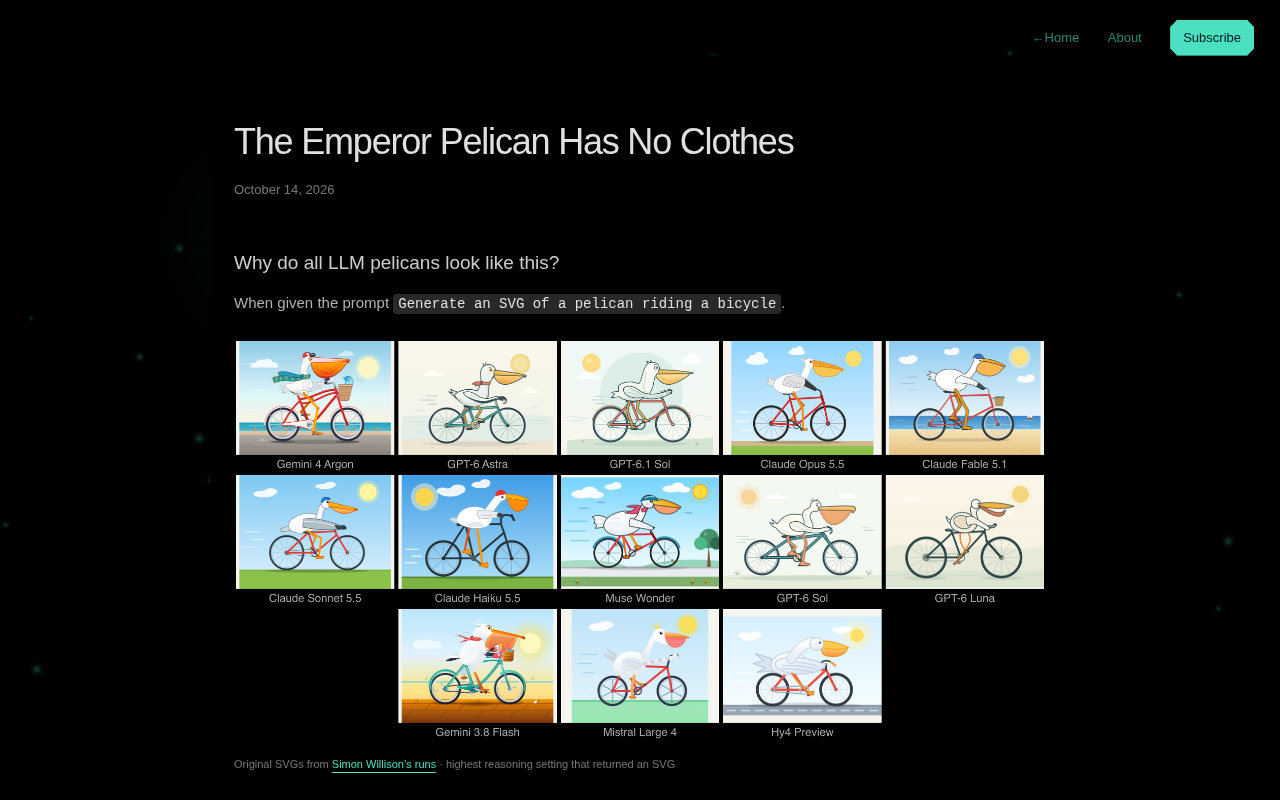
An Industry Reflection Sparked by a Fable
The title "The Emperor Pelican Has No Clothes" is a play on Hans Christian Andersen's fairy tale "The Emperor's New Clothes," swapping "Emperor" for "Pelican," and it has sparked widespread discussion on Hacker News. Behind this seemingly absurd title lies an unavoidable question for today's AI industry: when everyone is praising a magnificent garment that doesn't actually exist, who will play the child who speaks the truth?
The article's core metaphor is not complicated—certain technological narratives and commercial valuations in the AI field may be built on collective illusion. From claims about large model capabilities to AGI timelines, from funding valuations to product deployment, the entire chain contains promises that are "visible but intangible."
Consensus and Divergence: The State of AI Through Multiple Lenses
A Repeatedly Validated Concern
In the Hacker News discussion, multiple independent voices formed a rare consensus: there is a significant gap between the current capital enthusiasm in the AI industry and actual technological output.
On one hand, valuations of leading AI companies keep hitting new highs, with funding rounds routinely reaching billions of dollars; on the other hand, AI applications that actually generate stable commercial returns remain concentrated in a few scenarios—code assistance, content generation, customer service automation. This "narrative-driven valuation" model shares similarities with the characteristics of the dot-com bubble era.
Multiple commenters pointed out that the problem is not whether AI technology itself has value, but whether the market's expectations for technological maturity are being systematically overestimated. When all participants in an industry are repeating the same story, skeptics become the outliers.
Dot-com Bubble refers to the tech stock valuation frenzy between 1995 and 2000, driven by excessive optimism about the commercial prospects of the internet. The Nasdaq index peaked in March 2000 and then plummeted by about 78%, with numerous companies lacking profit models going bankrupt. Its typical characteristics include: valuations supported by non-revenue metrics like "user growth" and "click-through rates," frantic influx of venture capital, virtually non-existent IPO thresholds, and the narrative logic of "this time it's different." The current AI industry shows structural similarities: leading companies valued far beyond revenue, unvalidated business models, and capital markets granting extremely high premiums for "future monetization." But the differences are also significant—the internet infrastructure of that era (broadband, servers) cost far less than today's GPU compute clusters, and current AI leaders already have considerable revenue. Understanding this history helps determine whether we are seeing a "repeated bubble" or "normal fluctuations during an infrastructure build-out phase."
Where Divergence Lies: Bubble or Early Stage?
There is also clear divergence in the discussion. One side argues that the current AI investment boom resembles the early internet—the infrastructure build-out phase inevitably comes with valuation fluctuations, but it doesn't change the long-term trend. The other side warns that marginal improvements in large models are slowing, compute costs remain high, and the sustainability of business models is questionable.
This divergence itself deserves attention, as it reflects a lack of consensus within the industry about "what stage we are actually in."
Specific Manifestations of "No Clothes"
The Gap Between Capability Claims and Real Performance
The most common "new clothes" is the overclaiming of model capabilities. Benchmark scores keep breaking records, but users still frequently encounter hallucinations, reasoning errors, and context loss in actual use. The gap between evaluation sets and real-world scenarios constitutes a "looks beautiful" bubble layer.
Large language model "hallucination" refers to the model generating plausible-sounding but factually incorrect or fabricated content, rooted in its mechanism of generating text based on probability distributions rather than retrieval from a factual database. "Context loss" refers to the model forgetting earlier information when processing long conversations or documents that exceed the context window limit, leading to contradictions. "Reasoning errors" often manifest as skipped steps or incorrect associations in multi-step logical chains. These deficiencies are often masked by high scores in standardized benchmarks (such as MMLU, GSM8K) because evaluation questions are fixed, format-standardized, and don't involve ambiguity or noise in real scenarios. The systematic deviation between user failure cases in actual deployment and leaderboard scores is precisely the technical root of the "gap between capability claims and actual performance." Understanding this is essential for rationally evaluating vendor-published benchmark data.
Castles in the Air of Business Models
The revenue models of many AI startups are built on the assumption that "customers will pay at scale at some future point." When free trial periods end and subsidies taper off, actual paid conversion rates often fall far below expectations.
Unit Economics is an analytical framework for evaluating whether a single customer or transaction is profitable, with core metrics including Customer Acquisition Cost (CAC), Customer Lifetime Value (LTV), gross margin, and payback period. In AI startups, common danger signals include CAC far exceeding LTV, or reliance on continuous funding subsidies to maintain low-price customer acquisition. Paid Retention Rate measures the proportion of paying users who continue to pay after a specific period, and is a key metric for distinguishing "real demand" from "novelty-seeking behavior." Many AI products perform impressively during free trials, but trial-to-paid conversion rates are below 5%, with retention plummeting the following month. These "unsexy" metrics matter more than funding news because they directly reflect whether a product creates sustainable customer value, rather than short-term prosperity driven by capital narratives.
Implications for Practitioners
For AI practitioners and investors, this fable provides several practical judgment frameworks:
Distinguish technological narrative from product value. What a technology can do and what problem it actually solves for customers are two different questions. The former is launch-event language; the latter is business language.
Beware the "consensus trap." When no one in the industry publicly questions something, it often means the cost of questioning is too high—not that problems don't exist. Actively seeking opposing views is more valuable than following mainstream narratives.
Focus on deployment metrics rather than funding news. Paid retention rates, unit economics, customer acquisition costs—these "unsexy" metrics say more about the situation than valuation figures.
Final Thoughts
The value of "The Emperor Pelican Has No Clothes" lies not in denying AI technology, but in reminding us: a healthy industry needs to allow "truth-telling children" to exist. Bubbles themselves aren't necessarily bad—they may be an inevitable phase in the diffusion of new technology. But if the entire industry loses its capacity for self-correction, the cost when the bubble bursts will be borne by everyone.
Stay enthusiastic about AI while remaining vigilant about narratives—this may be the most rational posture right now.
Related articles

Bilibili's Hit Dify Tutorial: A Practical Guide to Building 20+ AI Apps from Scratch
A distilled guide to Bilibili's top-rated Dify tutorial: Windows + Docker deployment, MySQL connection, five app types, model integration strategy, and publishing.

Agent Skills Beginner's Guide: From Concepts to Multi-Agent Collaboration in Practice
A comprehensive guide to Agent Skills: core concepts, components, the importance of Description, standardization, beginner learning paths, and multi-agent collaboration.

One Neuron Detects Both Cats and Cars? We Reproduced It and Found a New Explanation
The cat-car neuron reinterpreted: researcher Cammarata argues it distinguishes pointy from round, not cats from cars. We reproduced the experiment and found the new explanation holds on most inputs—but cars are the exception. The interpretability debate continues on language models.