AI Weekly: Gemini 4 Carbon Stumbles in Practice, 24 New Releases Cut Costs and Boost Speed
Among 24 AI releases this week, Gemini 4 Carbon leads benchmarks but frustrates in practice, while lightweight open-source tools lower barriers and costs.
This week the AI world released 24 new results. Google's Gemini 4 Carbon scored 60 for second on the composite intelligence index at low per-question cost, but real tasks in AntiGravity exposed latency and stability issues—averaging 31.3 minutes per task, with complex tasks taking one to two hours and repeated rework. In contrast, Google's lightweight Hydrogen targets high-speed execution, beating Argon at the same tier and cutting quota by 24% and running 19% faster with Carbon; the Decisions API and Meta's Muse Ember push batch judgment tasks to $0.1 per million input tokens. Meanwhile, open-source real-time voice, on-device TTS, 4K image generation, 3D reconstruction, video acceleration, and AlphaGenome2 are all emerging, greatly lowering the barrier and cost of using AI.
This week the AI world dropped 24 new releases in one go. Google's next-gen flagship Gemini 4 Carbon looks impressive on paper, but real development tasks exposed shortcomings in latency and stability. What's really making waves are the other 23 newcomers—they don't try to do everything; they focus on slashing compute costs and wait times.
Gemini 4 Carbon: Leaderboard Star, Frustrating in Practice
Inside Google's AntiGravity development tool, Carbon ran five hands-on challenges at its highest thinking level. Tasked with writing a 90-second 1080P animation of human civilization history in pure frontend code with Gemini voice narration, it took nearly 40 minutes and three rounds of follow-up prompting, yet the visuals remained rough, with timeline and motion effects out of sync. More maddening: the interface showed no per-render usage, quota-check commands were unresponsive, and there was no visibility into how much compute was burned throughout.
In a computer-operation test, Carbon was asked to open an 88-key virtual piano in the browser, compose a one-minute fast-tempo solo, and perform it live. Pitch and rhythm were all over the place, while Claude Fable 5.2 on the same task was far more solid. A cross-software songwriting task ran for an hour on the first pass—accompaniment drowned out vocals, beats were off; after half an hour of rework, the synth accompaniment had rich layers, but vocal mixing still lagged. A Unreal Engine ninja parkour game ran for two hours and hit a sky-lighting error midway, with lighting and character feel both slightly behind GPT-6 Astra. A physical ray-tracing test produced nothing on the first round; after hard fixes, the water-splash effect looked like flickering fragments—clearly behind Fable 5.2.
Back to its home turf of image reading: when finding a camouflaged frog among fallen leaves, Carbon wrote its own script to tile and magnify eightfold, precisely circling the target—something even Fable 5.2 missed; only domestic DeepSeekAd also found it. But on six brain scans for tumor detection, it got only one right, same as GPT-6 Astra; Fable 5.2 got two—medical image understanding remains a shared hurdle.
The Other Side of Third-Party Leaderboards: The Cost of Second Place
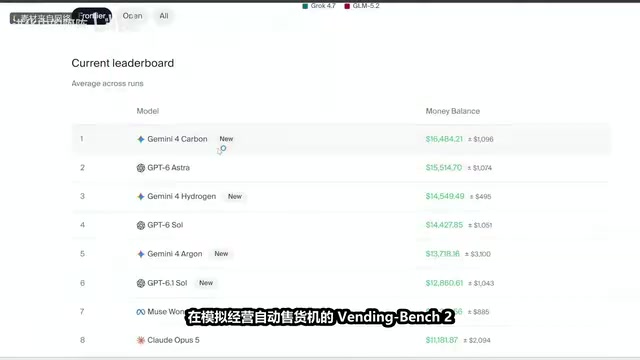
On the third-party composite intelligence index, Carbon scored 60, taking second place overall, edging out GPT-6 Astra, at an average bill of about $5.48 per question—2 to 5 times cheaper than the high-price tier of Claude Opus 5.5 and Fable 5.2. It took second on the pointer-dial reading test at 85%, still below the human average of just over 90%; third in maze navigation; third on the daily knowledge-work benchmark for finance, legal, and tax; third on software engineering at 61.2%, burning just over $61 per task—but the most economical in the top tier. Tests requiring long-horizon bookkeeping and 3D space actually shone: on the Vending Bench 2 simulation of automated vending machine operations, it earned over $16,000 for the highest score overall; on Blueprint Bench 2 converting 50 apartment photos into 2D curved floor plans, it scored 0.586, matching human level; and it also took first on the ultimate agent test with a dedicated framework.
On output speed, Carbon is faster than Fable 5.2 but slower than a batch of GPT models; yet on the composite intelligence index, average reasoning time per task hit 31.3 minutes, versus a median of 13.1 minutes among peers. Running long tasks on the ~$100/month Ultra subscription often means waiting one to two hours—the monthly entry fee feels heavy. The API enters Google AI Studio and Android development tools starting November 10, with a launch price of $2 per million input tokens and $10 output; after November 30 it reverts to $4 input and $20 output.
Composite intelligence index (as referenced in this article) generally refers to a benchmark suite built by independent evaluators, covering math, logic, knowledge Q&A, code, and multi-step reasoning, using standardized scores to compare large models. It is not equivalent to real development experience, because leaderboard scores are often obtained under controlled conditions and do not fully reflect stability on long tasks, tool-call failure rates, and wait times. Carbon's 60 points for second place at ~$5.48 per question, yet frequent rework in practice, precisely illustrates the gap between leaderboard ranking and engineering usability. Readers should combine task type, latency, and per-run cost when referencing such indices.
Light and Fast: Hydrogen and the Decisions API
Two days later, on November 12, Google released a lightweight new version, Gemini 4 Hydrogen, not focused on deep reasoning but on everyday coding and high-speed agent execution. It also supports 1M-token multimodal context with up to 1M-token output, and API pricing drops to $1.5 per million input and $7.5 output. The announcement states that under the same high-thinking mode, Hydrogen scores 51 on the composite intelligence index, beating the same-series Gemini 4 Argon's 50, which focuses on long-horizon reasoning; at the highest thinking level it can reach 54. With a new scheduler automatically switching between Carbon and Hydrogen in the same session, terminal coding test pass rates approach Carbon's while using 24% less quota and running 19% faster. Official examples include generating from one sentence a 3D block world you can walk around and add buildings to, a 3D online store for an outdoor water bottle with rotatable configurable appearance, and freezing thousands of spreadsheet cells into a pixel animation driven by code formulas. In comparison tables it beats the lightweight tier of Claude Sonnet 5.5 and GPT 6.1 Terra on multiple knowledge-work and web tasks. Besides AntiGravity (limited to paid Pro and Ultra), it's directly available to all users including the free tier across the Gemini app, Google Search, and AI Studio.
The Gemini Decisions API launched November 11 is backed by a custom Decision1 model that skips writing long responses word by word: it takes up to 256K tokens of images, documents, audio, and video in one shot, along with up to 1,000 yes/no or scoring questions, and answers them all in a single round. In a monitoring example, watching a clip lets it simultaneously answer whether liquid spilled, what to do next, and severity, with confidence scores per question for human review. End-to-end response latency is compressed to 150–250 milliseconds, output is billed at zero, and input costs just $0.1 per million tokens—the same input, no matter how many questions attached, is counted once. AI Studio offers a free trial quota, and on multi-decision evaluations it averages a win over TypeSafe Jeff 1.14, with individual items split.
Meta launched its smallest multimodal model, Muse Ember, on the same track, focused on document extraction, image classification, and small code tasks, also with 1M-token context and Responses API support. In the official workflow, a larger model acts as commander, dispatching 16 Muse Ember instances to caption, rename, and album-sort 10,000 camera photos; processing 5,632 photos cost about $0.72 total. API pricing has two tiers by total input per request including cache: within 200K tokens, $0.1 per million input, cached input as low as $0.004, output $0.5; above 200K, the whole request bills at $0.3 input, $0.012 cached, $1.5 output. It beats Claude Haiku 5.5 and GPT-6 Luna on same-tier tests; open weights not yet confirmed.
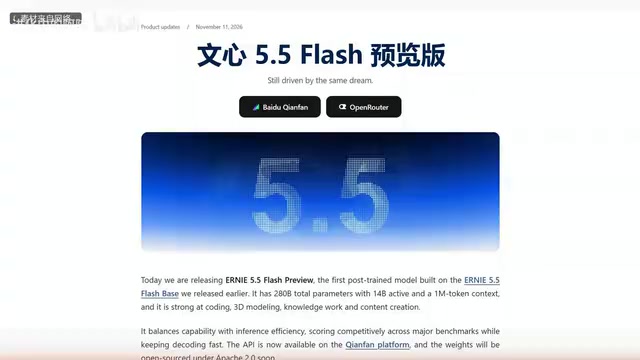
Baidu released the Wenxin 5.5 Flash preview on November 11: 280 billion total parameters with only 14 billion active per pass, 1M-token context. Official demos include an 11-hour C++ coding effort building a Zhangjiajie-style wuxia game "Yunxiu Xing" in Unreal Engine, plus an airport Blender 3D scene and prompt-to-full 2D animation. Baidu's self-reported scores are on par with top open-source rivals; the API is live on Qianfan and OpenRouter, and Baidu explicitly plans to open-source the weights under Apache 2.0 later.
Voice Interaction: A New Foundation for Listening While Speaking
Real-time conversational voice models are proliferating, with the common ability to respond before the other party finishes—listening and speaking simultaneously, handling interruptions at any time. Higurashi's open-source Haru 4B ingests and produces one frame of user and model speech and text every 133 milliseconds; it can chat with fillers like "mm" and "right" and laughter, shift tone with emotion, and naturally catch interruptions. Inference code and weights are available separately under Apache 2.0; it runs locally on about 12GB VRAM, with an Apple-silicon Mac version too—but it's a pretrained base without instruction-following dialogue fine-tuning: great for companionship, not for serious knowledge queries.
Fish Audio's Live 3 targets phone customer service and real-time web voice agents. In a simulated drive-thru ordering demo, the customer fires off orders rapid-fire and suddenly interrupts to swap the sugar-free cola in a Filet-O-Fish meal for iced coffee; Live 3 changes only that one drink, leaving the two Big Macs' ingredients untouched, and at the end recites all items and the $33.53 total exactly. Live on the official site and API; not open-sourced yet. On November 9, SoFone Realtime open-sourced code and weights under Apache 2.0, more focused on reading subtext: when the pancake order is interrupted at "flour" with "no eggs," it brakes within 0.36 seconds and offers yogurt as a substitute; a tense "I'm fine" is heard as forced composure; in "I didn't say he stole the money," it catches whichever word is stressed; even sarcastic "Great Monday" gets a chuckle before consolation. Of the three launch versions, Tag excels at emotion labels, Flash targets high concurrency, and E2E minimizes first-audio latency. In early comparison tests on a single 80GB GPU, E2E's first audio came at about 0.25 seconds and Flash at about 0.31 seconds; full Chinese and English support, with Japanese and Russian on Flash. On November 13, a Flash 4-bit quantized version was added, recommending at least 36GB unified memory, fully offline on Apple-silicon Macs.
Zephyr open-sourced ZONOS 3 mini on November 9, extremely light: 800 million total parameters, 100 million active per pass, under 1.8GB in size, Apache 2.0, running on cloud web, NVIDIA GPUs, Apple silicon, and pure CPU—even embedded in the browser locally via WebGPU. Official tests show first-audio latency below 570 milliseconds in a Pixel 9 phone browser and under 150 milliseconds on an Apple M3 laptop. One voice reference clones the timbre, and the same line can be tuned to American, British, haughty, young or middle-aged emotions, and breathy textures.
Real-time full-duplex voice models are fundamentally different from traditional "turn-based" voice interaction. Traditional voice assistants wait for the user to finish, transcribe speech to text, generate a reply with an LLM, and finally synthesize speech—a long pipeline that can't be interrupted. Full-duplex models receive and generate speech and text simultaneously at a fixed frame rate (e.g., Haru 4B's one frame per 133 milliseconds), enabling listening while speaking and interruption at any time. The technical challenge is modeling both the user's and the model's audio streams at once while maintaining semantic coherence and low latency. Key metrics for evaluating such models include first-audio latency, interruption response time, and voice naturalness—these directly determine whether they can be used in phone customer service, ordering, and other real-time scenarios.
Music and Vision: Open-Source Tools Fill Generation Gaps
ACE Music Gen 1 shot to the top of a third-party vocal-music blind-listening leaderboard, with a snapshot of 1,160 battle points, followed closely by SUNO V6 at 1,144.
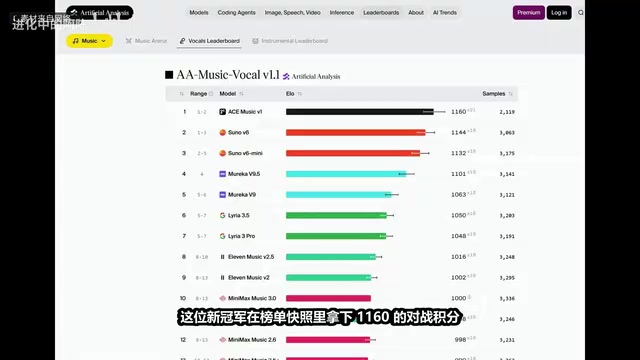
Given style text or your own lyrics, you can use bracketed commands in the lyrics to direct a line to be hummed softly or delivered in a raspy voice with guitar—from slow, spacious beats to fast continuous syncopation, it holds up. It's from the same family as the vocal software in Carbon's music test and is this week's separately released new model; after a song is made, the companion platform can split out vocals and individual instrument tracks for export and convert to MIDI for further editing. Web trial is live, and the official plan is to open-source a lightweight Flash model in late 2026.
On the image side, MiniMax released open-weight image model MiniMax H3 Image on November 11, porting the video model H3's foundation to images. In official examples, a native 4K square image at 4096 pixels per side (~16 megapixels) generates in under 10 seconds (official test claim; no universal local-device conditions given). It can ingest up to 16 reference images at once for outfit and scene swaps, handling natural-language editing, multi-view turnarounds of the same character, old-photo restoration and colorization, complex typographic text posters, and robotic-arm engineering line drawings; available via Hailuo AI Code and API.
Sperry team's Iris Z does three things with one set of weights: while drawing, it also computes a depth map indicating object distance; it reverse-derives depth maps from old photos; and with the same depth map it repaints the Roman Colosseum as an undersea ruin and as rainy neon. The large model version's average error on seven depth benchmarks is lower than the dedicated model Mog3, with individual items split. Weights and inference code are public; large weights ~64.4GB, small ~18.2GB, under the Flox non-commercial weight license.
In 3D reconstruction, open-source Budget 3D learns to be lazy: distinguishing empty background from key detail and concentrating compute on detail. In the research team's single-H100 batch-of-8-objects test, dropping the token budget from 100% to 40% cut per-object sampling time from 5.67 to 2.66 seconds on 50 standard-version objects—about 2.14x faster—and peak VRAM from 9.9GB to 7.8GB (sampling time only; Gaussian decoding and rendering extra). The Turbo version finishes sampling in under half a second; code and weights released, Apache 2.0, runs locally. Zhejiang University and Tencent Hunyuan's Splat Anything takes a few photos, multi-camera captures, or 360 panoramas and reconstructs viewable Gaussian 3D scenes from small ornaments to aerial city districts; main weights ~11GB, repo ~16.6GB total, model card says Apache 2.0 but the project page lists separate institutional registration terms—academic research, education, evaluation, and personal use need no registration.
On the video post side, open-source Reshoot 4D embeds the whole node and VFX workflow into ComfyUI: first reconstruct a dynamic space freely re-angleable along the timeline, then pull orbit, overhead, or dolly trajectories in a virtual camera editor, set focus, aperture, and vignette, and hand off to video model LTX2.3 to render new camera moves—changing depth-of-field blur without re-rendering the whole shot. Code is AGPL3.0 open source, models follow their original licenses; under the project page's test conditions, a single 24GB RTX 3090 takes about 30 minutes per shot. OpenH3 Regenerate 2K's open alternative can redraw directly to 1080P, 2K, or even native 4K; the reference-enhanced IC version no longer wipes and redraws but locks the low-res draft in reference context and fills in detail, reusing the original audio track, with facial features, lip sync, and text firmly aligned to the original. Code and local inference instructions are public, but hardware demands are not low.
Video Generation Acceleration: Four Studies Halve the Wait
MPAD Diffusion, joint research from UT Austin and Roblox, automatically selects foreground subjects for high-definition refinement while actively lowering background quality during generation. In a comparison benchmark running 720P 81-frame video on a 12,100,014B model, it achieved 4.8x speedup using only 30% of the tokens of the full-resolution approach; two other schemes with added region conditioning were faster at 5.2x but scored worse on several quality metrics. The same approach works on flux.24B.
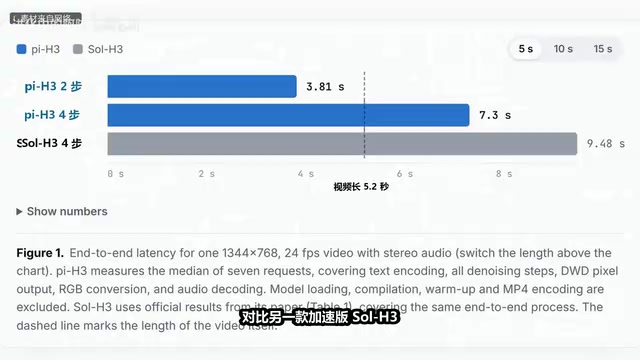
Stanford and others' PH3 operates on MiniMax H3, cutting sampling to 2–4 steps and removing the final pixel-decoding stage, outputting pixels plus stereo audio directly after the steps. Under specified test conditions on a single NVIDIA B200, the two-step mode spits out a 5-second 768P video with audio in 3.8 seconds and a 10-second video in 9.2 seconds—both faster than the video's own playback; a 15-second video takes 18.6 seconds. Versus the accelerated Saw H3, two steps are 2.4–2.7x faster and four steps 1.2–1.4x. An online demo is on Hugging Face; the team expects to release weights and inference code between November 16 and 22.
Roblox's Pixvid directly fine-tunes existing open-source video models, overturning the old "compress into an intermediate codebook then restore" rule in favor of a new pixel output layer painting frame by frame in final pixels. In controlled experiments at equal tokens per frame, it directly generates double-resolution frames; combined with depth-map control for video editing, a motocross bike at high speed stays frame-aligned, and button-control response latency drops from Solar WM's chunked output median of 400–495 milliseconds to 34 milliseconds—press and the next frame turns. Code and weights are in the upcoming release queue.
The Institute for Foundation Models (iFM) open-sourced world model PAN2 under Apache 2.0 on November 10, simulating up to 20 seconds of subsequent physical change from a starting image plus action descriptions or pure text—e.g., a train spinning around a tent, a wooden bowl, blue water poured into a glass container with wet paper. The repo is 86.2GB; online trial and local run are ready. It's for hypothetical simulation for robots or agents; demo visuals are model predictions and not experimentally verified physical laws.
Diffusion model sampling steps and decoders are key to understanding video acceleration research. Diffusion models typically require dozens of denoising iterations to generate video, then a decoder such as VAE restores the latent representation to pixels—both stages are extremely time-consuming. PH3 in this article cuts sampling to 2–4 steps and removes the final decoder, directly outputting pixels and stereo—a "few-step sampling + decoder-free" route; MPAD Diffusion reduces total compute by distinguishing foreground from background and allocating different token budgets to regions. The common idea is to compress computational redundancy while keeping quality acceptable, so evaluation must look at both speed multiples and quality metrics, not speed alone.
Robotics and Life Sciences: Tactile Interoperability, Molecular Prediction
Lingbo Tech's open-source Lingbot Touch tackles the problem of different robotic-hand sensors not sharing signals. Piezoresistive, magnetic, and vision-based tactile sensors used to be completely incompatible; Lingbot Touch trained a shared model on nearly 5,000 hours of tactile recordings so different robotic hands can directly share tactile experience—flipping photo albums, grabbing mahjong tiles, filling water cups, and plugging connectors all go smoothly, and even with vision occluded, two hands can coordinate by touch. The ultra-small model file is just 21.9MB and the small one 87.1MB; deployment still requires a physical robotic hand and sensors; code and weights are Apache 2.0 for commercial use.
Stanford's Flash Aloha speeds up robotic-arm work: instead of a joystick, the operator directly holds the backdrivable dual arms and demonstrates at normal speed hand-over-hand; each task needs only 50 human demonstrations with vision plus a lightweight smoothing algorithm for de-jitter, and training masks out the human operator in the frame, relying only on ordinary RGB input. The dual arms can then autonomously toss and catch balls, fold shorts with fingers, install batteries, and clear tableware at near-human hand speed, with success rates all above 80%. The full data collection, training, and inference code is MIT open source, with hardware designs published too.
Two life-science advances: Geodesic Intelligence delivered Nova Atom Light on November 10, predicting how proteins, nucleic acids, and small-molecule drugs fit into target pockets, with confidence scores for each local region and binding interface, helping drug discovery pick reliable candidates before wet experiments. On the FoldBench antibody–antigen interface subtask, official figures report 79.07% across all 172 cases, while AlphaFold3 cited on the same page is 47.90% across 167 evaluable cases—different denominators, corresponding only to this specific structural test.
Google DeepMind unveiled AlphaGenome2 on November 11. Nearly all human cells have identical DNA; what makes brain cells and immune cells differ is which genes are activated. Trained on over 100 million single-cell data points across 68 tissues, it predicts gene switches and mutation consequences given 1 million clipped letters and a specified cell type. Tested against existing research snapshots, it can infer never-seen new cell states—such as distinguishing immune T cells activated by COVID mRNA vaccines from resting cells—from just a few dozen cell samples without retraining. In a single-cell evaluation covering 28 immune cell types, it identified causal variants 30% of the time, nearly double the previous generation AlphaGenome's 16% after single-cell fine-tuning; directional gene-effect prediction rose from 23% to 43%, and in a review of known inflammatory bowel disease mechanisms it surfaced regulatory clues for gut macrophages activating specific genes. The API is open for non-commercial research, with commercial use in internal preview.
Protein–ligand/antibody–antigen structure prediction is a core task in AI drug discovery. Given a target pocket structure, the model must predict how a small-molecule drug or antibody binds, its binding pose, and confidence, to screen candidates before wet experiments. Common benchmarks like FoldBench score by metrics such as interface residues. Note that percentages reported by different models may be based on different case subsets and denominators; Nova Atom Light's 79.07% and AlphaFold3's 47.90% here have different denominators and cannot be directly compared. Such predictions are only for candidate ranking reference and still require experimental validation; confidence scores are more instructive for real decisions than a single overall score.
Hot and Cold: All-Around Flagship Still Maturing, Specialist Tools Cutting Prices
Having gone through all 24 releases, the hot-and-cold contrast is clear: Carbon, under intense hands-on use, revealed shortcomings in latency and stability; the other 23 are at various stages—open API, open code, open weights, or pending release. The 86.2GB world model and high-end-GPU-dependent video redrawing solutions still eat hardware, but $0.1-per-million-input batch APIs, browser-runnable on-device voice, and sub-100MB tactile models are indeed lowering the barrier and cost of using AI by a large margin. The most expensive all-around flagship is still maturing on stability, while specialist tools and open-source models are already rushing to bring down the barrier and cost for ordinary people.
Related articles

Gemini 4 Neon Review: Benchmark Scores Rival Carbon, API Pricing and Quota Breakdown
Google Gemini 4 Neon is now live, benchmark scores closely tracking Carbon, API pricing 3/15 at twice Hydrogen's rate. This article compiles Bilibili creator testing: Neon can replace 90% of Carbon scenarios, AntiGravity quota consumption is only one-third of Carbon, plus subscription channel restrictions and 2API ban risks.

Gemini 4 Helium Coming Soon? Signals of Google Loosening Subscription Restrictions
Google team member hints releases will continue; community speculates Gemini 4 Helium (Flash Lite) may be next. Subscription ban controversy gets a response as product lead says "Soon," suggesting restrictions may be lifted. This article covers Gemini developments, OpenAI Coding Agent and risk management, Doubao real-time audio-video API, and compute business dynamics.

AI-Assisted React Development in Practice: Optimizing a Video App and Handling Errors
A 14-year veteran developer demonstrates AI-assisted React video app optimization: compressing video from 80MB to 5MB (~94%) via ImageKit, plus reliable error handling and retry mechanisms. Includes planning, code understanding, and verification methods for working with AI.