AI Wiki Clones Are Hurting Your Favorite Wiki
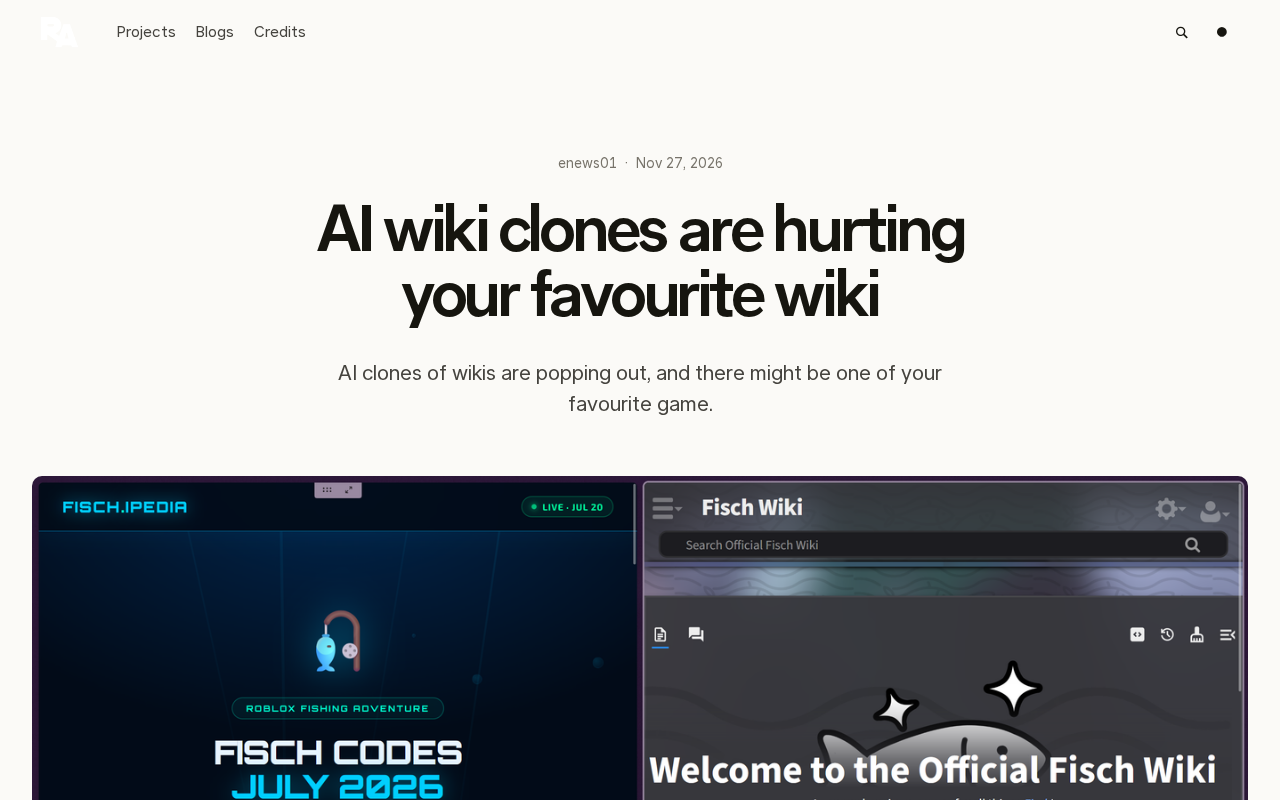
AI wiki clone sites divert search traffic and erode the community cycle of original wikis.
Starting from a Hacker News discussion, the article points out that AI-generated wiki clone sites scrape original wiki content, rewrite it, and publish it as standalone sites, diverting search traffic. By optimizing for long-tail queries, clone sites easily outrank original entries—especially damaging for small wikis that rely on search to find new readers. The impact extends beyond traffic: when search results are flooded with similar sites, new users struggle to identify the original source, weakening their sense of community and volunteers' motivation to contribute. The article recommends strengthening non-copyable elements like edit history and talk pages, using robots protocols and licensing terms to set boundaries, and pushing search engines to prioritize original sources, while helping readers recognize that the commitment to ongoing maintenance is the true moat.
When AI Starts Mass-Copying Wikis, the Original Communities Are Being Hollowed Out
A discussion on Hacker News titled "AI wiki clones are hurting your favourite wiki" has drawn attention. Though it didn't gain much traction, it points to a spreading problem: a large number of AI-generated wiki clone sites are diverting traffic and community resources away from the original wikis.
These clone sites typically scrape content from original wikis, rewrite or repackage it with AI, and publish it as standalone sites. To search engines, they look like "another information source"; to users, they may appear with a lower barrier to entry. But for the original wikis, this means visits, editing motivation, and donation support that should have flowed back to the community are quietly being siphoned off.
Wiki-style projects run on a fragile cycle: volunteers contribute content, content attracts readers, and readers' attention and donations feed back into the community. AI clone sites cut off the second half of this cycle—content is taken, but nothing comes back in return.
Why Clone Sites Gain Visibility
The reason AI-generated wiki clones can cause real harm lies primarily in the redistribution of search traffic. Clone sites often optimize for long-tail queries, breaking original wiki entries into structured pages that are easier for search engines to crawl. When a user searches for a specific concept, the clone site may rank above or alongside the original entry.
This diversion is especially devastating for small wikis. Large projects still have brand recognition, with users typing in the domain directly; but niche wikis rely heavily on search entry points, and once their rankings are diluted, the discovery path for new readers is essentially blocked. The Hacker News discussion, though brief, pinpoints exactly this asymmetry: clone sites replicate content at extremely low cost, while the original communities bear the full maintenance burden.
Long-tail queries refer to specific searches with low individual volume but extremely high variety—for example, the exact date of an obscure historical event or the configuration method for a niche piece of software. Compared to popular keywords, long-tail queries have low competition and insufficient content supply, so AI clone sites can easily rank for them simply by mass-generating structured pages. Wiki entries naturally cover a huge number of concepts and granular topics, making them a rich vein of long-tail queries. Clone sites break each entry into separate pages optimized for search intent, effectively occupying the search entry points that originally pointed to the source wiki at minimal cost—this is the technical reason they can rapidly gain visibility.
The Hidden Erosion of Editing Communities
Traffic loss is only the first layer of impact. The deeper problem is that clone sites change how potential contributors judge whether "this wiki is worth investing in." When search results are flooded with sites offering similar content, new users struggle to tell which is the original source, making it hard for them to develop a sense of belonging to any particular community.
Wiki editing culture is built on identity and collaborative history. Clone sites have no edit history, no talk pages, and no community norms—they offer only decontextualized information snippets. In the long run, this erodes the regenerative capacity of the entire wiki ecosystem—fewer and fewer people will be willing to spend time proofreading, adding sources, and mediating disputes.
Edit history (page history) is one of the most core mechanisms of wiki-style projects: it records the author, timestamp, summary, and diff of every change, making content traceable, auditable, and reversible. Talk pages carry the negotiation process between editors, and community norms gradually form within them. Together, these metadata constitute the "context" of content—readers can see not only conclusions but also how those conclusions were debated and verified. AI clone sites retain only the final text, discarding version history, discussions, and attribution, so they cannot present credibility sources or let readers participate in error correction. This is precisely the fundamental difference between clone sites and original wikis in terms of quality mechanisms.
How Open Source and Wiki Communities Can Respond
Facing AI clones, wiki communities are not entirely powerless. Several directions are worth considering: at the content level, strengthen the parts that cannot be copied, such as editorial discussions, version history, and community endorsement; at the technical level, use the robots protocol and content licensing terms to define boundaries; at the ecosystem level, push search engines to prioritize identifying original sources.
The more fundamental response is to make readers aware of the value of original wikis. Clone sites can copy text, but they cannot copy the commitment to ongoing maintenance. Making this clear may be the most practical moat for wiki projects in the AI era.
The robots protocol (robots.txt) is a text file in a website's root directory that tells crawlers which paths can be crawled and which should be avoided, but it relies on crawlers' voluntary compliance and has no enforcement power against malicious or rule-ignoring scrapers. Content licensing terms provide a legal boundary: for example, Creative Commons (CC) licenses typically require attribution and share-alike, so if a clone site fails to fulfill attribution obligations or adds restrictive terms, the original community can claim a license violation. In addition, search engines' original content or canonical link mechanisms can help algorithms identify the original source of content. Each of these methods has limitations; only by combining them can real constraints be formed.
Frequently Asked Questions
Will AI wiki clone sites replace the original wikis? A complete replacement is unlikely, but they will significantly divert search traffic, especially affecting small wikis that rely on search to discover new readers.
What can ordinary readers do? Prioritize visiting original wiki domains, participate in editing or donate, and report the original source to search engines when you encounter clone sites.
One-line Summary
AI wiki clone sites divert search traffic and erode the community cycle of original wikis.
Paragraph Summary
Starting from a Hacker News discussion, the article points out that a large number of AI-generated wiki clone sites are scraping original wiki content, rewriting it, and publishing it as standalone sites, thereby diverting search traffic. Clone sites optimize structurally for long-tail queries and easily outrank original entries, which is especially devastating for small wikis that rely on search entry points to gain new readers. The impact goes beyond traffic: when search results are flooded with similar sites, new users struggle to identify the original source and thus find it hard to develop a sense of community belonging, weakening volunteers' motivation to contribute. The article suggests that wiki communities strengthen non-copyable elements like edit history and talk pages, use the robots protocol and licensing terms to define boundaries, push search engines to prioritize original sources, and help readers recognize that the commitment to ongoing maintenance is the true moat.
Related articles

The Ultimate Form of Intelligence: From Black Hole Computers to the Universe's Final Question
Intelligence begins with survival but may end by reshaping the universe. This article explores the ultimate form of intelligence—from black hole computers to the Omega Point—and asks what intelligence is ultimately for.

Gift Guide for Book Lovers: Beyond Books, These Tech Gifts Are Worth Giving
Shopping for a book lover? Beyond books, e-readers, noise-cancelling headphones, reading lights, tablets, and styluses are worth considering. This guide covers buying advice for immersive, nighttime, and note-taking scenarios, plus tips on device habits and ecosystem compatibility before gifting.
The CES Travel Hack: Why This Portable Coffee Grinder Became a Tech Blogger's Go-To
A tech blogger ditches hotel coffee after years of CES and turns to travel coffee gear. This portable espresso grinder is on sale—here's why it's central to travel coffee setups and what to consider before buying.