AIGC Large Model Primer: From Prompts to Agent Practice, Fully Explained

From text generation to RAG and Agents, breaking down large model implementation paths and monetization cases.
Based on a Bilibili creator's beginner-friendly AIGC course, this article systematically lays out the complete implementation path of large model capabilities. Text generation is seen as the most basic and practical capability, with speech-to-text plus summarization enabling minute-level information distribution; prompt engineering has become standardized after official guides were released, and mastering structured expression covers most scenarios; multimodal generation for images, speech, and video already has monetization cases such as avatar-to-cartoon conversion, match commentary, and batch short videos. RAG knowledge bases use retrieval augmentation to make models answer based on specified documents, effectively suppressing hallucinations, and are suitable for legal statute matching and customer service product Q&A. AI Agents and system integration target multi-step complex tasks such as stock analysis, as well as analyzing chat records to improve conversion rates by identifying purchase intent. The article concludes with a beginner learning path: first get low-barrier pipelines working to build intuition, then understand RAG retrieval logic, and finally try Agent orchestration.
AIGC's capability boundaries are expanding rapidly, but many people's understanding of large models remains stuck at the "chat tool" level. A Bilibili creator systematically laid out the complete path from text generation and prompt engineering to RAG knowledge bases and AI Agents in a beginner-friendly course, and provided several side-hustle and efficiency-boosting cases that can be directly implemented. This article is based on that course content and offers an in-depth breakdown from a technical perspective.
1. Text Generation: The Underrated Workplace Fundamental
The course opens with a judgment: text output is the most basic and most practical capability of large models. The creator gave a real scenario — the boss speaks at a meeting, speech-to-text generates a summary, and within one minute of the speech ending the summary has already been sent to the company group chat. This "speech-to-text then summarize" pipeline requires almost no additional development, yet it can raise workplace information flow efficiency by an order of magnitude.
The same capability extends to content creation. The course mentions that some students, after finishing the course, went to novel websites to create short stories, trying to monetize at a unit price of twenty to thirty yuan. The creator's view is that text generation can serve both as an efficiency tool and as a low-cost entrepreneurial project; the key is to embed model capabilities into specific workflows rather than stopping at "have it write a paragraph."
2. Prompt Engineering: From Hype to "Good Enough"
Regarding Prompt Engineering, the creator offered a pragmatic observation: after ChatGPT officially released its prompt guide, community discussion around "prompt engineering" cooled noticeably, because the official guide already provided six major categories of approaches. But the official documentation is lengthy, so the course compressed it into the core points of a two-page PPT for learners to apply directly.
The industry trend implicit here is that prompts are shifting from a "mystical art" into a built-in product capability. Model vendors are lowering the barrier to use through documentation and default behaviors; ordinary users do not need to dig into complex frameworks — mastering structured expression (role, task, constraints, examples) is enough to cover most scenarios. What truly creates differentiation is what comes next: RAG and Agents.
3. Multimodal Generation: Real-World Cases for Images, Speech, and Video
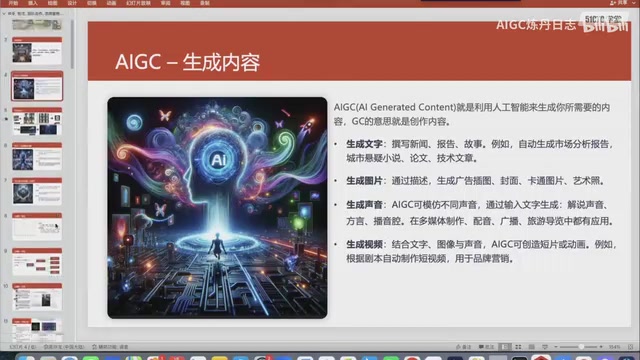
The course demonstrates concrete ways to use AIGC on the image and video side. For images, this includes advertising illustrations, cartoon avatars, and artistic photos; the images shown on site by the creator were generated by ChatGPT's image capabilities. For speech, converting video to text and then calling a large model to generate narration audio has already been used for football match commentary content. For video, using a large model to write scripts and combining with editing tools like CapCut plus image composition can mass-produce "web-novel-style animated" short videos.
Even more instructive is the IP derivative approach: GIF generation leverages the code interpreter to slice and reorder a nine-grid image and play it frame by frame. The tedious manual image-assembly process of the past can now be completed with a single prompt. The creator also mentioned that a student was selling a real-photo-to-cartoon-avatar service on Taobao, priced at 9.9 yuan, starting from a volume of about a dozen orders a day in the early days — this kind of asset-light model validates the commercial viability of "model capability plus simple packaging."
4. RAG Knowledge Bases: Making Large Models Stop "Making Things Up"
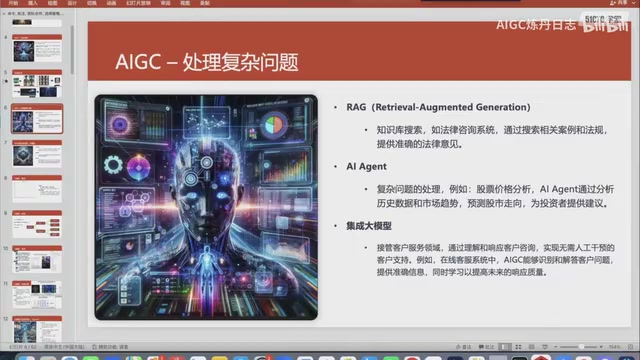
The course divides large model applications into two schools: 2C and 2B. 2C focuses on content generation and individual monetization, while 2B targets enterprise planning and complex problem solving, with RAG (Retrieval-Augmented Generation) as a representative technology. The creator used an "enterprise legal statutes database" example: when handling a lawsuit, you input the case facts into the knowledge base, and the system automatically matches relevant statutes instead of letting the model fabricate from memory.
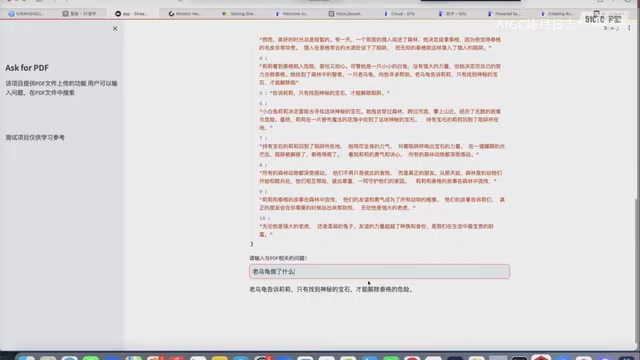
To demonstrate how RAG suppresses hallucinations, the course used a PDF Q&A case: upload a PDF of a fairy tale about Tiger and Lily, and the system splits it into about 11 chunks. Asking the Baidu Qianfan model directly "What is the relationship between Lily and Tiger," the model has no idea; but after retrieval via the knowledge base, the model can accurately answer "friends." When asked "What did the old turtle do," the knowledge base likewise provided the original answer: "Only by finding the mysterious gem can Tiger be rescued."
This mechanism is even more directly valuable in customer service scenarios. The creator demonstrated a customer service assistant built with a custom GPT: after uploading a TXT product document for "Haomenglai" duvet covers, when asked for a product introduction, the model prioritized information from the document library rather than dumping generic duvet cover knowledge from the internet onto the user. For enterprises, this means they can control what the model "should say" and precisely convey recommended products and business information through the knowledge base.
What Is "Hallucination"
Hallucination refers to content generated by a large model that appears plausible but is inconsistent with facts or with the given context. It stems from the fact that the model is essentially predicting the next word based on probability rather than querying a factual database, so when training data is missing or a question exceeds its knowledge scope, the model "makes up" an answer. RAG turns "answering from memory" into an "open-book exam" by first retrieving relevant snippets from an external document library and then having the model answer based on those snippets, thereby significantly reducing the hallucination rate. Common ways to measure hallucination include manual verification, comparison with reference answers, and having the model cite the source of its answer.
Vector Retrieval and Text Chunking
One of the core steps of RAG is retrieval. Documents are usually first split into several text chunks, then converted into vectors via an embedding model and stored in a vector database; when a user asks a question, it is likewise converted into a vector, and the most relevant chunks are recalled through similarity computation. Chunk size directly affects performance: too large a chunk introduces noise and makes retrieval imprecise, while too small a chunk loses context. In the course, the PDF being split into about 11 chunks is exactly an embodiment of this process. Beyond vector retrieval, there are also sparse retrieval methods such as keyword-based BM25, and real systems often combine the two.
5. AI Agents and System Integration: Solutions for Complex Problems
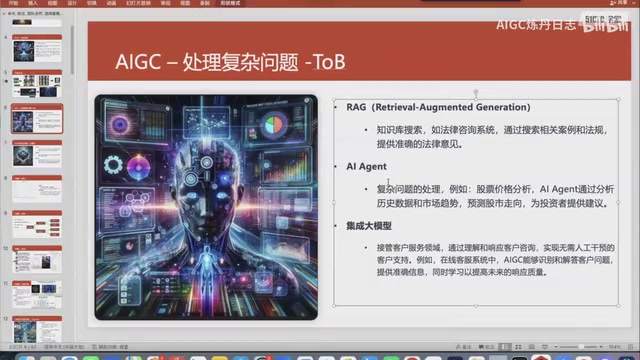
For complex tasks such as stock analysis, a single prompt is powerless. The course broke down the complete pipeline: first locate a stock price data website; downloading the data requires writing code; the code may error and require supervised reruns; once the data is downloaded it must be compared with historical data; the comparison also relies on code; and finally charts must be generated to support investment advice. This chain of steps involves multiple stages — data fetching, error correction, comparison, and visualization — which is exactly where AI Agents come in. The course mentions introducing Microsoft's AutoGen architecture to orchestrate such multi-step tasks.
Another path is integration. A large number of enterprise systems (APPs, OA, internal management systems) were developed years ago, and connecting them to large models can give them new capabilities. The creator shared a customer service system case: analyzing purchase intent from customer chat records and extracting high-intent customers to improve conversion rates. Compared with the past, when the system could only handle symbolic Q&A like "Is shipping included" or "How many days for returns," this kind of intent recognition based on conversation data is the real incremental value of large model integration.
AutoGen and Multi-Agent Orchestration
AutoGen is Microsoft's open-source multi-agent framework. Its core idea is to break complex tasks down and have multiple agents with different roles and tools collaborate to complete them. Developers can define roles such as "the agent that writes code," "the agent that reviews code," and "the agent that executes code," with the framework managing the conversation and message passing among them, and actually running the generated code through a code executor and feeding errors back to the agents for correction. This aligns closely with the "data fetching — error correction — comparison — visualization" pipeline in the course. Compared with a single Agent, multi-agent orchestration is better at tasks requiring division of labor, mutual checking, and iteration, but it also brings engineering challenges such as high token consumption, complex debugging, and unstable convergence; in practice, it usually requires setting maximum rounds and termination conditions.
Function Calling and Tool Use
A large model itself can only generate text and cannot directly query databases, call APIs, or execute code. The Function Calling mechanism lets the model output structured call requests when needed, which external programs execute and then pass the results back to the model, forming a "think — act — observe" loop. This is both the technical foundation of Agents and the key to enabling "system integration": by wrapping the interfaces of enterprise OA, customer service, and CRM systems into tools the model can call, the model can trigger real business actions during a conversation. Understanding this mechanism helps distinguish "what the model can say" from "what the system can do," and is also a basic prerequisite for evaluating whether an Agent solution is feasible.
6. Course Knowledge Map and Learning Advice
Taken together, this course covers a clear main line: text and multimodal generation build the foundation, prompt engineering lowers the barrier, RAG knowledge bases address accuracy and enterprise data access, AI Agents handle multi-step complex tasks, and system integration embeds capabilities into existing business flows. The creator's overall understanding of AIGC can be summarized as — generating and understanding text, images, sound, and video in ways humans can understand, and improving production efficiency at the level of knowledge bases and process automation.
For beginner learners, the recommended path is to first get a low-barrier pipeline like "speech-to-text plus summarization" working to build intuition, then use PDF Q&A to understand RAG's retrieval logic, and finally try using an Agent to orchestrate a small multi-step task. Tools will continue to iterate, but the methodology of "mapping model capabilities to specific scenarios" is the real value of this content.
One-line Summary
From text generation to RAG and Agents, breaking down large model implementation paths and monetization cases.
Paragraph Summary
Based on a Bilibili creator's beginner-friendly AIGC course, this article systematically lays out the complete implementation path of large model capabilities. Text generation is seen as the most basic and practical capability, with speech-to-text plus summarization enabling minute-level information distribution; prompt engineering has become standardized after the release of official guides, and mastering structured expression covers most scenarios; multimodal generation for images, speech, and video already has monetization cases such as avatar-to-cartoon conversion, match commentary, and batch short videos. RAG knowledge bases use retrieval augmentation to make models answer based on specified documents, effectively suppressing hallucinations, and are suitable for legal statute matching and customer service product Q&A. AI Agents and system integration target multi-step complex tasks such as stock analysis, as well as analyzing chat records to improve conversion rates by identifying purchase intent. The article concludes with a beginner learning path: first get low-barrier pipelines working to build intuition, then understand RAG retrieval logic, and finally try Agent orchestration.
Related articles

64 Releases in 40 Days: How Strata Uses Release Velocity to Define Its AI Local Inference Roadmap
Strata shipped 64 releases in 40 days with 460k+ characters of notes. From 0.1.0 to 0.2.10, a three-step path: make it run, make it fast, make it trustworthy.
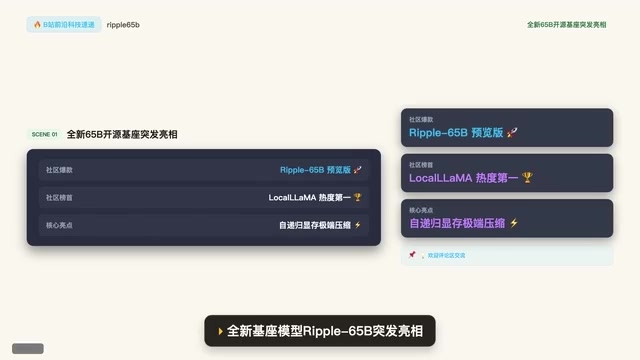
Ripple-65B Open-Source Model Tops Community Charts
Ripple-65B open-source LLM debuts atop community charts, using a self-recursive architecture to slash long-context KV cache for low-latency hundred-billion-scale inference on ordinary GPUs, with preview weights, quantized files, and one-click Olema & VLM deployment.

Deploy Open-Source Video Model MiniMax H3 Locally in 5 Minutes and Skip Cloud Generation Fees
Bilibili creator tests local deployment of open-source video model MiniMax H3: three-step ComfyUI install, 5-minute setup, no coding. Same prompt generates in 2 minutes locally vs 4 minutes online with queuing, saving about 30 RMB per 15-second 720P video. Includes VRAM requirements and RTX 5080 test results.