AirAlarm Review: Using AirPods Instead of Apple Watch for Sleep Cycle-Based Wake-Up

AirAlarm uses AirPods instead of Apple Watch to wake you gently at the end of a sleep cycle.
AirAlarm is an iOS app that turns your iPhone and AirPods into a sleep cycle-aware alarm clock without requiring an Apple Watch. It uses a 90-minute sleep cycle algorithm with a wake-up window to rouse you during light sleep, reducing sleep inertia. The app features built-in sleep sounds, supports personal media playback, and takes a strong privacy stance with no accounts, no ads, and no cloud data — all processing stays on-device.
AirAlarm: A Counterintuitive Sleep Alarm App
While the entire wearable market is encouraging users to buy smartwatches and strap on various sensors to monitor their sleep, AirAlarm takes the opposite approach. This iOS app, which reached #6 on Product Hunt (98 upvotes, 6 comments), centers on a single core concept: wake you up at the end of a sleep cycle — without requiring an Apple Watch.
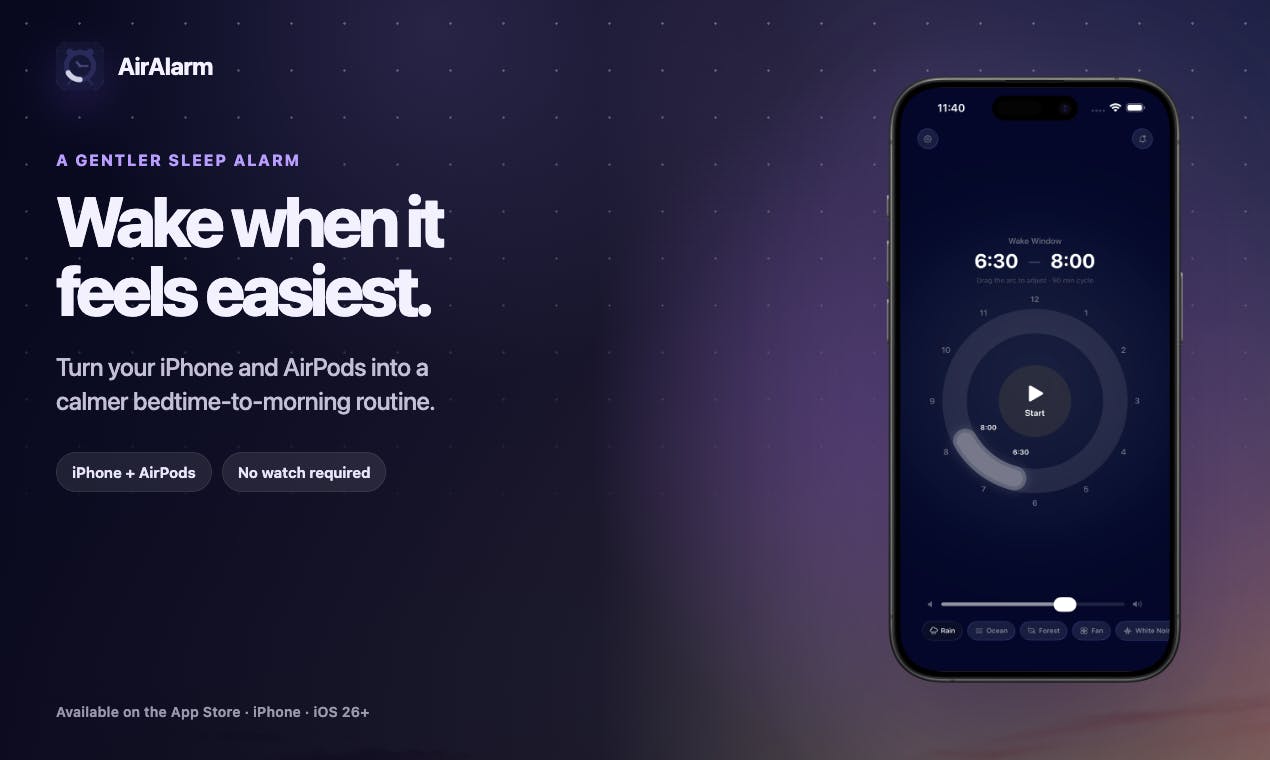
Its product positioning is remarkably restrained — turning your iPhone and AirPods into a gentler sleep alarm. Users set a "wake-up window," fall asleep accompanied by built-in sounds or their own media, and the app wakes them at the end of a 90-minute sleep cycle. The developer is 張詩楓 (カエデエエエ), and the product is categorized under iOS, Health & Fitness, and Audio.
Why "Sleep Cycle Wake-Up" Instead of a Fixed-Time Alarm
Human sleep isn't a uniform state of consistent depth. Rather, it consists of multiple cycles of approximately 90 minutes each, with every cycle passing through light sleep, deep sleep, and rapid eye movement (REM) stages.
This cyclical structure of sleep was first discovered by sleep research pioneers Nathaniel Kleitman and Eugene Aserinsky in 1953 through electroencephalogram (EEG) observations. Modern sleep medicine divides a complete cycle into four stages: N1 (sleep onset, lasting 1-5 minutes, with brain waves transitioning from alpha to theta waves), N2 (light sleep, lasting 10-60 minutes, featuring sleep spindles and K-complexes), N3 (deep sleep/slow-wave sleep, lasting 20-40 minutes, dominated by delta waves, during which the body performs tissue repair and growth hormone secretion), and REM (rapid eye movement, lasting 10-60 minutes, with brain activity approaching waking levels, the primary stage for dreaming). A typical night involves 4-6 complete cycles, and as the night progresses, the proportion of deep sleep gradually decreases while REM proportion increases. It's precisely this structural characteristic that gives the "wake at the end of a cycle" strategy its scientific foundation.
The Cost of Being Woken During Deep Sleep
Traditional alarms go off at the exact time you set, with zero regard for which sleep stage you're currently in. If you happen to be forcibly awakened during deep sleep, you'll experience what's known as "sleep inertia" — that groggy, sluggish, irritable feeling after getting up that can persist for dozens of minutes.
Sleep inertia is a neurophysiological phenomenon validated by extensive research. A systematic review published in Sleep Medicine Reviews in 2019 showed that cognitive function (including reaction time, working memory, and decision-making ability) can decline by 20%-50% after being woken from N3 deep sleep, with this impairment lasting anywhere from 15 minutes to 4 hours. A NASA study even found that severe sleep inertia can impair cognitive performance to a degree comparable to legal intoxication. In contrast, waking from N1/N2 light sleep or the end of REM significantly reduces the impact of sleep inertia.
AirAlarm's approach: rather than waking you at a single fixed point in time, it provides a "wake-up window" and wakes you within that window when you're at the natural end of a cycle (near light sleep or a waking state). In theory, this can significantly reduce sleep inertia and help you feel more refreshed upon waking.
The Trade-offs of the 90-Minute Sleep Cycle Algorithm
An important detail: 90 minutes is merely a statistical average, and individual variation is substantial — some people's cycles may be 80 minutes, while others approach 110 minutes. Research also shows that a single person's sleep cycle length varies within the same night — cycles in the first half of the night typically contain more deep sleep, while later cycles are REM-dominant, and overall duration may fluctuate as well. AirAlarm's combination of a fixed 90-minute cycle plus a "wake-up window" is essentially an engineered approximation — using the window's margin of error to compensate for imprecise cycle estimation. This also explains why it emphasizes a "window" rather than a "precise time."
Using AirPods Instead of Apple Watch for Sleep Monitoring
This is AirAlarm's most interesting technical choice. Mainstream sleep tracking solutions on the market — Apple Watch, Oura Ring, Fitbit — all rely on body-worn sensors (heart rate, body movement, blood oxygen, etc.) to determine sleep stages.
AirAlarm explicitly states it doesn't require an Apple Watch, instead leveraging the iPhone and AirPods — two devices most iOS users already own. While the official copy doesn't detail the exact detection mechanism, based on its product form, it likely combines the iPhone's motion sensors, microphone ambient sound, and AirPods' wear and motion data for comprehensive assessment — or it may simply employ a time-window-based heuristic algorithm rather than strict physiological signal monitoring.
It's worth noting that since AirPods Pro 2nd generation and AirPods 3, Apple has integrated increasingly more sensors into its earbuds — including a six-axis inertial measurement unit (IMU, with accelerometer and gyroscope), skin detection sensors, and the microphone array required for adaptive transparency mode. Apple also enabled "Conversation Awareness" for AirPods Pro 2 in iOS 17, demonstrating that its microphones and motion sensors can detect the user's subtle movements and environmental changes in real time. Theoretically, these sensors could capture micro head movements during sleep (a form of body movement signal), and body movement signals are precisely the core basis many non-medical-grade sleep monitoring devices use to determine sleep stages — the deeper the sleep, the less body activity. However, Apple's sensor APIs available to third-party developers are limited in scope, meaning AirAlarm may not have access to raw data as rich as that available to dedicated wearable devices.
The value of this "lightweight" approach: it reduces the barrier to sleep optimization to virtually zero — no extra hardware to buy, no potentially uncomfortable watch to wear while sleeping, just a pair of AirPods. For the large number of people unwilling to invest in a smartwatch solely for sleep, this is a remarkably pragmatic entry point.
Privacy First: No Accounts, No Ads, No Cloud Data
In the product description, the developer uses a series of "No's" to define AirAlarm: no accounts, no ads, no analytics tracking, no cloud sleep profiles.
This is a distinctive stance among health-related apps today. The vast majority of sleep apps require you to register an account, upload sleep data to the cloud, and use it to build long-term user profiles — yet sleep data happens to be among the most sensitive categories of personal health information. AirAlarm chooses to keep all processing on the local device and builds no cloud-based sleep profiles, meaning your schedule patterns and time-to-fall-asleep data never leave your iPhone.
AirAlarm's "no cloud" strategy echoes an important trend in software architecture in recent years — Local-First Software. This concept was systematically articulated by Martin Kleppmann and colleagues at the Ink & Switch lab in their 2019 paper of the same name. The core argument is that user data should be stored and processed primarily on local devices, with the cloud serving only as an optional sync channel. In the health data domain, this architecture is particularly important: the EU's GDPR and the US's HIPAA regulations impose strict restrictions on the collection, storage, and cross-border transfer of health data. While sleep data may not legally be classified the same as clinical medical records, it can reveal a user's daily routines, health status, and even psychological state — making it highly sensitive behavioral biometric data. Choosing local processing not only avoids compliance risks but also eliminates the attack surface for data breaches.
For users who increasingly care about data sovereignty, this "local-first, zero-tracking" design is itself a selling point. It also reflects a common advantage of indie developer products: without the commercial pressure to monetize data, they can create purer, more privacy-respecting tools.
AirAlarm's Sleep-Onset Experience Design
Beyond the wake-up mechanism, AirAlarm also addresses the falling-asleep phase. It includes built-in sleep sounds while allowing users to play their own media content (such as favorite podcasts, white noise, or music) to accompany them to sleep.
When used with AirPods, this closed-loop experience of "sound companionship while falling asleep, gentle awakening when it's time to get up" feels quite natural. Sound plays privately through the earbuds without disturbing a bed partner — a point that makes it more practical than phone speakers or bedside smart speakers in shared bedroom scenarios.
AirAlarm's Position in the Sleep App Market
The global sleep technology market was valued at approximately $15 billion in 2023 and is projected to exceed $40 billion by 2030. On the mobile app level, Sleep Cycle (developed by Sweden's Northcube, with over 50 million downloads worldwide) is the benchmark product in the sleep cycle alarm category, using the iPhone's microphone or accelerometer to detect body movement and determine sleep stages; Pillow (developed by Greece's Neybox) deeply integrates Apple Watch and HealthKit data. On the hardware side, Oura Ring (Finland, retail starting at approximately $299) and Whoop (US, subscription-based at approximately $30/month) represent the premium tier of dedicated wearable devices.
AirAlarm's "zero hardware investment" positioning neatly fills the gap for users who don't want to buy dedicated devices but still want to optimize their wake-up experience. Compared to mature competitors like Sleep Cycle, AirAlarm differentiates itself by using AirPods as the core interaction hardware rather than relying solely on the iPhone, while simultaneously using an extreme privacy stance as its brand identity.
Summary: Who Is AirAlarm For?
AirAlarm isn't a product trying to revolutionize sleep science. It's more of a scenario-specific tool that cleverly combines a mature concept (sleep cycle wake-up) with ubiquitous hardware (AirPods). Its trade-offs are clear:
- Trading the tolerance of a "time window" for the convenience of not needing dedicated sensors;
- Trading "local processing, zero tracking" for user trust;
- Trading "no accounts, no ads" for a minimalist user experience.
For those who are rudely jolted awake by their alarm every day but don't want to buy a smartwatch to fix it, this app offers a low-cost option to try. Whether it can truly improve the wake-up experience ultimately depends on the accuracy of its sleep stage detection — a challenge shared by all lightweight solutions of this kind. But from a product philosophy standpoint, AirAlarm demonstrates how indie developers can use restrained design to solve a specific life pain point just right.
Related articles

Frontend to AI Agent Development: A Frontline Architect Explains Career Paths and Opportunities
A frontline AI architect explains the industry changes and practical paths for frontend developers transitioning to AI Agent development: why pure frontend jobs are disappearing, why Agent + full-stack has become mainstream in hiring, and three transformation routes—Agent development engineer, FDE, and remote contracting—along with corresponding learning strategies.

How to Choose an AI Agent Development Course: Five Pitfall-Avoidance Guidelines
A mechanical-engineering career changer's two-year pitfall-tested checklist for screening AI Agent development courses: complete delivery pipeline, resume-worthy projects, real development perspective, update frequency, and coaching feedback—with concrete judgment methods and pitfall-avoidance tips.

Coze AI Agent Building for Beginners: A Zero-Code AI Agent Development Guide
Coze, ByteDance's one-stop AI application development platform, supports zero-code drag-and-drop AI agent building. This article outlines Coze's core concepts, three advantages, differences between the domestic and international versions, and the distinction between agents and apps, helping beginners quickly get started with AI Agent development.