MyClaw 3.0: Building an Always-On AI Team with Shared Memory
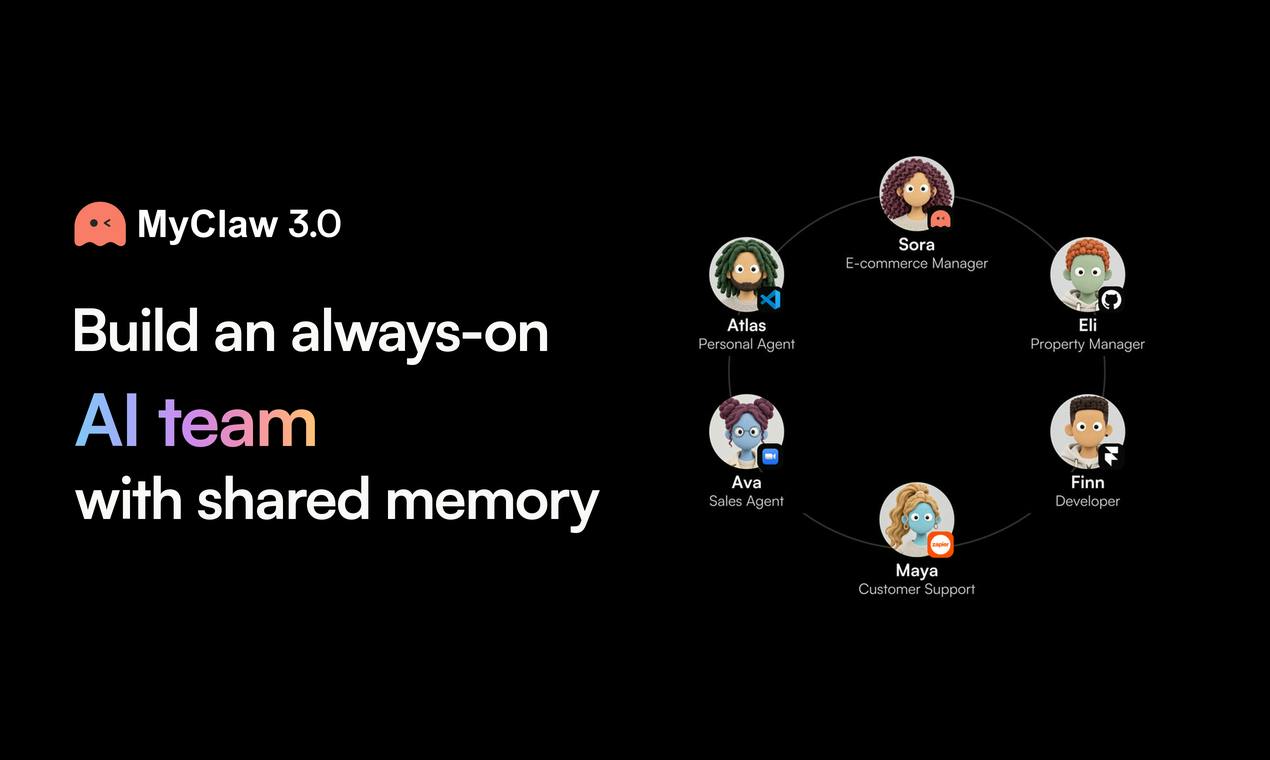
MyClaw 3.0 builds an orchestratable heterogeneous AI team with shared memory and always-on cloud agents.
MyClaw 3.0 topped Product Hunt with 153 upvotes by pitching an always-on AI team with shared memory. It orchestrates heterogeneous agents like OpenClaw, Claude Code, and Codex, each with its own role and tools, while shared memory lets context and experience flow across agents. It offers 50+ models with no vendor lock-in, runs agents on always-on cloud computers, and supports task dispatch via Web, Slack, Telegram, and WhatsApp. Shared memory and heterogeneous compatibility are core differentiators, but memory consistency, permission isolation, and multi-agent observability remain key challenges for production use.
From Solo Work to Team Collaboration: MyClaw 3.0 Redefines AI Agents
MyClaw 3.0, which topped Product Hunt's daily leaderboard with 153 upvotes, puts forward an ambitious concept: "Build an always-on AI team with shared memory." This is not just another wrapper chat tool—it attempts to solve the core pain points in current AI agent applications: siloization and failing when offline.
Traditional AI assistants are often confined to a single conversation window, with state reset to zero once the task ends. MyClaw 3.0's differentiation lies in allowing users to orchestrate multiple heterogeneous agents (supporting OpenClawAd, Claude Code, Codex, Hermes Agent, Pi, and more), assigning each "teammate" an independent role, toolset, and skill, while keeping context synchronized across the team through a shared memory mechanism. This means information obtained by a research-focused agent can be directly called upon by an execution-focused agent, without manual copy-pasting.
Heterogeneous Model Compatibility: No Vendor Lock-In
MyClaw 3.0 offers more than 50 model choices at the model layer, letting users match the most suitable engine to different roles based on task nature. For example, code generation tasks might lean toward Claude Code, while everyday tasks requiring fast responses might use a lighter model. This "no vendor lock-in" design philosophy seems especially pragmatic amid today's fragmented AI ecosystem. Users don't have to subscribe to a full suite just to access a specific feature, nor do they need to worry about a single platform's price hikes or outages disrupting their business.
Always-On Cloud and Multi-Channel Access
The product emphasizes that agents run on "always-on cloud computers"—even when users are offline, agents can continue using authorized applications, accessing data, and handling periodic tasks. This is crucial for automated workflows: AI is no longer a dialog box passively waiting for instructions, but rather like a real team member who keeps pushing the project forward while you sleep.
The diversity of task dispatch channels is also noteworthy. Users can issue work instructions via the web interface, Slack, Telegram, or WhatsApp, lowering the barrier to use and letting the AI team fit into existing collaboration habits rather than forcing users to migrate to a new platform. The official description explicitly mentions "no server setup required," further minimizing the technical barrier.
AI Agent refers to a software entity capable of perceiving its environment, making autonomous decisions, and invoking tools to execute tasks. Unlike chatbots that merely respond passively, it typically possesses planning, tool-use, and memory capabilities. Most current agent products operate in a single-session, stateless mode, where context is cleared after a task completes, preventing information from being reused across tasks and applications—creating so-called "siloization." In addition, most agents rely on users triggering them while online, and stop working once the user goes offline—that is, "failing when offline." The always-on team and shared memory proposed by MyClaw 3.0 are design responses to these two structural flaws.
Shared Memory: The Glue of Team Intelligence
MyClaw 3.0's core selling point—shared memory—is in fact a key step toward making multi-agent systems practical. In architectures lacking shared memory, each agent is an information silo, and team collaboration degrades into "multiple solo operatives each fighting alone." By letting memory flow at the team level, MyClaw attempts to achieve true context transfer and experience reuse.
However, shared memory also brings new challenges: memory conflict resolution, permission isolation, and context bloat during long-running operation are all areas the product needs to keep refining. Based on currently public information, MyClaw 3.0 has not yet disclosed technical details of its memory architecture, which will be key to determining whether it can move from "impressive demo" to "production-ready."
Multi-Agent System is a collaborative architecture composed of multiple agents with independent goals and capabilities, where agents work together on complex tasks through message passing, task allocation, and shared state. Typical patterns include pipeline-style division of labor (e.g., research, execution, and review handled by different agents) and the blackboard pattern (agents read from and write to the same shared space). Shared memory plays the role of the "blackboard" in a multi-agent system, allowing one agent's output to be directly consumed by other agents, thereby reducing redundant work and manual relaying. But this brings engineering challenges such as memory consistency, access permissions, and context window bloat—important dimensions for evaluating whether such systems are production-grade usable.
Market Positioning and Competitive Landscape
MyClaw 3.0 targets a fast-growing niche within AI productivity tools: multi-agent orchestration platforms. Compared with single AI coding assistants or general-purpose chatbots, it places more emphasis on the "team" concept and "always-on" capability. Its Product Hunt performance—153 upvotes, 27 comments, and first place for the day—indicates that this concept hits a real need for some users, especially small teams and independent developers who need to handle repetitive cross-application workflows.
But objectively, the complexity of multi-agent systems also means higher debugging costs. When five agents run simultaneously, the probability of errors and the difficulty of troubleshooting rise non-linearly. Whether MyClaw 3.0 can provide sufficient observability tools (logs, tracing, replay) will directly affect user experience.
Conclusion
MyClaw 3.0 represents a trend: AI applications are evolving from "conversational assistants" to "always-on digital labor." Shared memory and heterogeneous model compatibility are its two most valuable differentiators. If the team can keep investing in memory consistency and multi-agent observability, this kind of product has the potential to become standard equipment for future knowledge workers.
One-line Summary
MyClaw 3.0 builds an orchestratable heterogeneous AI team with shared memory and always-on cloud agents.
Paragraph Summary
MyClaw 3.0 topped Product Hunt's daily leaderboard with 153 upvotes, centered on an "always-on AI team with shared memory." It lets users orchestrate multiple heterogeneous agents such as OpenClaw, Claude Code, and Codex, assigning each agent an independent role, tools, and skills, while enabling context and experience to flow among agents through team-level shared memory. At the model layer it offers more than 50 choices and emphasizes no vendor lock-in; agents run on always-on cloud computers, so periodic tasks can continue even when users are offline, and instructions can be dispatched via Web, Slack, Telegram, and WhatsApp. The article argues that shared memory and heterogeneous compatibility are its core differentiators, but memory consistency, permission isolation, and multi-agent observability remain key challenges on the path from demo to production readiness.
Related articles
Building a VR Starship with an AI Agent Team: A Multi-Agent Collaboration Chronicle
A creator built Star Trek's Enterprise-D in VR from scratch using an AI agent team of Claude Code and Codex—breaking down roles, rules, and bottlenecks.
Airbot: The Proactive AI Chief of Staff That Messages You First, So You Can Escape Notification Overload
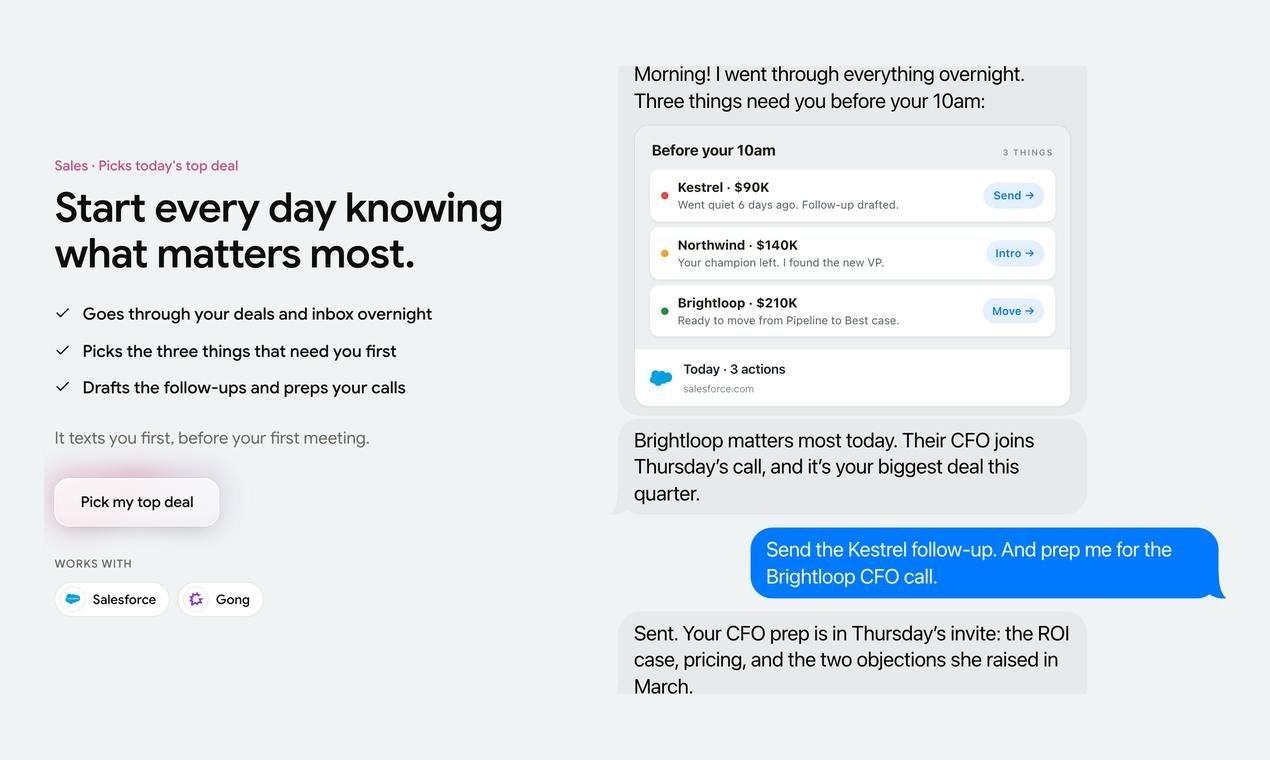
Airbot is a proactive AI chief of staff that aggregates email, Slack, calendar, and CRM, pushing priority items with drafted replies and meeting briefs to WhatsApp or iMessage for one-tap approval.

Schumer's Leadership Controversy: Tactics or Communication?
Based on a YouTube video, this explores Senator Schumer's leadership controversy: is it a matter of tactics or communication? It covers taxes, healthcare policy, and primary interventions.