AiSOC: An Open-Source AI Security Operations Center with LLM Agent Triage and a Replayable Decision Ledger

Open-source, self-hosted AiSOC uses LLM agents to triage alerts and keeps a replayable decision ledger.
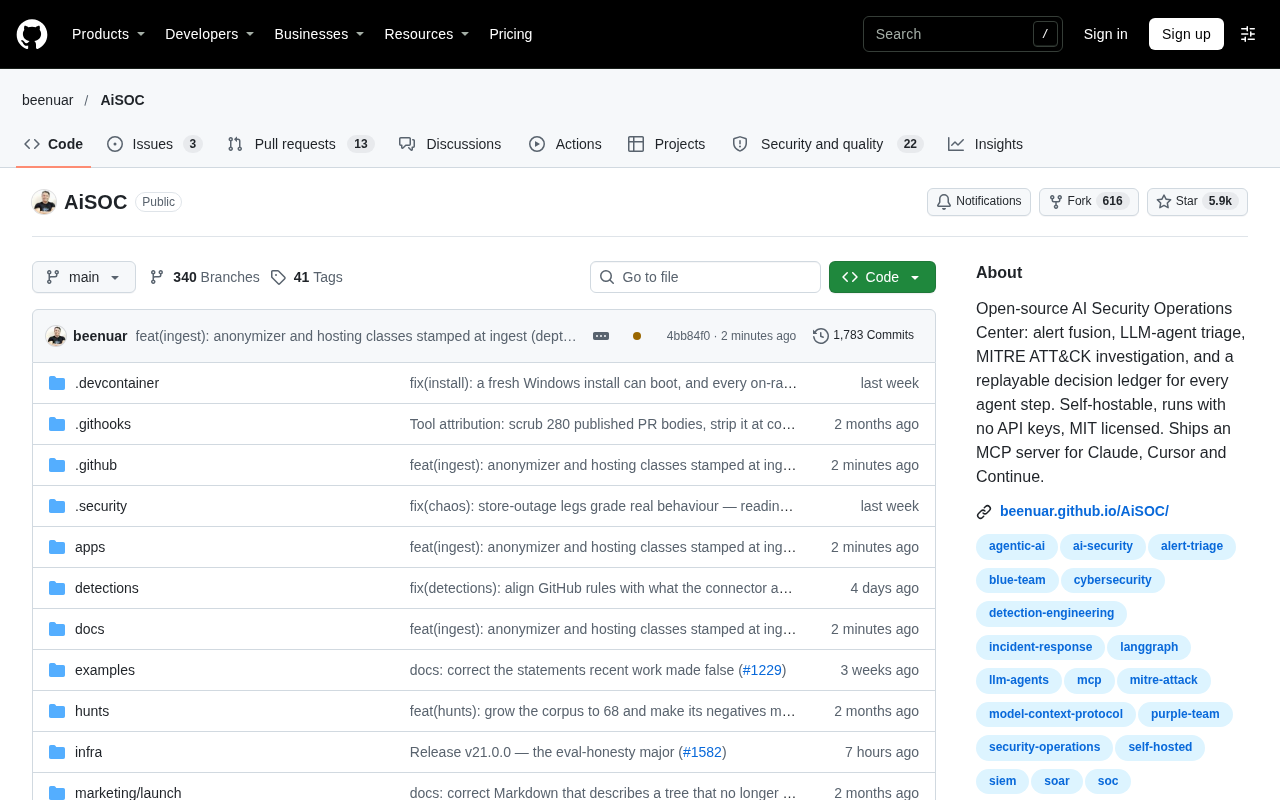
The GitHub project beenuar/AiSOC is an open-source AI security operations center written in Python under the MIT license, self-hosted, and able to run without an API key. It targets SOC alert overload with four core capabilities: alert fusion that aggregates and denoises duplicate alerts from multiple sources; LLM agent triage that makes initial judgments and prioritizes alerts; investigation mapped to the MITRE ATT&CK framework for structured views of attack tactics and techniques; and a replayable decision ledger recording every agent step, addressing the auditability pain point of black-box AI security tools. It also ships MCP servers for Claude, Cursor, and Continue to integrate with existing AI toolchains. The author sees its value in combining agent automation with auditability, making it suitable for data-sovereignty-sensitive organizations, though alert source coverage and triage accuracy should be evaluated before production adoption.
A New Option for an Open-Source AI Security Operations Center
Security Operations Centers (SOCs) have long struggled with alert overload: massive volumes of alerts are mixed with a large number of false positives, leaving analysts overwhelmed and unable to focus on genuine threats. The beenuar/AiSOC project on GitHub attempts to change this with LLM agents—it is an open-source AI security operations center that combines alert fusion, LLM agent triage, MITRE ATT&CK investigation, and a replayable decision ledger. The project has already gained 5,841 stars and 615 forks, with 436 stars added in a single day, showing just how much attention it is attracting.
Self-Hosted and Runs Without an API Key
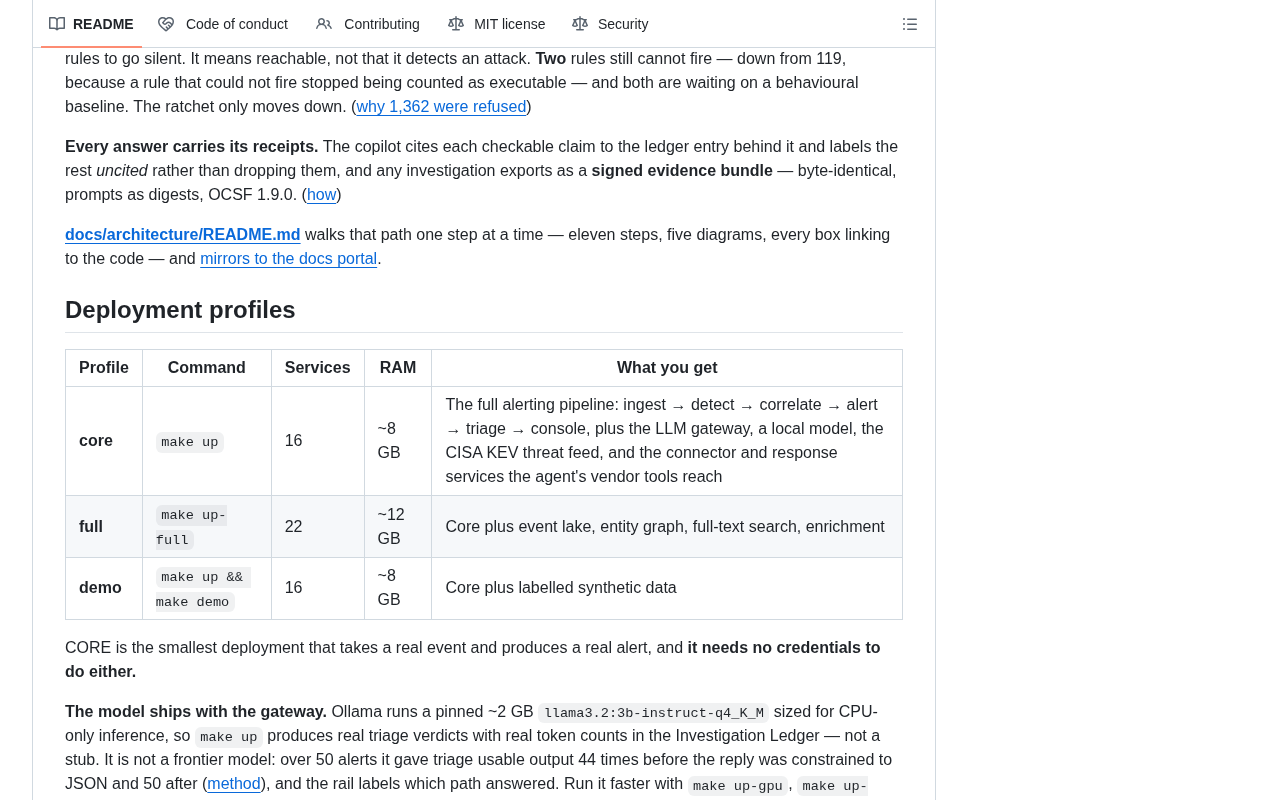
AiSOC is written in Python, open-sourced under the MIT license, and supports self-hosted deployment. One notable feature is that it can run without an API key. For security teams, this means they can quickly validate results in an isolated environment without worrying about compliance risks from key management or external service dependencies. The project also ships with MCP servers for Claude, Cursor, and Continue, making it easy for developers to plug security analysis capabilities into their existing AI coding toolchains.
A SOC (Security Operations Center) is the combination of teams and facilities within an organization that centrally monitor, detect, analyze, and respond to cybersecurity incidents, typically equipped with tools such as SIEM (Security Information and Event Management) and SOAR (Security Orchestration, Automation, and Response). So-called "alert overload" refers to security devices (IDS/IPS, EDR, firewalls, cloud audit logs, etc.) generating tens of thousands of alerts every day, with only a very small proportion representing real threats. Analysts must manually assess each one, which consumes manpower and makes it easy to miss critical events—a widely recognized operational bottleneck in the industry.
MCP (Model Context Protocol) is a standardized protocol proposed and open-sourced by Anthropic for connecting LLM applications to external tools and data sources in a unified way. An MCP server can expose a capability (such as querying security alerts or retrieving threat intelligence) through a standard interface, and any MCP-compatible client (such as Claude Desktop, Cursor, or Continue) can call it in a plug-and-play manner. For AiSOC, providing an MCP server means its security analysis capabilities do not have to be bound to its own interface but can be embedded into the AI coding tools developers use every day, lowering the cost of adoption.
Breaking Down the Core Capabilities
Alert Fusion: Extracting Signal from Noise
Alert fusion is AiSOC's first line of defense. When faced with duplicate and related alerts from different security devices, the system aggregates them to reduce analysts' cognitive load. This layer of processing lays the foundation for subsequent agent triage—only fused alerts are better suited for contextual reasoning by an LLM.
LLM Agent Triage and MITRE ATT&CK Investigation
The triage stage is driven by LLM agents, which make initial judgments and prioritize alerts. Furthermore, the system maps the investigation process to the MITRE ATT&CK framework, so that analysis results can be tied to specific attack tactics and techniques. This structured output helps security teams understand attackers' behavioral patterns rather than merely handling individual alerts.
MITRE ATT&CK is a public knowledge base maintained by MITRE that systematically catalogs the tactics (the "why," such as initial access, lateral movement, and data exfiltration) and techniques (the "how," such as phishing attachments and credential dumping) used by real attackers. It organizes the attack chain into 14 tactical stages, and each technique has an ID (such as T1059 Command Execution). When security tools map alerts to ATT&CK techniques, they help teams identify the stage of an attack, predict the next move, and establish a common vocabulary across different vendors' products. AiSOC structurally maps investigation results to this framework precisely so that a single alert can be elevated into a correlatable view of attack behavior.
Replayable Decision Ledger
After an agent makes a judgment, how do you trust and reproduce its decision? AiSOC provides a replayable decision ledger for every agent step. This design addresses a major pain point of AI security tools: black-box decisions are hard to audit. Replayability means teams can trace what the agent saw at each step, what it reasoned, and ultimately why it made that judgment, providing a basis for post-incident review and compliance audits.
The "black box" problem of LLM agents stems from the fact that their reasoning process is jointly determined by the model's internal weights and context. The same input does not necessarily produce exactly the same output, and intermediate steps are not exposed by default. A replayable decision ledger typically records the input context, tool calls, model outputs, and timestamps for each step, forming a tamper-resistant sequence of events that can be replayed in order afterward to reproduce the judgment path at the time. This is especially critical in security scenarios: auditing and forensics require traceable conclusions and clear accountability, and regulatory and compliance frameworks generally require automated decisions to be explainable.
What It Means for Security Teams
AiSOC's value lies in bringing LLM agents into SOC workflows while preserving auditability. Its open-source and self-hosted nature makes it suitable for organizations sensitive about data sovereignty; MCP integration gives it an opportunity to fit into existing AI-assisted development environments. Of course, as a project still iterating rapidly, its alert source coverage and the accuracy of agent triage need to be evaluated before adoption in production.
For teams looking to explore AI-driven security operations, AiSOC offers a low-barrier starting point: it can be launched without an API key, its decision process is replayable, and the code is fully open.
Related articles

9 AI Subscription Plans Compared: The Real Cost Per 100M Tokens Revealed
Bilibili creator tests 9 AI subscription plans from Volcano, Alibaba, Tencent, Baidu, Zhipu, Xiaomi, MiniMax and more, converting them all to real cost per 100M tokens, breaking down fixed-quota vs. three-tier coefficient billing and how caching, time-of-day discounts, and window limits affect actual quota.

Vibe Coding for Beginners: Expressing Intent Instead of Handwriting Code
What is Vibe Coding? A 137-episode Bilibili course defines it: the core is expressing intent, not writing code. This article analyzes Vibe Coding's productivity logic, target audience, and entry expectations to help beginners decide if it's worth learning.

LangChain Beginner's Guide: An Agent Development Roadmap from LangGraph to Deep Agents
Clarify the encapsulation relationship among LangChain, LangGraph, and Deep Agents, and master the learning path and selection logic for agent development frameworks—suitable for beginners in large model development.