AISTATS 2027 Review Results Are Out: Community Debates Review Quality and Direction
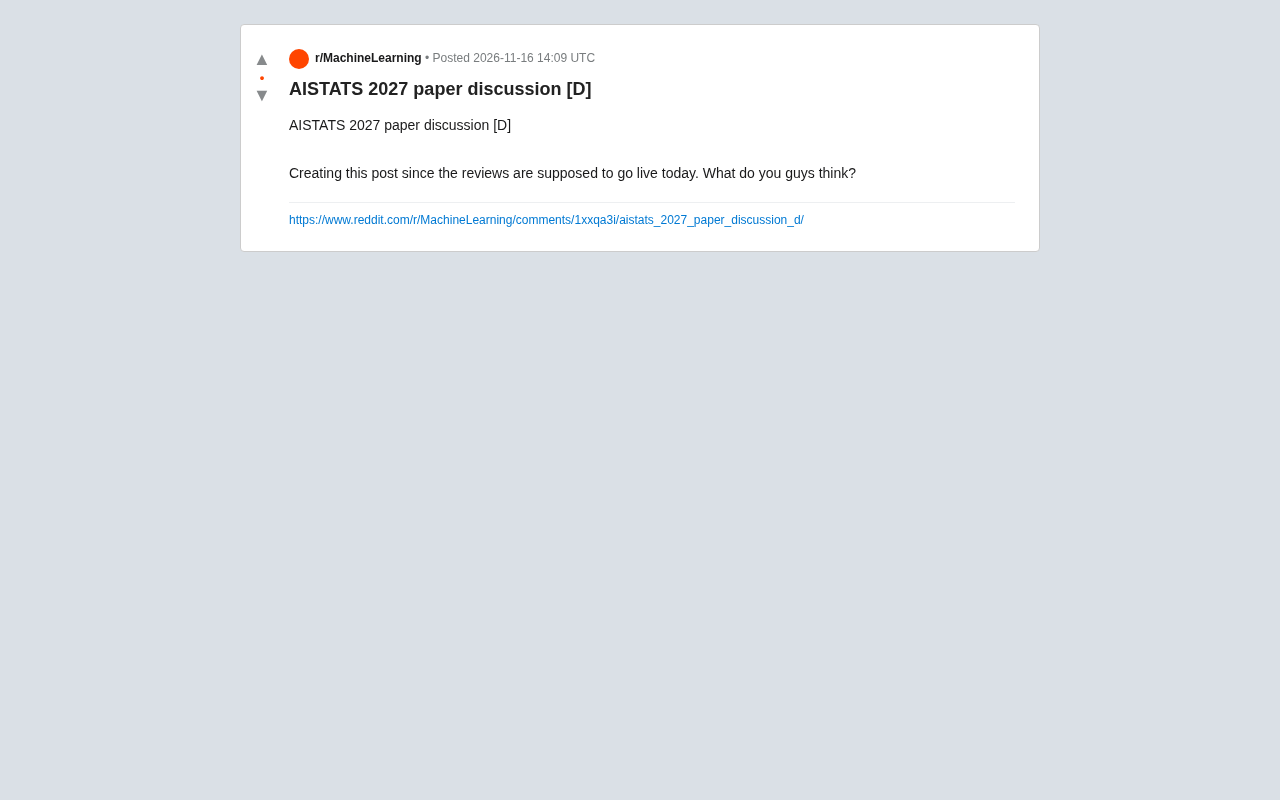
AISTATS 2027 reviews released, Reddit thread gathers authors and reviewers for discussion.
Reviews for AISTATS 2027 papers were released today as scheduled, and a Reddit user opened a thread inviting authors and reviewers to share views. The post itself is limited, only confirming the release time and posing an open question, but its value lies in aggregating dispersed individual experiences. The article outlines the typical rhythm of such review-season threads: official schedules and system refreshes often diverge, and the community tends to form discussion atmospheres earlier; discussions typically center on score distribution, the balance of review standards between theoretical and experimental papers, rebuttal effectiveness, and area chairs' adjudication tendencies. For authors, during the window between review release and the rebuttal deadline, they should prioritize assessing whether low scores are recoverable and whether reviewers misread the core contribution, while avoiding over-reliance on others' experiences and ultimately returning to the paper's technical quality.
AISTATS 2027 Reviews Released, Reddit Community Sparks Discussion First
According to a Reddit community post, reviews for AISTATS 2027 papers were released today as scheduled, and a user opened a thread specifically to invite authors and reviewers to exchange views. The post itself doesn't carry much information—just a single line, "Reviews are supposed to go live today, what does everyone think?"—but it sends a clear signal: another round of top-conference review season has entered the community retrospective phase.
For researchers focused on machine learning statistics and theory, AISTATS has always been a conference that's hard to avoid. Compared to top venues that chase large-scale experiments, it places greater emphasis on methodology and statistical rigor, so the "taste" of its reviews often reflects the field's preferences regarding theoretical contributions.
The Typical Rhythm of Review Season, as Seen Through a Single Post
The wording of the original post is worth pondering. The author uses "supposed to go live today" to describe the release time—this slightly uncertain phrasing is precisely a true reflection of the author community waiting for results: there's often a gap between the official schedule and when the system actually refreshes, and the community tends to form a discussion atmosphere earlier than official channels.
The value of such discussion threads lies not in information dissemination but in aggregating dispersed individual experiences. Authors compare score ranges and exchange rebuttal strategies here, while reviewers anonymously share their review criteria. For student authors submitting for the first time, this is a window into understanding "reviewer language."
The Rebuttal mechanism is a key stage in the review process of machine learning conferences. After reviews are released, authors typically have about one to two weeks to submit a rebuttal, responding point by point to reviewers' concerns. An effective rebuttal is not simply a defense; it requires distinguishing three types of issues: misunderstandings arising from reviewers misreading the paper (which can be clarified with clear wording), technical challenges that can be addressed through additional experiments or proofs (which require substantive evidence), and positional disagreements with reviewers (which are usually difficult to resolve through written argument). Program chairs and area chairs reference whether new critical information appears in the rebuttal when making final decisions. Therefore, authors should prioritize responding to substantive misreadings that could lead to a "recoverable score," rather than getting emotionally entangled in the low score itself.
What Community Discussions Usually Focus On
Although the original post doesn't elaborate on specifics, based on community feedback from past AISTATS editions, discussions typically center on several directions:
- Whether the score distribution is reasonable, and whether there's obvious score polarization;
- Whether the review threshold for theoretical papers and the evaluation standards for experimental papers are balanced;
- The effectiveness of author feedback during the rebuttal stage, and whether reviewers respond seriously;
- The tendency of area chairs (ACs) in adjudicating disputed papers.
These topics come up every year, but the specific points of controversy differ each time. The openness of the original post precisely leaves room for subsequent discussion—it's more of a "gathering point" than an expression of opinion.
Area Chairs (ACs) bear the responsibility of meta-review in the conference review system. When multiple reviewers give significantly divergent scores—for example, one gives a "weak reject" and another gives a "weak accept"—the AC needs to synthesize the reviews, the authors' rebuttal, and their own judgment of the paper to give a final recommendation level. The AC's adjudication tendency often reflects the conference's implicit preferences: whether to conservatively maintain low scores or to be more willing to give disputed papers a chance. For authors, understanding the AC's role helps in judging appeal strategies—when score divergence is large, a well-organized rebuttal that directly addresses core concerns may have more influence on the AC's decision than on persuading any single reviewer.
Practical Advice for Authors
In the window between reviews being released and the rebuttal deadline, what authors can do is actually limited but critical. Rather than obsessing over a single low score, it's better to prioritize judging the "recoverability" of scores: Did the reviewer misread the core contribution? Are there additional experiments that can directly address the concerns?
At the same time, community discussions can serve as a reference frame, but shouldn't be overly relied upon. Standards vary greatly among different reviewers, and directly applying others' experiences to your own paper can easily lead to misjudgment. For work in theoretical directions, clearly explaining assumptions and the boundaries of proofs often impresses reviewers more than piling on experiments.
The review logic for theoretical papers differs structurally from that for experimental papers. Experimental work typically uses performance improvements on benchmark datasets as core evidence, and reviewers focus on whether the experimental design is fair, whether baselines are sufficient, and whether improvements are significant. Theoretical work (such as convergence analysis, statistical estimation error bounds, sample complexity) has its core contribution in the strength of theorems and the correctness of proofs, and reviewers focus more on whether assumptions are reasonable, whether proofs are complete, and whether conclusions represent substantive progress relative to existing results. Therefore, for theoretical papers, clarifying "assumption boundaries" and "key proof steps" in the rebuttal is often more effective than supplementing experiments; piling on experiments unrelated to theoretical claims may instead lead reviewers to question the paper's positioning.
Summary
The review discussion for AISTATS 2027 has just begun, and this Reddit post is only the starting point. Truly valuable information will gradually emerge through subsequent score comparisons and exchanges of rebuttal experiences. For submitters, staying informed about community dynamics is necessary, but final decisions should still return to the technical quality of the paper itself.
One-line Summary
AISTATS 2027 reviews released, Reddit community opens thread to gather authors and reviewers for discussion.
Paragraph Summary
Reviews for AISTATS 2027 papers were released today as scheduled, and a Reddit community user opened a thread inviting authors and reviewers to exchange views. The original post has limited information, only confirming the release time and posing an open-ended question, but its value lies in providing a gathering point for dispersed individual experiences. The article outlines the typical rhythm of such review-season discussion threads: there's often a gap between the official schedule and system refresh, and the community tends to form a discussion atmosphere earlier; discussions typically revolve around score distribution, the balance of review standards between theoretical and experimental papers, rebuttal effectiveness, and area chairs' adjudication tendencies. For authors, in the window between reviews being released and the rebuttal deadline, they should prioritize judging whether low scores are recoverable and whether reviewers misread the core contribution, while avoiding over-reliance on others' experiences—ultimately returning to the technical quality of the paper itself.
Related articles

Gemini 4 Neon Review: Benchmark Scores Rival Carbon, API Pricing and Quota Breakdown
Google Gemini 4 Neon is now live, benchmark scores closely tracking Carbon, API pricing 3/15 at twice Hydrogen's rate. This article compiles Bilibili creator testing: Neon can replace 90% of Carbon scenarios, AntiGravity quota consumption is only one-third of Carbon, plus subscription channel restrictions and 2API ban risks.

Gemini 4 Helium Coming Soon? Signals of Google Loosening Subscription Restrictions
Google team member hints releases will continue; community speculates Gemini 4 Helium (Flash Lite) may be next. Subscription ban controversy gets a response as product lead says "Soon," suggesting restrictions may be lifted. This article covers Gemini developments, OpenAI Coding Agent and risk management, Doubao real-time audio-video API, and compute business dynamics.

AI-Assisted React Development in Practice: Optimizing a Video App and Handling Errors
A 14-year veteran developer demonstrates AI-assisted React video app optimization: compressing video from 80MB to 5MB (~94%) via ImageKit, plus reliable error handling and retry mechanisms. Includes planning, code understanding, and verification methods for working with AI.