Aktar: An Open-Source Tool for Instant File Sharing via Your Own Cloud Storage

Aktar is an open-source drag-and-drop tool that uploads files directly to your own S3-compatible storage and generates shareable links instantly.
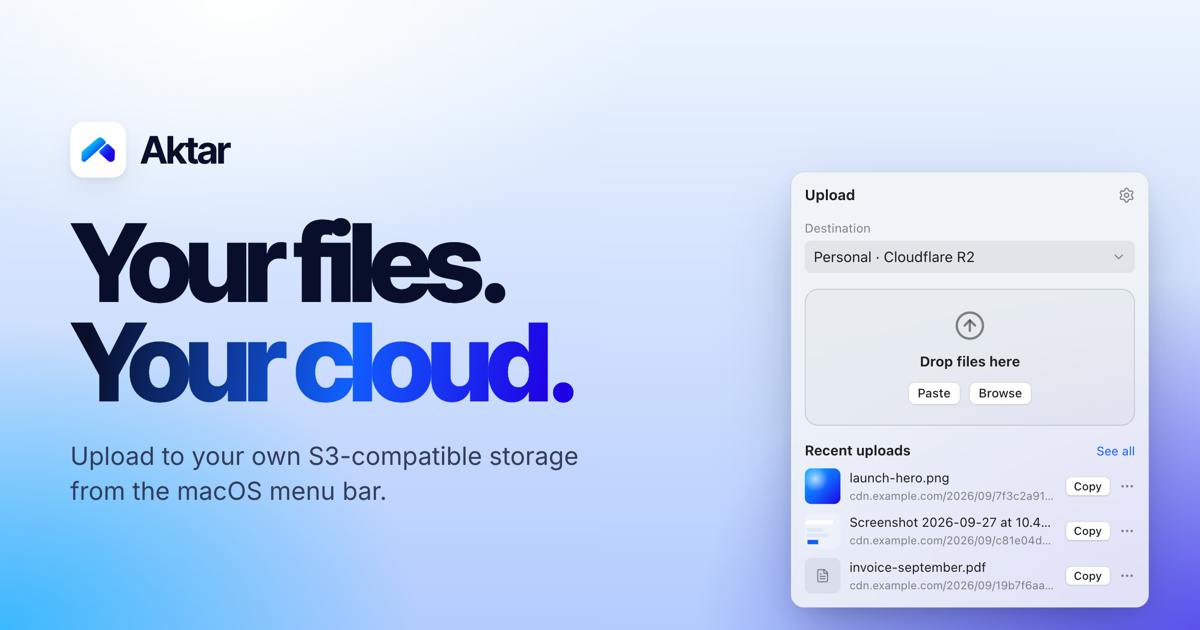
Aktar is a free, open-source file sharing tool built around data sovereignty. Drag a file into the app, and it uploads directly to your own S3-compatible object storage — Amazon S3, Cloudflare R2, Backblaze B2, or self-hosted MinIO — then copies the sharing link to your clipboard automatically. No intermediate servers, no account system, and full control over access permissions and file lifecycle. Available on Mac, Windows, and iOS, with Android in development. Best suited for developers and technical users who already have object storage infrastructure in place.
A File Sharing Tool That Puts Data Ownership Back in Your Hands
In day-to-day work, sharing a screenshot, a log file, or an installer often means routing through third-party cloud drives or temporary upload services. These platforms typically require account registration, serve up ads, and store your files on servers you have no control over. Aktar takes a different approach: letting you share files directly through your own S3-compatible storage.
Aktar is a free, open-source application with a straightforward core logic — drag in a file, and it automatically uploads to your configured object storage and copies a shareable link to your clipboard. There's no intermediate server involved; your files always stay in your own storage bucket. The product earned 79 upvotes on Product Hunt, reaching #13 on the daily leaderboard, and was built by developer Mert Topuz.
How It Works: Drop a File, Get a Link
Aktar compresses the sharing workflow down to the fewest possible steps. You drag a file into the app, it uploads to your pre-configured storage service, then places the sharing link in your clipboard — ready to paste and send. This "drop and share" interaction is particularly well-suited for high-frequency sharing scenarios.
There are no restrictions on file types — screenshots, log files, builds, videos, all handled. For developers, quickly sending a crash log or a beta build to a colleague happens every day, and Aktar turns that into a single drag.
Compatible with the Major S3 Ecosystem
One of Aktar's standout qualities is its broad compatibility with storage backends. It supports Amazon S3, Cloudflare R2, Backblaze B2, MinIO, and other S3-compatible storage services. This means you can choose freely based on cost and regional requirements: Cloudflare R2 for low egress fees, MinIO for fully self-hosted deployments, or Backblaze B2 as a budget-friendly option.
S3 (Simple Storage Service) was originally Amazon's object storage protocol, and its clean HTTP API design has made it the de facto industry standard. "S3-compatible" means a third-party storage service implements the same API interface — clients only need to swap the Endpoint address and credentials, with no code changes required to migrate. Cloudflare R2's biggest advantage is zero egress fees, making it extremely cost-effective for frequent external file sharing. Backblaze B2 costs roughly one-fifth of Amazon S3 per GB, ideal for budget-conscious individual users. MinIO is an open-source, self-hosted solution that can be deployed on your own server or NAS for true full-stack privacy. Understanding these differences helps users make the right storage choice based on their privacy needs, latency requirements, and budget.
Why "Your Own Cloud" Is the Core Selling Point
Aktar's most distinctive positioning is data sovereignty. The pain point with traditional sharing tools is that files pass through third-party intermediaries — you never know how long they're stored or who can access them. Aktar emphasizes three "nos": no accounts, no intermediate servers, and files never leave your own storage.
For teams or individuals handling sensitive data, this architecture reduces concerns about data leakage. Access permissions, file lifecycle, and storage costs are all controlled by you within your own storage service. Being open source also allows technical users to audit the code and confirm there's no hidden data exfiltration — a more convincing trust proposition than closed-source alternatives.
Cross-Platform Coverage and Roadmap
Aktar is currently available on Mac, Windows, and iOS, with an Android version reportedly in development. Consistent cross-device experience matters for a sharing tool — you can handle files on your computer and quickly send links from your phone, all sharing the same storage configuration.
The product appeared under three Product Hunt categories: Mac, Productivity Tools, and Developer Tools, which makes its target audience quite clear — developers and technical professionals who value efficiency, prefer building their own toolchains, and have a certain level of concern for data security.
Who Should Use Aktar
If you're already using S3, R2, or a self-hosted MinIO setup, Aktar is a near-zero-cost addition to your toolkit that eliminates the tedious steps of manual uploading and link construction. For general users without an existing object storage setup, there's an initial configuration hurdle to clear first — which is where it's less "plug and play" compared to out-of-the-box cloud drive services.
Overall, Aktar represents a product philosophy increasingly embraced by the technical community: don't be a middleman for data — just be an efficiency layer on top of infrastructure users already own. The combination of free and open source gives it considerable appeal among similar tools.
Setting up S3-compatible storage typically requires a few preliminary steps: register an account on your chosen platform and create a "Bucket," then generate an Access Key ID and Secret Access Key pair, and finally enter this information along with the corresponding Endpoint address in Aktar. For Cloudflare R2, the free tier provides 10 GB of storage and 1 million Class A operations per month — more than sufficient for light sharing use cases. For users with less technical background, this configuration process is a real barrier, but once the initial setup is complete, the day-to-day experience is indistinguishable from a regular cloud drive — and you're no longer subject to any third-party service's policy changes or shutdown risks.
Related articles

Free Unlimited Claude Code Solution: Agnes AI + CC Switch Setup Guide
No paid subscription needed — pair the free AI platform Agnes AI with the open-source tool CC Switch to provide a backend for Claude Code, enabling unlimited free calls to text, image, and video models. This guide covers the full setup, test results, and usage boundaries.

A Complete Zero-Cost Guide to Getting Started with Claude Code for Beginners in China
A beginner's guide to Claude Code for users in China: two installation methods (command line and IDE plugin), full configuration steps for replacing the official API with the free domestic LongCat model, and a hands-on demo of building a small tool with natural language, plus tips.

When the NSA Gets Involved: The AI Supply Chain Crisis Behind Open-Source CVEs and API Key Hijacking
Multiple open-source projects disclosed severe CVEs in one day, PHP flaws alarmed the FBI, and Railway and OpenCode were breached with API keys stolen. This article breaks down the vulnerability window, AI-accelerated exploitation, and the AI supply chain crisis behind the API key black market, with a developer defense checklist.