Albertsons Teams Up with OpenAI: In-ChatGPT Grocery Shopping at Safeway

Albertsons builds Safeway carts inside ChatGPT, but checkout stays with the merchant, leaving AI agent commercialization unproven.
Albertsons announced an expanded OpenAI partnership to enable Safeway cart building inside ChatGPT: users provide a recipe, photo, or dinner idea, and ChatGPT identifies products and deals, assembles a cart, and directs them to Safeway for checkout. The deal also covers a selective ChatGPT Enterprise rollout and AI promotional insights for merchants, with a six-brand roadmap but no timeline. The article notes this makes the chat platform the discovery entry point while the retailer retains transactions and data—a key experiment in agentic AI. Yet no financial terms, productivity data, or order completion rates were disclosed, leaving a gap between goals and verified results.
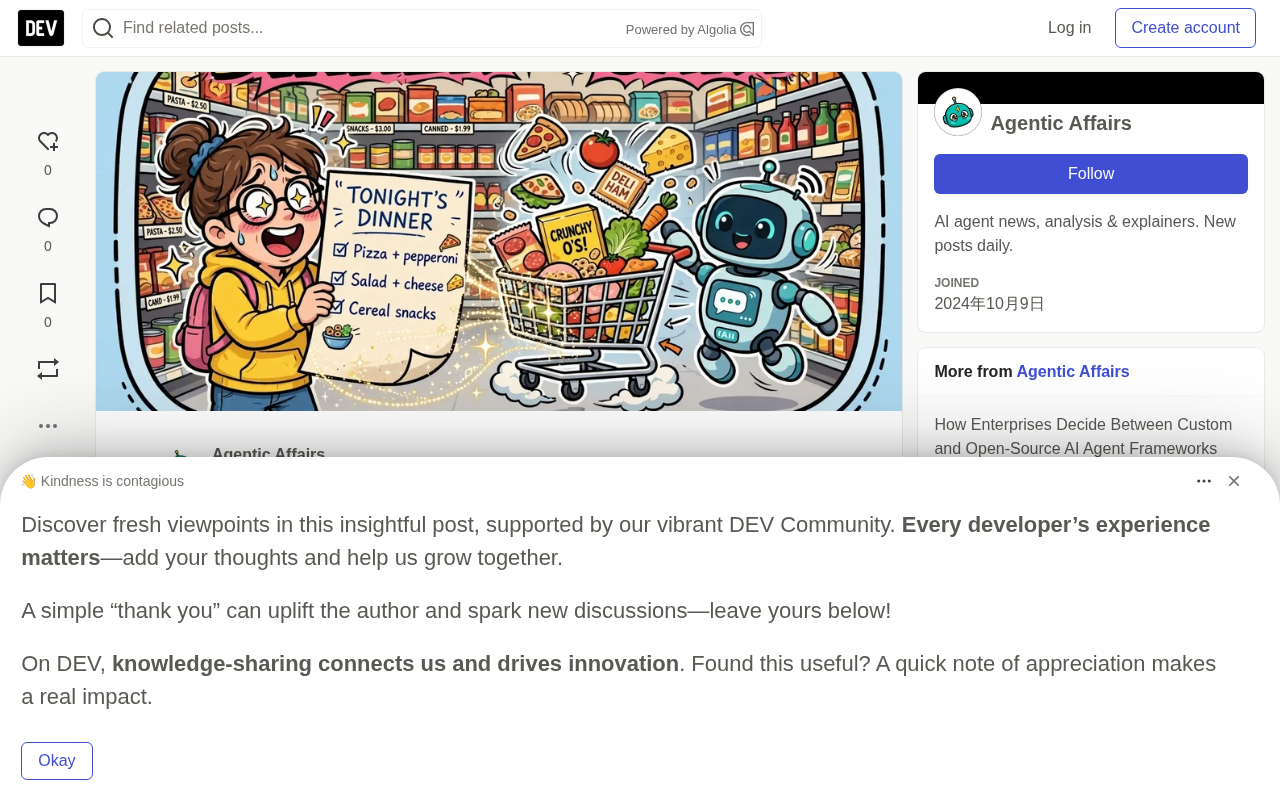
Albertsons Companies is moving grocery shopping into ChatGPT. The retail giant, which operates more than 2,200 stores and serves 36 million customers each week, has announced an expanded partnership with OpenAI. The centerpiece is building a Safeway shopping cart inside ChatGPT—users simply provide a recipe, a photo, or a dinner idea, and ChatGPT identifies the relevant products and deals, assembles a cart, and then guides the user to Safeway to complete checkout.
This is not just a new channel for retail—it is a pivotal experiment in defining the role of agentic AI in commercial transactions.
A Shopping Cart Built in ChatGPT, Checkout Completed by Safeway
According to OpenAI, the whole flow starts with “what do you want to eat?” Users can give ChatGPT a recipe, a photo of a pantry shelf, a digital list, or simply a dinner idea. ChatGPT identifies the relevant products and discounts and automatically assembles a cart.
The launch examples given include: a pizza night for four, a quick deli dinner, and restocking breakfast items with store brands. Meal planning, prepared foods, and everyday restocking—these are the scenarios explicitly covered so far.
One key boundary is worth noting: the announcement hints at the possibility of “checking out inside ChatGPT,” but the detailed description states that customers are directed to Safeway to complete checkout. Cart building happens within the chat interface, but the transaction itself remains with the retailer. For retail technology teams, this is a critical design pattern: open-ended request → purchasable basket, with the merchant retaining final transaction control.
This division of labor—AI handles the front end, the merchant handles the back end—lets ChatGPT serve as the entry point for conversational discovery while avoiding the outflow of payments and customer data, the issues retailers are most sensitive about.
Agentic AI refers to AI systems that can autonomously understand goals, plan steps, and call external tools to complete tasks. Unlike chatbots that only handle single-turn Q&A, it emphasizes a closed loop of “perceive—decide—execute.” In retail scenarios, typical agentic AI capabilities include: parsing natural language or image inputs (such as recipes or shelf photos), mapping them to product catalogs and inventory, applying discount rules, and assembling a purchasable basket. The key constraint on commercial deployment lies in permission boundaries—an agent can complete “discovery and assembly” within the chat interface, but sensitive steps such as payment, order confirmation, and customer accounts typically need to be handed back to the merchant’s systems to comply with payment regulations (such as PCI DSS) and the principle of data minimization. This also explains why Albertsons chose the division of labor where “ChatGPT builds the cart, Safeway completes checkout.”
Employees Use ChatGPT Enterprise; Merchants Get AI Insights
The partnership goes far beyond the shopping interface. According to the announcement, three tracks are advancing simultaneously:
- Internal teams use ChatGPT Enterprise, rolled out selectively to streamline work and accelerate retail technology development—a focused deployment, not a company-wide mandate.
- Merchants receive recommendations and promotional insights from a combination of predictive models and generative AI, described officially as “explainable and data-driven.”
- Customer-facing applications are built on the OpenAI API, targeting basket building, repeat purchases, and meal suggestions customized to shopper preferences.
The announcement discloses no financial terms, no quantified productivity gains, and no evidence that the chat flow improves order completion rates. “Easier shopping” and “faster internal work” are stated goals, not verified results.
ChatGPT Enterprise is OpenAI’s enterprise-tier offering. Compared with the consumer version, it typically provides a larger context window, an admin console, single sign-on (SSO), usage analytics, and explicit data privacy commitments (enterprise data is not used for model training). The “selective rollout” mentioned here means the company grants access team by team or role by role rather than mandating deployment for everyone, which helps control costs, reduce change resistance, and gather early feedback. For retail technology teams, such deployments are often used for knowledge work such as code assistance, drafting requirements documents, and vendor communications. Evaluating their value requires adoption rates, task cycle times, and quality metrics—exactly the quantitative evidence missing from the announcement.
Roadmap: Expansion to Six More Brands
The Safeway experience builds on Albertsons’ existing AI shopping assistant and Ask AI foundation. The expansion plan covers six brands—Albertsons, Vons, Jewel-Osco, Shaw’s, ACME, and Tom Thumb—but the roadmap does not disclose a timeline.
For enterprise implementers, a useful distinction lies in three layers: customer workflows, internal deployment, and outcome evidence. Albertsons and OpenAI describe specific applications and a focused approach to expansion. Whether this delivers sustained improvement requires operational results beyond the announcement.
Signals and Noise in Retail’s Shift to AI Agents
This partnership sends a clear signal: major retailers are starting to treat AI chat interfaces as a new channel for product discovery and cart building, not merely a customer service tool. But the deliberately blurred question of who owns checkout exposes the core tension in the commercialization of AI agents today—conversational platforms want to extend into transactions, while retailers want to hold onto them.
For teams watching AI applications, the Albertsons case offers a reusable framework for observation: look at the customer interface, look at internal deployment, look at the evidence chain. The first two are already clear; the third awaits the test of time.
Explainable and data-driven insights in a retail context usually means promotional recommendations that not only say “what to push” but also explain “why”—for example, attribution based on historical sales, inventory turnover, price elasticity, and customer segment characteristics. The role of generative AI here is to translate the outputs of predictive models into natural-language operational recommendations, lowering the bar for merchants to understand them. But “explainable” itself requires verifiable evaluation criteria: does the recommendation drive incremental sales, does it cause excessive discounting, does it conflict with inventory constraints? The announcement describes merchant-side capabilities as “explainable and data-driven” yet discloses no A/B tests or pilot results, so this is closer to a capability claim than proof of effectiveness. Readers should distinguish it from verified operational metrics.
One-line Summary
Albertsons builds Safeway carts inside ChatGPT, but checkout stays with the merchant, leaving the boundaries of AI agent commercialization to be proven.
Paragraph Summary
Albertsons announced an expanded partnership with OpenAI to enable Safeway cart building inside ChatGPT: users provide a recipe, photo, or dinner idea, and ChatGPT identifies products and deals, assembles a cart, and ultimately directs them to Safeway to complete checkout. The partnership also covers a selective internal deployment of ChatGPT Enterprise and AI-driven promotional insights for merchants, with a roadmap to expand to six brands but no timeline. The article notes that this model makes the conversational platform the discovery entry point while the retailer retains transactions and data—a key experiment in commercializing AI agents. At the same time, the announcement discloses no financial terms, productivity data, or order completion rates, leaving a validation gap between goals and results that must be judged by operational evidence.
Related articles

AI Digital Twin in Action: Using DOT to Automatically Track Bugs and User Feedback
DOTS engineers demonstrate how AI digital twin DOT collects cross-platform user feedback, categorizes issue themes, opens threads to investigate bug root causes, and submits PRs—showcasing a complete AI agent workflow for defect triage with auditable design.

Why Transistors Are No Longer Flat: The Evolution from Planar to Gate-All-Around
Transistor evolution from planar to FinFET to gate-all-around: why gates went from three-sided to four-sided wrapping to suppress short-channel effects and leakage current, extending Moore's Law.

Swarm Intelligence = a Single RL Agent? A Proof of Multi-Armed Bandit Equivalence
A paper proves that collective decision-making through local imitation in swarms is mathematically equivalent to single-agent reinforcement learning: N blind imitators act as N parallel environment samples, with an effective learning rate of 1/N. This article explains the derivation and implications of the Maynard-Cross Learning algorithm.