Alexandr Wang: Proof of the Riemann Hypothesis Signals Superintelligence Is Near
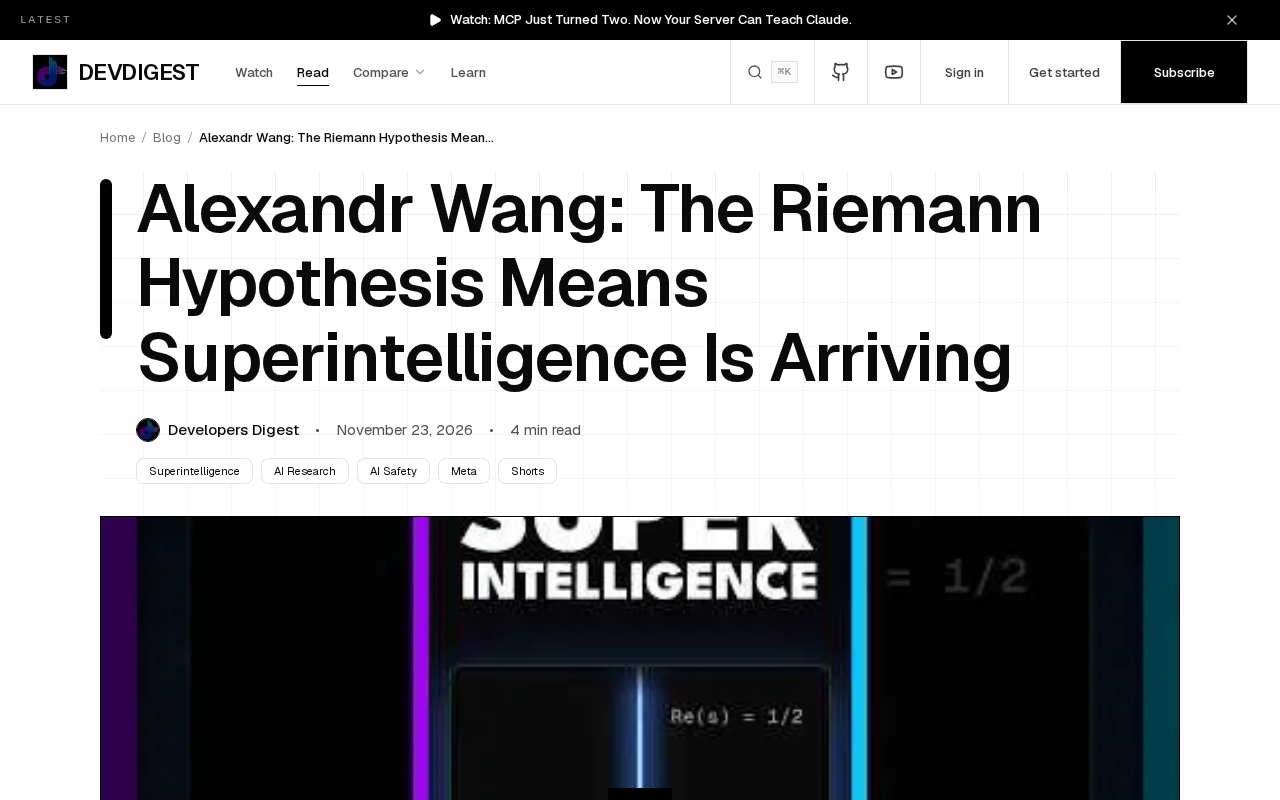
Wang argues AI-assisted proof of the Riemann Hypothesis shows intelligence is no longer scarce, but the path to ASI remains a choice.
The article explores Alexandr Wang's judgment: AI participating in proving top-tier mathematical problems like the Riemann Hypothesis shows the long-standing bottleneck of "intelligence supply" is being lifted—but this doesn't mean superintelligence will arrive automatically by default. When intelligence shifts from scarcity to abundance, real constraints move to alignment, compute allocation, institutional design, and safety governance, and industry competition shifts from talent and model capability to who can better control, deploy, and verify agents. The article also notes that while the Riemann Hypothesis, as a low-tolerance mathematical task, carries strong signal value, Wang's argument is closer to a directional judgment; specific technical paths and verification status are not elaborated in the source material.
When AI Cracks Math's Holy Grail
Alexandr Wang recently put forward a striking argument: the fact that AI can assist in proving the Riemann Hypothesis shows that intelligence is no longer the bottleneck—but the default path to ASI (superintelligence) is not inevitable. That sentence carries a lot of information density, and it's worth unpacking.
The Riemann Hypothesis is a problem that has sat unresolved in mathematics for more than a century and a half, deeply tied to the distribution of prime numbers, and one of the Millennium Prize Problems. It has long been regarded as the ultimate test of human intellect. The core of Wang's argument isn't the technical details of the proof itself, but a structural shift: when AI can participate in mathematical breakthroughs at this level, it means the long-standing constraint of "intelligence supply" is being lifted.
The Riemann Hypothesis was proposed by the German mathematician Bernhard Riemann in 1859: the real part of every non-trivial zero of the Riemann zeta function equals 1/2. It is profoundly connected to the distribution of primes—the precision of the error term in the prime number theorem depends directly on whether the conjecture is true. The Clay Mathematics Institute listed it in 2000 as one of seven "Millennium Prize Problems," with a one-million-dollar prize. To date, more than a thousand mathematical propositions rest on the assumption that the Riemann Hypothesis holds; if it were disproven, a large number of conclusions would collapse in a chain reaction. Because of this, it is widely regarded as one of the most important and most difficult open problems in mathematics, and any progress related to it draws intense attention from both academia and the public.
If Intelligence Is No Longer the Bottleneck, What Is?
There's an easily overlooked turn in Wang's argument—he does not follow the linear logic of "therefore ASI is inevitable." Instead, he stresses that the default path is not inevitable. The subtext: technical capability reaching the bar does not mean the social outcome is determined.
Over the past few years, public discussion of AGI/ASI has focused heavily on "can it be done." Wang's framework pushes the question one step further: when intelligence itself becomes abundant or even surplus, the real constraints shift to non-intellectual dimensions—alignment, compute allocation, institutional design, safety governance. In other words, the bottleneck moves from "can we think it up" to "do we dare let it run" and "who decides what it does."
This shift has practical significance for the industry. If intelligence is a scarce resource, the competitive logic is about grabbing talent and model capability; if intelligence becomes abundant, the competitive logic shifts to who can better control, deploy, and verify these agents. The two logics correspond to entirely different organizational forms and regulatory strategies.
ASI (Artificial Superintelligence) generally refers to a hypothetical intelligence system that far surpasses the best human level in almost all cognitive domains, sitting above AGI (artificial general intelligence). Two typical positions surround it: accelerationism holds that capability improvements will naturally lead to superintelligence; alignment research focuses on how to ensure such a system's goals align with human values. Wang's statement that "the default path is not inevitable" corresponds precisely to the latter's concerns—even if the capability ceiling is reachable, system goal-setting, the degree of power concentration, and governance mechanisms will still significantly change the ultimate social form. This is also part of the background for the current shift in AI safety from "capability evaluation" to "institutional and deployment evaluation."
Why a Mathematical Proof Is a Signal
Choosing the Riemann Hypothesis as evidence is itself symbolic. Mathematical proof differs from engineering tasks: it demands rigorous logical chains and verifiable reasoning processes, with very little room for error. If a system can make an effective contribution to such a task, it shows not pattern-matching-level "looks right," but some form of reasoning capability that peers can examine.
It should be noted that, in currently public information, the specific technical path, verification status, and peer-review situation regarding "AI-assisted proof of the Riemann Hypothesis" are not elaborated in the source material. Wang's argument is more of a judgment based on trends than a detailed post-mortem of a completed result. When citing this argument, readers should understand it as a directional signal rather than a settled fact.
Formal verification and checkable reasoning are key to understanding why mathematical tasks serve as a touchstone for AI capability. Unlike natural language generation, every step of a mathematical proof can be independently checked: whether the premises hold, whether the inference rules are valid, whether the conclusion follows strictly from the premises. In recent years, the development of interactive theorem provers such as Lean, Coq, and Isabelle has made it possible for some mathematical proofs to be verified step by step by machine. The significance of this path is that it turns "can AI really reason" from a subjective judgment into a reproducible, objective test—which is why mathematics is often treated as a benchmark scenario for measuring depth of reasoning rather than fluency of language.
Correcting the ASI Narrative
Discussion around superintelligence has long had two extremes: an accelerationist inevitabilism that holds the technology curve will automatically carry humanity to the endpoint, and a thorough stagnationism that argues for slowing everything down. Wang's formulation opens a gap between the two—capability may be reachable, but there is room for choice along the path.
This middle position is gaining traction in the industry. It acknowledges the reality of technological progress while preserving human agency over direction. For teams building AI products and research, this means safety, evaluation, and interpretability are not after-the-fact patches but preconditions that determine the ultimate direction.
Conclusion
Wang uses the Riemann Hypothesis as a lead-in, but what he really wants to say is two things: the supply of intelligence is moving from scarcity to abundance, and where it goes after abundance depends on non-intellectual factors. A mathematical breakthrough is proof of capability, not a verdict of destiny. For practitioners, the next competitive focus may not be how smart the model is, but who can apply that intelligence safely, controllably, and verifiably in the right places.
Related articles

Pure-Code Video Generation Tested: Which AI Model Actually Follows Instructions?
A Bilibili creator tested three AI models' pure-code video generation with unified prompts and three revisions each: Xiaonaomao has a high ceiling but lacks stability, GPT 6.2 Extra models well but only follows half the instructions, and OPAS 5.5 remains the benchmark.

GPT-6 Six-Tier Hands-On Test: Astra Ultra Dominates but Bills Double
GPT-6 six-tier test: Astra Ultra sweeps 3:0 in 3D tasks thanks to sub-agents and runs 14% faster, but hidden backend bills make its real cost 2.6x single-threaded.

GPT-6.2 Astra vs Fable 5.2: Huge Cost-Efficiency Gap Across 12 Real-World Tests
Bilibili creator tests GPT-6.2 Astra vs Fable 5.2 across 12 real tasks: Fable wins 7-5 but costs 7.2x more and takes nearly 5x longer. Token efficiency emerges as the key selection metric.