Alibaba Bans Claude Across the Board: Chinese Cloud Giants Move to Eliminate Closed-Source Model Dependencies

Alibaba bans Claude company-wide, signaling China's cloud giants are cutting closed-source model dependencies.
Alibaba has issued a company-wide ban on all Anthropic Claude products, effective July 10, 2025, requiring employees to uninstall models like Sonnet and Opus as well as Claude Code. Driven by distillation attack accusations, enterprise controllability concerns, and geopolitical supply chain pressures, the move signals a broader shift in Chinese enterprise AI: closed-source frontier models are no longer the default, domestic alternatives are accelerating, and the race for self-reliant AI infrastructure is intensifying.
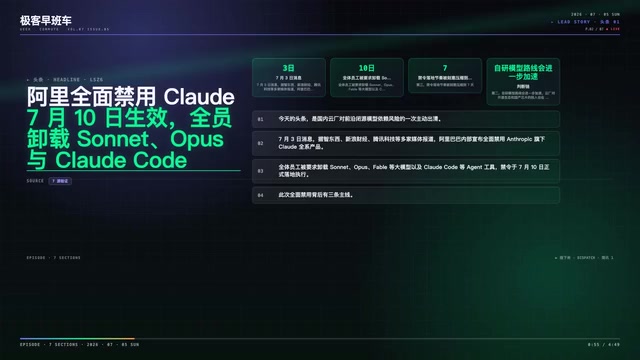
Headline: Alibaba Bans Claude Entirely Starting July 10
On July 3, 2025, multiple Chinese media outlets — including Zhidongxi, Sina Finance, and Tencent Tech — reported that Alibaba has issued an internal directive to ban all Anthropic Claude products company-wide. All employees are required to uninstall large models such as Sonnet and Opus, as well as Agent tools like Claude Code. The ban takes effect on July 10.
This is not a routine tool swap. It represents a deliberate move by a major Chinese cloud provider to proactively eliminate its exposure to cutting-edge closed-source models. With only a seven-day window between announcement and enforcement, the speed and breadth of the directive signal that Alibaba is willing to absorb short-term productivity costs in exchange for severing its dependence on frontier closed-source models as quickly as possible.
Three Threads Behind the Ban
First, accusations of distillation attacks have brought the fracture in the China-US AI supply chain into the open. Anthropic previously accused Alibaba of conducting distillation attacks against Claude. A distillation attack involves making large volumes of API calls to a target model, collecting input-output pairs, and then using that data to train a smaller, cheaper "student model" — effectively transferring the target model's capabilities without accessing its original weights. This is essentially the reverse commercial application of knowledge distillation: a technique originally designed for legitimate model compression, repurposed to "steal" the capability boundaries of a closed-source model without authorization. Anthropic, OpenAI, and others explicitly prohibit this in their terms of service, but enforcement is extremely difficult in practice, since API calls made for this purpose are indistinguishable from normal usage. Against this backdrop, Chinese cloud providers that continue using frontier closed-source models face compounding compliance and reputational risks. Banning Claude is, in part, a proactive move to sidestep those risks.
Second, controllability in enterprise AI deployment is being repriced. Major cloud providers have been investing heavily in both proprietary models and open-source ecosystems. The more dependent they are on external closed-source models, the narrower their own margin for differentiation. Proactively eliminating external dependencies has become a key signal cloud providers use to demonstrate controllability to their clients.
Third, the rollout timeline was deliberately compressed to seven days. It's worth noting that Claude Code — one of the core tools covered by this ban — is Anthropic's command-line AI coding Agent. It can directly read and write local codebases, execute terminal commands, debug code, and submit pull requests. It represents a paradigm shift from "AI-assisted coding" to "AI autonomously executing development tasks." Unlike completion tools such as GitHub Copilot, Claude Code is capable of multi-step planning and tool invocation, and has achieved deep penetration among engineers at major Chinese tech companies. Banning it means developers must switch to Tongyi Lingma or other domestic alternatives, which will have a real short-term impact on engineering productivity. A seven-day uninstall window is itself a clear statement of priorities: severing the dependency matters more than preserving short-term convenience.
Three-Level Implications for Enterprise AI Deployment
The impact of this move extends far beyond Alibaba's internal operations — it carries deep implications for the broader landscape of enterprise AI deployment in China.

Level one: Closed-source frontier models are no longer the default choice for major domestic clients. In the past, frontier closed-source models like Claude and GPT were typically the first choice when procuring AI capabilities. Today, compliance and controllability are becoming hard prerequisites — the security perimeter around a model's origin is rapidly gaining weight in procurement decisions.
Level two: The push toward proprietary model development is accelerating. Cloud providers' sustained investment in open-source ecosystems and domestically produced chips is expected to enter an intensive payoff phase over the next one to two years. We will see a wave of proprietary models and domestic compute solutions come to market at an accelerated pace.
Level three: Domestic alternatives for Agent tools will spread from large enterprises to smaller teams. As tools like Claude Code are banned, domestic alternatives will first gain a foothold among large enterprise clients, then gradually penetrate mid-sized and smaller teams. The center of gravity of the entire developer ecosystem is shifting toward domestic vendors.
AMD Launches China-Specific AI Chip to Work Around H20 Restrictions
On July 4, multiple outlets including Tencent Cloud and developer community media reported that AMD plans to release a China-specific version of its AI chip based on the Radeon AI PRO R9700, positioning it against NVIDIA's previous compliance-grade offerings for the Chinese market.
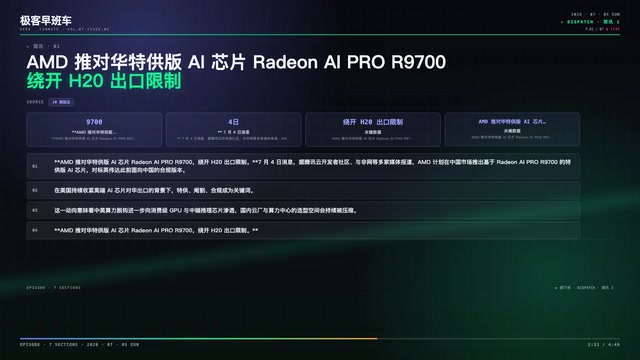
The AMD Radeon AI PRO R9700 is based on the RDNA 4 architecture and was originally positioned for professional graphics and AI inference markets. After NVIDIA's H100 and A100 were blocked from sale in China due to US export controls, NVIDIA released a downgraded H20 as a workaround — only for the US Commerce Department to bring the H20 under export controls by late 2024. AMD's logic with this new China-specific chip follows a similar playbook: by proactively reducing key specs such as interconnect bandwidth and memory capacity, the chip's performance falls within the compliance threshold for export controls, allowing it to legally enter the Chinese market. This pattern reveals the structural dilemma at the heart of compute restrictions — every new line drawn by regulators spawns a new generation of "compliance-grade" designs engineered right up to that line, continuously eroding the real-world effectiveness of the controls through technical workarounds.
As the US continues tightening high-end AI chip exports to China, terms like "China-specific," "downgraded," and "compliant version" have become defining keywords. This trend signals that the China-US compute decoupling is increasingly penetrating consumer-grade GPUs and edge inference chips. Domestic cloud providers and data centers are finding their procurement options progressively narrowed. This is the same underlying logic as Alibaba's Claude ban — from models to compute, Chinese players are being pushed toward self-reliance across the board.
Frontier Model Companies Are Building Their Own Chips
On July 3, it was reported that Anthropic has begun early development of its own AI chip and plans to partner with Samsung using a 2nm process node. This means another top-tier AI lab has joined the custom silicon race, following in OpenAI's footsteps.

Anthropic's choice of Samsung and the 2nm process follows a path of vertical integration already validated by Google (TPU), Meta (MTIA), Amazon (Trainium/Inferentia), and Microsoft (Maia). For frontier model companies, the core motivation for building custom chips is twofold: first, the heavy reliance on NVIDIA H-series GPUs during training makes compute costs extremely high, and custom chips designed through hardware-software co-design can dramatically reduce per-unit compute costs; second, as user scale grows, per-call inference costs become the primary bottleneck to profitability during the inference phase, and inference chips optimized for specific model architectures can multiply throughput several times over. The 2nm process node is at the frontier of current mass-production capabilities — TSMC has already begun volume production, while Samsung is working to catch up. Anthropic's choice of Samsung likely reflects a balance of cost considerations and supply chain diversification.
Under the dual pressures of persistent training compute scarcity and rapidly growing inference demand, custom silicon has evolved from a moat for top-tier cloud providers into a must-have for frontier model companies. As model companies begin vertically integrating hardware, competition in the AI industry is extending from the algorithm layer down into the deeper foundations of compute infrastructure.
Other Noteworthy Developments
World's First Stratigraphic AI Foundation Model Released
On July 3, China released the world's first stratigraphic AI foundation model, designed to build a cross-regional, cross-lithology shared database for earth science. Stratigraphy is the branch of geoscience that studies the formation sequence, age, and spatial distribution of rock strata, and serves as the foundational discipline for oil and gas exploration, mineral development, and paleoclimate reconstruction. Traditional stratigraphic correlation relies heavily on manual interpretation by geologists — a time-consuming process that struggles to maintain consistent standards across regions. Developed by a consortium of Chinese research institutions, the model covers all three major rock types (sedimentary, igneous, and metamorphic) and supports use cases including stratigraphic correlation, paleoenvironmental reconstruction, and oil and gas exploration. Its core value lies in building a structured knowledge graph that spans regions and rock types, enabling global basin data to be brought into a unified semantic space for comparative analysis — and allowing the model to predict reservoir distribution probabilities in unexplored areas based on patterns from known basins, significantly reducing exploration risk. Following biomedical and geological foundation models, this marks another important deployment of Chinese industry-specific large models in a vertical scientific domain, signaling that large model applications are expanding from commercial use cases into fundamental scientific research.
Open-Source AI Testing Tools Landscape
This week's GitHub trending projects featured a comprehensive map of open-source AI testing tools, covering four major areas: unit testing, API testing, visual testing, and AI Agent evaluation. Developers can use this open-source toolchain to build a complete quality gate — from unit tests to the agent layer — without purchasing any commercial platform. For small and medium-sized teams, this represents a practical solution for integrating AI testing capabilities directly into the development pipeline.
Closing Thoughts
From Alibaba banning Claude, to AMD's China-specific chips and Anthropic's custom silicon ambitions, the recent news cycle traces a clear throughline: the AI industry's supply chain is being rapidly restructured along geopolitical fault lines. For domestic Chinese vendors, self-reliance is no longer an option — it has become a baseline for survival. For global frontier model companies, vertical integration of hardware has become an unavoidable imperative. The contest over models and compute infrastructure has only just begun.
Key Takeaways
Related articles

Cursor AI Programming in Practice: Build a Student Management System from Scratch in 30 Minutes
A Bilibili creator demonstrates Cursor AI programming: generating a student management system in 30 minutes with natural language. Details on Agent mode, Claude selection, prompt techniques, and thresholds.

Top 20 AI Coding Tools Ranking: From Rock-Solid to Lackluster, a Scored Matrix
Bilibili creator releases top 20 AI coding tools ranking, tiered T0–T4 from rock-solid to lackluster, with Claude Code and Codex tied at T0. This article details the scoring dimensions (capability, reliability, robustness, durability, cost, domestic availability) and tool performances to help developers choose the right AI coding assistant.

Vibe Coding Systematic Tutorial: Master AI-Assisted Programming from Zero
A three-month Vibe Coding tutorial from a Bilibili creator covering Codex, ClaudeCode, and Cursor, from core logic to commercial project practice for beginners.