All Tests Passed — But Quietly Polluted the Production Log: A Python Test Isolation Lesson
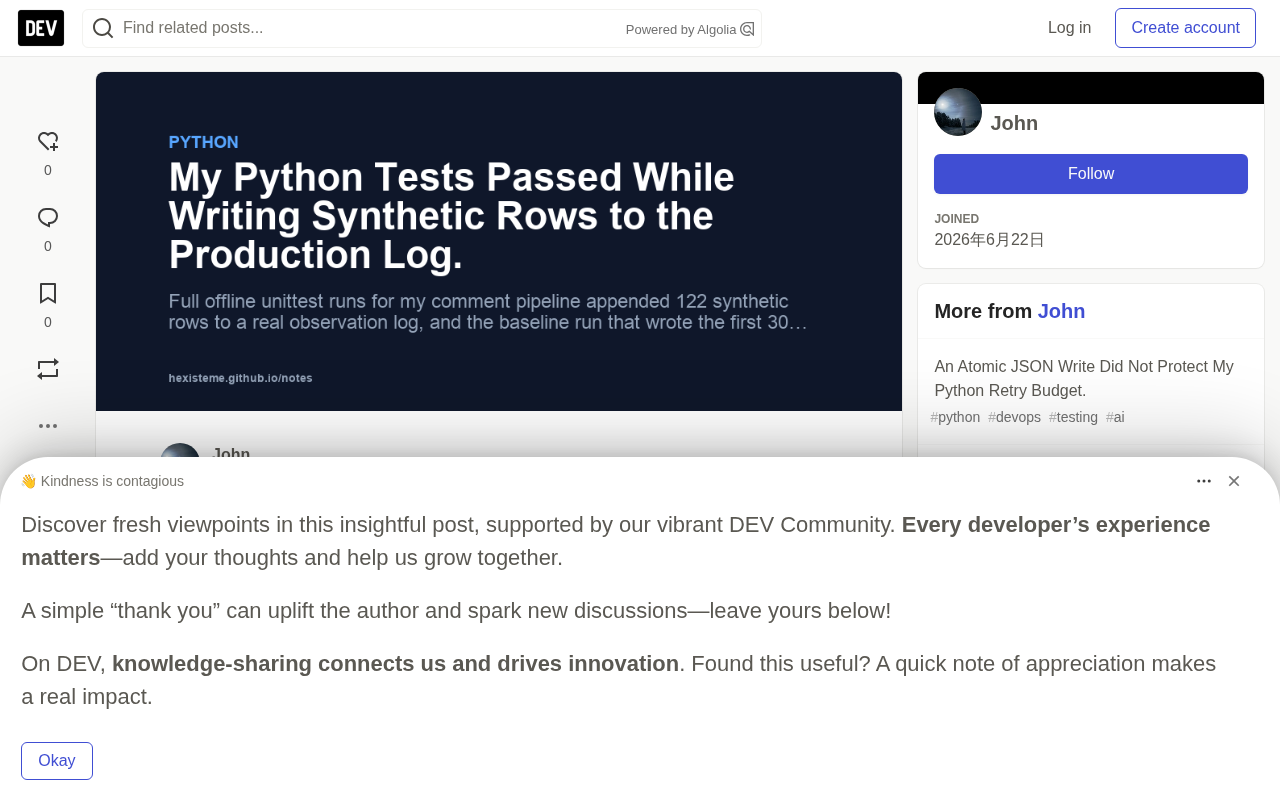
All tests passed — but the production log was silently getting 122 fake records written into it.
A developer's comment-delivery pipeline test suites all passed, yet 122 synthetic records quietly accumulated in the production log `landing-observations.jsonl`. The root cause: assertions only verified what the delivery check *returned* — nobody asked what else the code was writing to. Cleanup used precise attribution (matching by fixture fingerprints, timestamps, and occurrence counts) rather than blunt deletion, preserving all 623 real records. The fix operated on two levels: redirecting output paths to disposable temporary locations via `tempfile` and `mock.patch.object` (isolation), and adding byte-level before/after comparisons (guardrails) to turn silent side effects into explicit failures. The core lesson: for any test suite that touches real I/O, don't just ask "did it pass?" — ask "what did it write, and where?"
There's a truth in software testing that often gets overlooked: a passing test only proves that the behavior you explicitly asserted is correct — it tells you nothing about everything else the code happened to do along the way. One developer discovered this blind spot while cleaning up their comment-reply pipeline. The entire offline test suite passed, yet it had been quietly writing 122 synthetic records into a production log.
How It Happened
The developer maintained a comment-delivery pipeline that, each time it checked whether a submitted reply had actually appeared on the page, appended a JSON line to a production log called landing-observations.jsonl. Each entry recorded the article, the comment, whether delivery succeeded, and which attempt succeeded. The log had a clear purpose: it was evidence of real deliveries, and other downstream decisions (like reviewing reply-retry budgets) depended on reading it.
The problem lived in three unittest-based test suites — watcher, autoreply, and reply. Some of those tests triggered the delivery-check logic: they fed temporary HTTP data to the observer and asserted on its judgment. The input data was synthetic and temporary, but the output path was never isolated — so when the tests ran, the observer dutifully wrote results to the real landing-observations.jsonl.
The first full baseline run appended 30 synthetic lines — while reporting 176 tests as OK. Several subsequent full runs before the fixture isolation fix was applied added even more. By the time it was caught, 122 synthetic lines had accumulated. (An earlier summary had estimated 145; a line-by-line audit by timestamp and target confirmed 122.)
Why "Passing" Told You Nothing
A passing test means its assertions held. Those assertions only cared about what the delivery check returned: success or failure, whether the attempt count was recorded correctly. Not a single assertion asked what else the code had touched in the process.
Writing one line to a file outside the test sandbox doesn't fail any assertion — the pass/fail mechanism doesn't even notice the action. The author put it plainly: the suites were correct about the behavior they tested, and silent about the side effects they didn't test — and that side effect landed in a file whose entire purpose was to contain only true records.
This is the core mechanism behind the false sense of security that green tests provide. Assertions cover the outputs of behavior; side effects — file writes, network calls, global state mutations — routinely fall outside the assertion's field of view.
Cleanup: Precise Attribution Over Blunt Deletion
Faced with a contaminated log, several fast-and-dirty cleanup approaches were available: truncate the file, delete all lines within the test-run time window, or restore from an older backup. Each carries real risk — potentially wiping legitimate observations written in the same window, or losing real data produced after the backup point.
The developer chose precise attribution instead. The synthetic lines carried recognizable fixture fingerprints, matchable by exact timestamp, target, and the number of times each combination appeared. The process had two steps: first, save those lines along with the full original JSON to a recovery backup; then remove them precisely from the log. All 623 real production records came through untouched, and the file settled at 97,094 bytes.
There's a principle worth keeping: if lines cannot be precisely attributed, the right call is to leave them in place and document the contamination as a known limitation of the log — not to guess and delete. For a file that exists as evidence, a known imperfection beats uncertain damage.
The Fix: Isolate First, Then Add a Guardrail
The primary fix was isolation. The watcher and autoreply tests now redirect the observation file to a temporary fixture path, so the code under test writes to a throwaway location. The reply suite's delivery tests were refactored to mock the watcher rather than invoke it for real.
Python's tempfile module is the standard tool for creating these "disposable locations." The pattern the author settled on looks roughly like this (names simplified for illustration):
class LandingCheckTests(unittest.TestCase):
    def setUp(self):
        tmp = tempfile.TemporaryDirectory()
        self.addCleanup(tmp.cleanup)
        patcher = mock.patch.object(watcher, "OBS_PATH",
                                    Path(tmp.name) / "observations.jsonl")
        patcher.start()
        self.addCleanup(patcher.stop)
If the project used pytest, the tmp_path fixture would serve the same purpose; these suites use unittest, so it doesn't apply here.
The second part is a guardrail that would have caught the problem on the very first run. The watcher suite now includes a teardown assertion that compares the real log's byte count before and after the tests run; an outer wrapper does the same comparison around the full suite run and the shared checker. Byte comparison is crude — and that's exactly the point. It doesn't need to know which code path might write to the file; it only needs to know this file must never change.
The author drew a clear line between the two: a after-the-fact guardrail can't undo a write — it only turns a silent side effect into a failed run. Isolation is what prevents the write from happening in the first place. The guardrail patches the net; isolation blocks the source.
mock.patch.object from Python's standard library unittest.mock is a context manager/decorator that temporarily replaces an attribute or method on an object during a test, then restores it automatically when the test ends. Here, it swaps out the watcher module's OBS_PATH variable for a path pointing to a temporary directory — the code under test writes to that throwaway location without knowing the difference. addCleanup is a unittest.TestCase mechanism that registers a callback to run at test teardown regardless of whether the test passed or failed — more reliable than tearDown alone, because registered cleanups still execute even if setUp raises partway through. tempfile.TemporaryDirectory() creates a unique directory in the system's temp space and deletes it along with all its contents when cleanup() is called, guaranteeing that no temporary files from the test run are left behind.
Verification and a New Checking Habit
After the fix, all 223 watcher, autoreply, and reply tests passed, and the production log was byte-for-byte unchanged at 97,094 bytes.
A shared offline test framework covering five components passed 203 tests (140 watcher, 42 telemetry, 7 browser, 14 grammar). The author noted explicitly that 223 and 203 overlap (both include watcher tests) and cannot be added together. Claude Code, Codex, and agy each ran the shared checker from temporary directories outside the project — it calls no models, publishes nothing, runs entirely offline with synthetic data, and therefore says nothing about how real browser sessions perform in production.
The incident changed how the author frames questions about tests. The byte guardrail only covers the one file he now knows about; it won't catch other paths a test might write to. So for any suite that touches real I/O, he now asks not just "did it pass?" but "what did it write, and where?" For a log that other decisions read from, the only acceptable answer is "nothing" — and something must verify that.
Takeaways for Engineers
This incident is small, but it lands precisely on a widespread blind spot in test engineering. A few lessons that transfer directly:
- Passing ≠ clean. Assertions only cover the outputs you explicitly check; side effects routinely live outside that view.
- Real I/O must be isolated. File paths, database connections, external service addresses — all of these should be redirected to disposable locations during tests.
tempfileand mocking are the baseline tools. - Use guardrails to turn silence into noise. Byte-level or state-level before/after comparisons are crude, but they convert a quietly corrupting side effect into an explicit test failure.
- Prioritize precise attribution when cleaning up data. If you can identify contaminated records exactly, remove them exactly. If you can't, document the limitation honestly rather than guessing and compromising the integrity of the evidence.
When your tests can touch data whose entire job is to stay true, isolation and guardrails aren't optional — they're the floor.
Background
This phenomenon is generally described in testing theory as the "side-effect invisibility" problem. A test framework's pass/fail verdict is driven entirely by assert statements: no failed assertion means the test passes, and the framework itself does not actively monitor changes the code under test makes to external state. File writes, database inserts, environment variable modifications, and global singleton mutations are all "side effects" — they can occur silently with zero assertion failures. This is also why test coverage metrics can mislead: 100% line coverage only means every line was executed, not that every consequence of that execution was verified. True test robustness requires attention to both assertion coverage of inputs and outputs and the degree of side-effect isolation — neither alone is sufficient.
Related articles

Free Unlimited Claude Code Solution: Agnes AI + CC Switch Setup Guide
No paid subscription needed — pair the free AI platform Agnes AI with the open-source tool CC Switch to provide a backend for Claude Code, enabling unlimited free calls to text, image, and video models. This guide covers the full setup, test results, and usage boundaries.

A Complete Zero-Cost Guide to Getting Started with Claude Code for Beginners in China
A beginner's guide to Claude Code for users in China: two installation methods (command line and IDE plugin), full configuration steps for replacing the official API with the free domestic LongCat model, and a hands-on demo of building a small tool with natural language, plus tips.

When the NSA Gets Involved: The AI Supply Chain Crisis Behind Open-Source CVEs and API Key Hijacking
Multiple open-source projects disclosed severe CVEs in one day, PHP flaws alarmed the FBI, and Railway and OpenCode were breached with API keys stolen. This article breaks down the vulnerability window, AI-accelerated exploitation, and the AI supply chain crisis behind the API key black market, with a developer defense checklist.