AlphaGenome Atlas: A Free Tool for Visualizing Predicted Impacts of 9 Billion DNA Variants
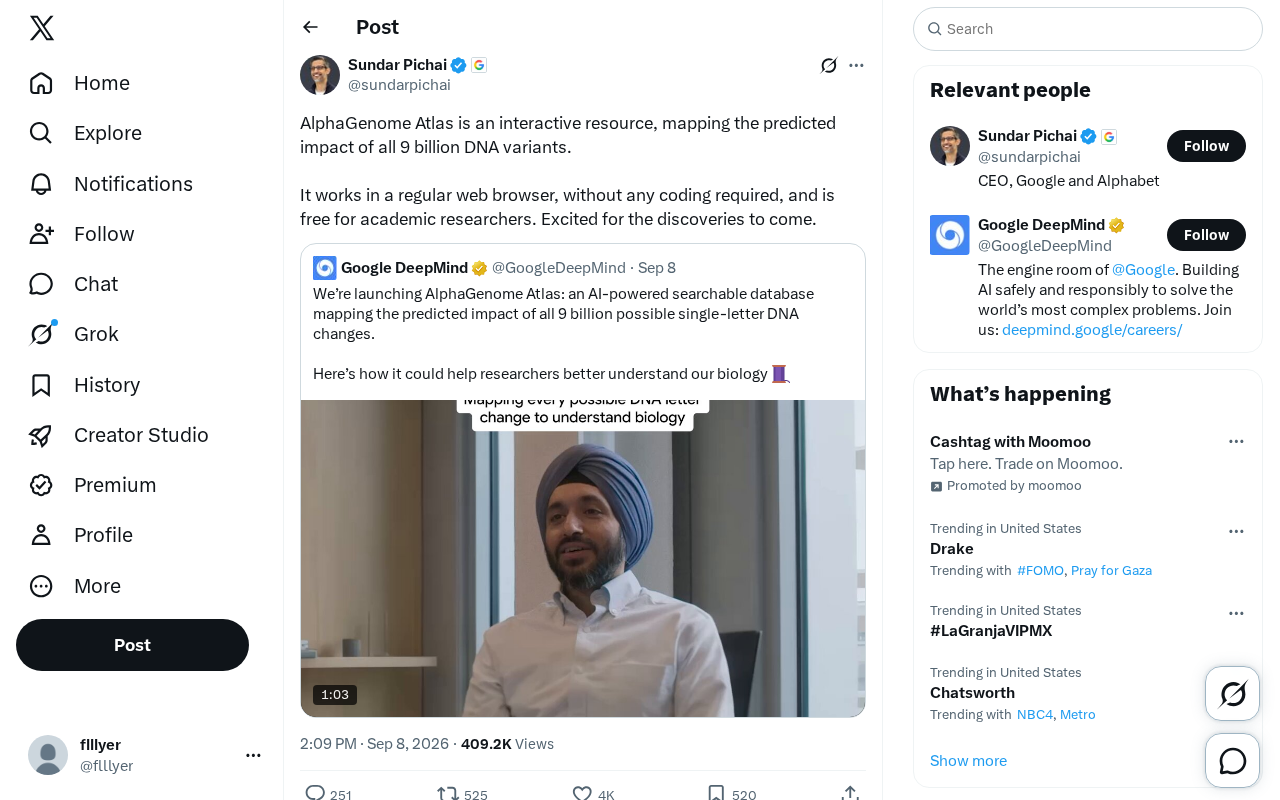
AlphaGenome Atlas maps AI-predicted impacts of 9 billion DNA variants in a free, no-code browser tool.
AlphaGenome Atlas is an interactive genomics resource from DeepMind that uses deep learning to systematically predict the functional impacts of all ~9 billion theoretically possible human DNA variants, packaged into a free, browser-accessible platform requiring no coding or local compute setup. Its key significance: countless rare or previously unrecorded variants have had no reference point — this full-coverage predictive map provides a prior starting point for rare disease research, clinical genome interpretation, and experimental design. Free for academic use, it has the potential to extend functional variant prediction beyond bioinformatics specialists to clinical geneticists and wet-lab researchers. Note that Atlas provides computational predictions, not experimental validation; technical details and benchmarks warrant further review before use in high-stakes settings.
A Genomic Variant Atlas Accessible from Any Browser
AlphaGenome Atlas is an interactive resource that systematically maps the predicted functional impacts of all ~9 billion possible DNA variants. In genomics research, variant annotation at this scale has historically required complex computational pipelines and specialized toolchains. The core value of AlphaGenome Atlas lies in consolidating these results into an interface that can be accessed directly through a standard web browser.
For researchers, the most immediate reduction in friction comes from two things: no coding required, and no need to set up a local computing environment. In the past, querying the functional predictions for a specific variant typically meant downloading massive datasets, configuring runtime environments, and writing custom scripts. Atlas puts the power of interactive exploration into the browser, making it accessible even to biologists without a programming background.
Why "9 Billion Variants" Is a Critical Number
The human genome contains approximately 3 billion base pairs, and in theory, each position can undergo multiple types of substitutions, insertions, or deletions. The phrase "all ~9 billion DNA variants" refers to systematic predictive coverage of this vast variant space — not just the known variants already observed in human populations.
The significance of this "full coverage" approach is this: many disease-causing or functionally relevant variants are extremely rare, and some have never been recorded in any existing database. When researchers discover a novel mutation, they often have nothing to reference if the tool only queries known variants. When a predictive map covers the complete theoretical variant space, the potential impact of any given position can be looked up — providing a prior reference for rare disease research, clinical genome interpretation, and functional experiment design.
Free and Open to Academic Researchers
AlphaGenome Atlas is freely available to academic researchers. This positioning aligns with the broader trend of openness among large sequence models and genomic prediction tools in recent years — by lowering the cost of access, a wider research community can leverage predictions generated by expensive high-performance computing, without each group having to repeat that computation independently.
Free access combined with zero-code requirements effectively redefines who can use such a resource. It is no longer limited to teams with bioinformatics expertise — clinical geneticists, wet-lab researchers, and even educators may all find value in it. The developers have expressed excitement about "discoveries to come," positioning the tool as an accelerator for scientific findings rather than an end product in itself.
Limitations to Keep in Mind
It is worth emphasizing that Atlas provides predicted impacts — not experimentally validated conclusions. Any computational model's assessment of variant function carries inherent uncertainty, and its predictions should serve as a starting point for research hypotheses, not as definitive verdicts. For high-stakes contexts such as clinical decision-making, experimental evidence and expert interpretation remain essential.
Additionally, the information currently available comes primarily from a brief release announcement. Technical details about the model architecture, training data, prediction accuracy, and benchmark performance have not been covered in the materials released so far. Researchers are encouraged to consult the accompanying documentation and methodology notes to understand the scope and limitations of the predictions before applying them in practice.
Background note: The underlying AlphaGenome model (released by DeepMind in 2025) uses a sequence-to-function deep learning framework inspired by earlier work such as Enformer — given a genomic sequence as input, it outputs predictions for multiple molecular phenotypes including gene expression, chromatin accessibility, and histone modifications. The accuracy of such models is heavily dependent on the quality and coverage of training data (primarily sourced from large functional genomics projects like ENCODE and GTEx); predictive reliability is significantly reduced for cell types or species underrepresented in the training data. Furthermore, these models are fundamentally predicting whether a variant affects a molecular phenotype — not directly predicting clinical presentation. Bridging from molecular predictions to disease association still requires additional layers of biological inference. When using Atlas, focusing on the specific molecular phenotype categories being predicted (e.g., splicing changes, regulatory element activity) and their associated confidence intervals will be more informative than relying on aggregate scores alone.
Potential Impact on Genomics Research Workflows
If Atlas's prediction quality holds up to scrutiny from the research community, it could become a standard entry point in variant annotation workflows. After identifying a new variant, researchers could immediately retrieve a preliminary functional assessment in the browser, enabling more efficient prioritization of candidates worth pursuing through in-depth experiments.
From a broader perspective, this kind of tool reflects a pragmatic direction for the intersection of AI and basic life sciences: not replacing experiments, but using large-scale predictions to narrow the experimental search space — concentrating limited experimental resources on the most promising targets. As more researchers engage with the tool and provide feedback, the value and credibility of the atlas itself will be tested and refined through use.
Background: Understanding the Scale
To put the numbers in context: the human genome has approximately 3 billion base pairs, and each position can undergo one of 3 possible single-nucleotide substitutions (SNVs), plus insertions and deletions (InDels) and other variant types — bringing the theoretical variant space into the tens of billions. In practice, public databases like dbSNP catalog roughly 1 billion known variants, but the vast majority have been observed only a handful of times or in a single individual (known as "private" or "ultra-rare" variants). The number of functionally significant variants in human populations that have never been recorded is difficult to estimate.
Earlier functional prediction tools (such as CADD, PolyPhen-2, and SIFT) can also score large numbers of variants, but the deep learning models used by AlphaGenome can directly predict multi-dimensional molecular phenotypes from sequence — including epigenetic states, splicing signals, and transcription factor binding — giving the concept of "predicted impact" far richer meaning than a single pathogenicity score. This is precisely what makes the coverage of ~9 billion variants notable given current technological capabilities.
Related articles
AI Agent Terminology Too Confusing? One Interactive Concept Map to Untangle 40+ Core Terms
Confused by AI Agent terms like MCP, harness, orchestration, and skills? AI Concept Atlas is an interactive map visualizing 40+ concepts and their relationships, with cited sources.
Meta's Broken Promise: Community Demands to Know Where the Muse Spark Weights Are
Meta promised to open-source Muse Spark model weights over a month ago, but still hasn't delivered. The community questions how this squares with Zuckerberg's "can't delay even a month" stance.
Running Qwen3 27B Locally on a Single RTX 5090: What Can It Actually Do?
A developer runs Qwen3 27B locally on a single RTX 5090 via the Row-Bot Agent framework, generating an 8-scene, 105-second interactive animation from one prompt — including real-time math, fractals, and physics.