Amazon May Negotiate with Meta to Lift Muse AI Shopping Block
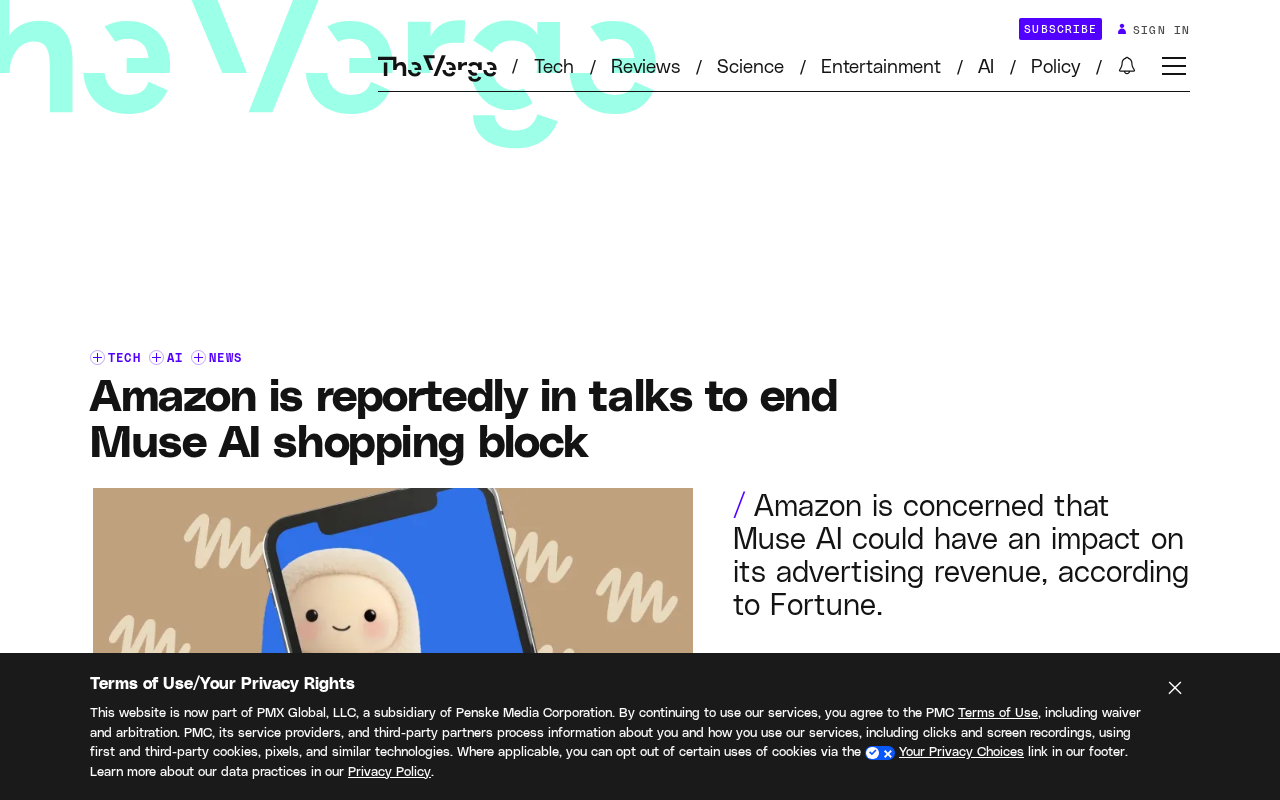
Amazon negotiates with Meta to unblock Muse AI shopping agent, focusing on product categories and ad revenue.
According to Fortune, Amazon blocked Meta's AI shopping agent Muse from completing purchases on its platform and is now negotiating to lift the block. The talks focus on what product categories Muse will recommend and how that affects Amazon's ad revenue, touching the sensitive core of AI agent shopping—where agents shift purchasing decisions to the model side and may bypass platform recommendation algorithms and ad bidding. The outcome may serve as a reference for other AI agent–e-commerce platform partnerships.
Why Amazon Blocked Meta's Muse AI Shopping Agent
According to Fortune, Amazon has begun negotiations over allowing Meta's AI shopping agent Muse to operate on its e-commerce platform. Previously, Amazon had blocked Muse, preventing the AI agent from completing shopping activities within its marketplace. The blocking itself is not surprising—for any e-commerce platform that relies on product recommendations and advertising revenue, an entry point where an external AI agent makes purchasing decisions on behalf of users is both a traffic opportunity and a direct challenge to the existing business model.
The core of the negotiation is not a simple "on or off" switch, but rather two specific questions: what types of products Muse will recommend, and the potential impact of such recommendations on Amazon's advertising revenue. These two issues strike at the most sensitive area of the AI agent shopping model.
Negotiation Focus: The Battle Over Product Categories and Ad Revenue
Fortune's report notes that one of the key points of discussion is the range of product categories recommended by the Muse AI agent. This may seem like a technical detail, but it actually concerns the distribution of interests within the platform ecosystem. If the AI agent tends to recommend products in specific categories or from specific sellers, the platform's product diversity and advertisers' exposure opportunities will both be affected.
Another focus is advertising revenue. Amazon's e-commerce business is deeply tied to its advertising business—sellers bid for exposure, and if an AI agent bypasses or weakens this mechanism by directly offering purchase recommendations, the platform's ad monetization path will be restructured. The negotiation aims to address exactly this: how to introduce an AI shopping entry point without disrupting the existing advertising revenue structure.
AI Shopping Agent refers to an intelligent agent driven by large language models that can complete the entire process from product discovery and comparison to placing orders on behalf of users. Unlike traditional price-comparison plugins or recommendation algorithms, AI agents have a degree of autonomous decision-making authority—they can proactively interact with e-commerce platform interfaces, filter products, and offer purchase recommendations. Their technical foundation typically includes tool use, web interaction capabilities, and multi-turn dialogue understanding. For platforms, such agents are both a new source of traffic and a potential means to bypass the platform's recommendation algorithms and ad bidding systems, directly changing users' purchasing paths—making them a focal point of interest negotiation between platforms and AI companies.
E-commerce ad bidding mechanism is the core source of Amazon's advertising revenue. Sellers bid on keywords or display positions through formats such as Sponsored Products, and the platform's algorithm determines exposure order based on bid, relevance, and conversion rate. This mechanism allows the platform to monetize traffic while influencing the product ordering users see. When an external AI agent makes purchasing decisions on behalf of users, if the agent bypasses the platform's ad ranking and directly offers recommendations, sellers' bid-based exposure opportunities will be weakened, and the platform's ad monetization chain will be bypassed. This is precisely the deeper reason why Amazon is focused on Muse's recommendation logic and product category scope in the negotiations.
AI Agent Shopping: Entry Point Migration and Platform Control
This negotiation reflects a larger industry question: when AI agents become the new entry point for user shopping, platform control is being redistributed. Traditional e-commerce traffic distribution is dominated by platform algorithms and advertising systems, while AI agents shift part of the decision-making power to the model side. For Amazon, blocking Muse was a defensive posture; negotiating is a pragmatic choice after acknowledging this trend.
From Meta's perspective, if Muse can access Amazon's marketplace, it means the utility of its AI agent will be significantly enhanced—users can complete the entire chain from discovery to purchase within a conversation. The outcome of the negotiations may provide a reference model for cooperation between other AI agents and e-commerce platforms.
Industry Impact and What to Watch
The negotiations are still ongoing, and the outcome remains uncertain. What is certain is that the relationship between AI shopping agents and e-commerce platforms will not have only one answer: "blocking." Platforms need to find a balance between an open ecosystem and protecting advertising revenue, while AI companies need to prove that their agents' behavior will not harm partners' commercial interests.
This event also provides an observation window for those following AI application deployment: the commercialization of AI agents depends not only on model capabilities but also on whether they can be embedded into existing interest chains. The direction of the Amazon-Meta negotiations deserves continued attention.
One-line Summary
Amazon is negotiating over its block on Meta's Muse AI shopping agent, with focus on product categories and ad revenue.
Paragraph Summary
According to Fortune, Amazon previously blocked Meta's AI shopping agent Muse from completing purchases on its platform, and the two sides are now negotiating to lift the block. The core of the negotiation is not a simple on/off switch but two specific questions: what product categories Muse will recommend and the potential impact of such recommendations on Amazon's ad revenue. The article notes this touches the most sensitive area of the AI agent shopping model—AI agents shift part of purchasing decision-making power to the model side and may bypass platform recommendation algorithms and ad bidding mechanisms. The event reflects a larger industry question: as AI agents become a new shopping entry point, platforms need to balance an open ecosystem with protecting ad revenue, and the negotiation outcome may provide a reference for cooperation between other AI agents and e-commerce platforms.
Related articles

GLM-5.4 Released: How a 750B Model Achieves Stronger Reasoning
Zhipu AI releases GLM-5.4, a 750B model that boosts reasoning by running the middle 28 layers twice. GPQA Diamond rises from 47.58 to 56.26, with 1M token context and weights to be open-sourced after safety hardening.

Understanding GLM 5.4 in 8 Minutes: How Loop Transformer Makes AI Smarter Without More Parameters
GLM 5.4 didn't grow its parameters yet got smarter. Using the memorizer-vs-reasoner analogy, this article explains how Loop Transformer runs the middle 28 steps twice, how gated progressive update and two other techniques stabilize the second pass, and how generalized Coding uses code to command 3D, mechanical design, and game development — with official comparison data and open questions.

GLM-5.4 Released: An In-Depth Look at Zhipu's First Loop Transformer Flagship Model
Zhipu releases GLM-5.4, its first Loop Transformer flagship. Built on GLM-5 with 28 layers looped twice—no extra params, ~10% more compute, stronger math and long-context reasoning.