Understanding GLM 5.4 in 8 Minutes: How Loop Transformer Makes AI Smarter Without More Parameters

GLM 5.4 keeps its parameter count unchanged, boosting reasoning via Loop computation and generalized Coding strategies.
The article uses the 'Abei and Asuan' analogy from a Bilibili creator to distinguish two AI capabilities: memorizing knowledge through parameters versus multi-step reasoning through computation. GLM 5.4 does not increase its 750-billion parameter scale; instead it adopts Loop Transformer, running the middle 28 steps twice so each word passes through 106 steps — an 'extra pass of mental math.' Official small-model tests show gains in math and scientific reasoning with more concise output. To handle numerical instability and memory overhead, Zhipu uses gated progressive update, KV Cache reuse, and attention key-point reuse. Generalized Coding lets the model command 3D and mechanical design software via code. The article also notes self-testing limitations, the model's tendency to 'think endlessly,' and open questions about more loop iterations.
Two Types of Students: The Memorizer and the Reasoner
The UP host first introduces two students. Abei is a "memorizer" who knows the textbook inside out. Asuan is a "reasoner" who is average at memorizing but exceptionally good at thinking. During an exam, Abei breezes through the fill-in-the-blank and dictation questions, but on the final big problem that requires a dozen steps of derivation, Abei can't recall the answer from memory — yet Asuan can work it out step by step.
This analogy maps to AI in terms of two distinct capabilities: answering by memorizing large amounts of knowledge, and answering through multi-step reasoning. Zhipu's judgment is that memorizing relies on parameters, while reasoning relies on computation. Writing large programs, building 3D models, designing machinery — all of these require dozens of interlocking steps of derivation that can't be memorized no matter how large the brain capacity.
First, Understand: How Does AI "Answer Questions"?
To understand GLM 5.4's approach, you first need to know how large models work. When you type on your phone's input method every day, it guesses your next word — you type "It's raining today, remember to bring an" and it suggests "umbrella." That's exactly what AI does: guess the next word, except it guesses extremely accurately and can keep guessing continuously to form a passage.
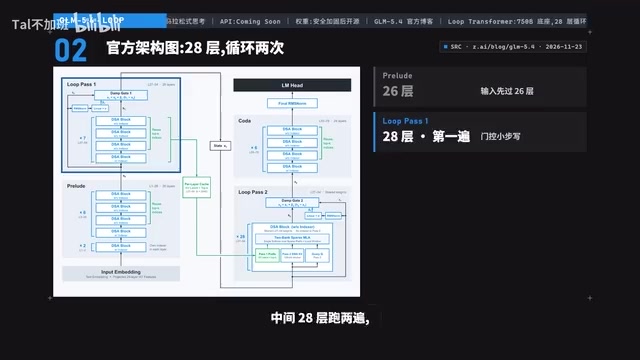
For each word it guesses, the model internally runs through an "assembly line," where every word must be processed step by step before it exits. This assembly line has a technical name: Transformer. GLM 5.4's assembly line has 78 steps in total, and each step contains what was learned during training — namely, parameters. GLM 5.4 has 750 billion parameters (the original spoken text says "7500 yi," which should mean 750 billion) — the larger the number, the more knowledge it can hold. But a large brain capacity doesn't equal reasoning ability, and that's exactly where the problem starts.
Transformer is a neural network architecture proposed by the Google team in the 2017 paper "Attention Is All You Need," and virtually all mainstream large language models today are built on it. Its core is the self-attention mechanism: when processing each word, the model computes how relevant that word is to every other word in the sentence, thereby dynamically deciding which positions to "look back" at. This mechanism is what allows the model to understand long-distance semantic dependencies — for example, which noun a pronoun refers to earlier in the text. The "assembly line steps" mentioned in the article correspond to Transformer layers, each containing an attention sub-layer and a feed-forward network sub-layer; 78 steps means 78 layers. The number of layers determines the depth of information processing, while the parameter count per layer determines how many patterns that layer can store.
Two Paths to Scaling: Stack Parameters or Stack Computation
There are two ways to make AI more capable. The first is to hold more knowledge — give it a bigger brain capacity. This is called adding parameters. The second is to let it think longer — reason more deeply on each problem. This is called adding computation. The industry calls the latter "Scaling," which basically means throwing more resources at it. The core question a Scaling strategy answers is actually: where do you throw them?
Zhipu's choice was not to pick one between "Abei" and "Asuan." The official statement is "not either-or, but both advancing together": continue enlarging the brain while continuing to research how to think more deeply. They also revealed that the next model will be significantly larger in scale.
Loop Transformer: No Extra Steps, but the Middle Runs Twice
The key trick GLM 5.4 uses this time is called Loop, meaning cycling. Not a single step was added to the 78 steps, but the middle 28 run twice. The brain is still the same brain, yet each word actually passes through 106 steps — no extra equipment purchased, but the work is done more thoroughly.
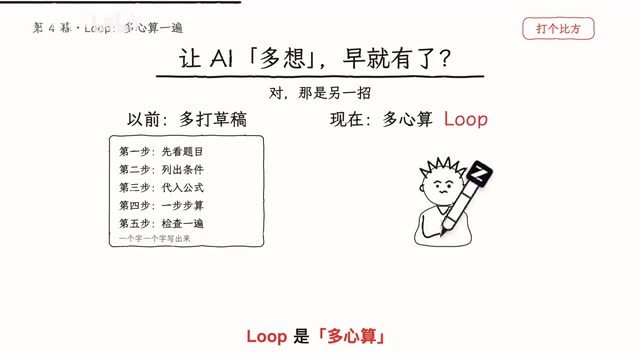
How is this different from previous "thinking more"? Previously, AI was made to draft more — writing out step-by-step thoughts for you to see, with each character popping out one by one, visible and time-consuming. Loop makes it do more mental math: not a single extra character written, but an extra pass of calculation in its head before speaking. Drafting is writing out thoughts; mental math is thinking once more before opening your mouth — and the two tricks can be used together.
Does an Extra Pass of Mental Math Really Help?
Zhipu ran a comparative experiment: two small models with the same brain size, one thinking one extra pass and one not. Math competition problems rose from 19 to 30 points (out of 100), and scientific reasoning problems rose from 48 to 56. Even more interestingly, it also became less verbose — in most subjects it said over 10% less. More mental calculation means less need to ramble. Note that this was tested by the officials themselves using small models, not GLM 5.4 itself.
Three Troubles with the Extra Pass and Their Solutions
The extra pass comes at a cost — the second pass brings three troubles, and Zhipu provides a solution for each.
Trouble one: Will the second pass mess up the first pass's results? If done naively, yes — the numbers in the brain keep growing, and everything downstream goes haywire. The solution is to write lightly on the first pass, like sketching in pencil; then on the second pass, look carefully before pressing down hard, and the harder the spot, the more effort goes into the first pass. This technique is called gated progressive update.
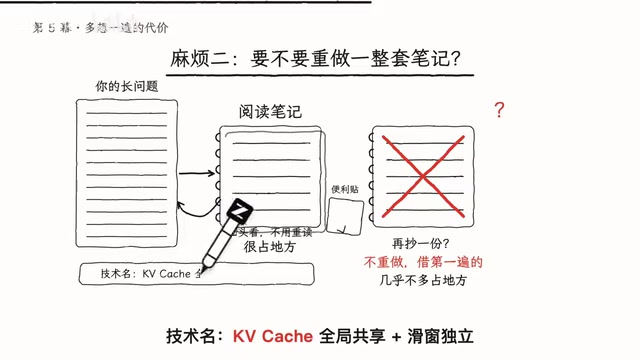
Trouble two: Does the extra pass require redoing the entire set of reading notes? When AI reads a long problem, it takes reading notes, and every subsequent word it says relies on looking back at these notes. The solution is not to redo them but to borrow the first pass's notes directly, only keeping a separate "sticky note" for the most recently read small segment — this takes almost no extra space.
Trouble three: Does the second pass need to re-highlight the key points? For very long inputs, AI doesn't reread every word but first highlights the key points and focuses only on the most relevant segments. The solution is not to re-highlight but to use what the first pass already marked — officially, the effect is almost the same as re-highlighting.
All three solutions make the second pass both stable and economical. As for speed, the official figures are: up to 200 tokens per second when few people are using it, and 70 to 80 even when many are. A token can be understood as a small chunk of text.
The "reading notes" and "highlighting key points" mentioned in the article correspond to the technical terms KV Cache and sparse attention, respectively. KV Cache means caching the Key/Value vectors of already-processed tokens during inference and reusing them directly when generating new words, avoiding redundant computation — equivalent to "not redoing the reading notes." "Highlighting key points" refers to sparse attention or sliding-window attention: when the sequence is very long, the model lets each token attend only to the most recent segment or the few most relevant positions, thereby reducing computation from quadratic to linear. Loop's second pass reusing these two types of caches is essentially completing extra computation without increasing memory or compute. Gated progressive update borrows the gating idea from residual connections, using a learnable scaling coefficient to control the strength of the second pass's writes and prevent numerical accumulation from exploding.
Generalized Coding: Using Code to Command the Entire Computer World
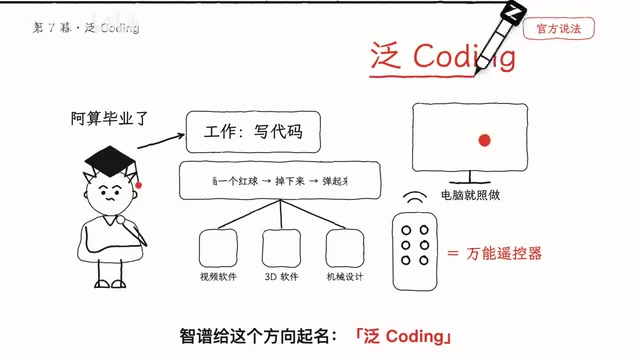
In the story, Asuan graduates and gets a job writing code. Code is the instruction you give the computer: you say draw a red ball here, make it fall and then bounce back up, and the computer does it. Video software, 3D software, mechanical design software on a computer are all controlled by code behind the scenes. So code equals getting a universal remote for the computer world.
Zhipu calls this direction "generalized Coding" — "generalized" meaning not just writing programs but using the craft of programming to do other jobs. The officials showcased four works: a music video whose visuals were all drawn in real time by code, without a single image asset; a 3D bird built entirely from mathematical calculations without any ready-made model; a six-axis robotic arm modeled in professional mechanical design software; and a complete game character with physics, maps, and combat all included.
Two clarifications here. First, GLM 5.4 is not a model that directly generates video — it writes code to command those software tools to do the work. Second, these works were made bit by bit by creators with professional tools, not popped out from a single sentence; the music for that song also called on another music model.
On coding ability, the officials compared against 200 real programming problems: against its previous generation it won more than half; against one competitor it's not yet truly competitive; against another it's basically a draw. A reminder: the problems were set and graded by the officials themselves, so take it with a grain of salt and don't treat it as conclusive. The officials also acknowledge one flaw: it tends to think endlessly, which they call "thunderous overthinking."
Things Not Yet Figured Out
This strategy wasn't adopted on a whim: it was first validated on a 1-billion-parameter small model, then worked at 4 billion and 30 billion, before they dared use it on the 750-billion-parameter flagship. But unresolved questions remain — currently it only thinks one extra pass; whether three or five extra passes still work, the officials say they don't know yet. They also want to achieve thinking less on easy parts and more on hard parts, but that's just a direction, not yet accomplished.
Three-sentence summary: Brain capacity and depth of thinking are two different abilities, and AI needs to train both; GLM 5.4's brain didn't get bigger — it just thinks through the middle section one extra pass; being able to write code means being able to command the entire computer. Remember Abei and Asuan, and you'll remember this whole approach.
One-line Summary
GLM 5.4 keeps its parameter count unchanged, relying on Loop cyclic computation and generalized Coding strategies to boost reasoning ability.
Paragraph Summary
The article borrows the analogy of "Abei and Asuan" from a Bilibili creator to distinguish two AI capabilities: memorizing knowledge through parameters versus multi-step reasoning through computation. GLM 5.4 does not increase its 750-billion parameter scale; instead it adopts Loop Transformer, running the middle 28 steps twice so each word actually passes through 106 steps — equivalent to "an extra pass of mental math." Official small-model comparisons show improved math and scientific reasoning scores with more concise output. To address numerical instability and memory overhead from the second pass, Zhipu employs three techniques: gated progressive update, KV Cache reuse, and attention key-point reuse. Generalized Coding lets the model command professional software like 3D and mechanical design tools by writing code. The article also notes limitations of official self-testing, the model's tendency to "think endlessly," and open questions about whether more loop iterations remain effective.
Related articles

GLM-5.4 Coding Test 4.6x Slower? Unpacking the Loop Transformer Architecture
GLM-5.4 coding test took 431 minutes vs. competitor's 109, 4.6x more steps. We analyze its Loop Transformer architecture, KingBench4 score of 55.3, Max tier's 1.04M token cost, and tier selection advice.

Zhipu GLM-5.4 Quietly Released: A Debut for Loop Transformer Architecture
Zhipu GLM-5.4 quietly lands in coding plans: first Loop Transformer flagship with 750B params, 1M token context, AIM math up from 19.2 to 30.4, and native vision for coding from screenshots.
GLM-5.4 Releases 750B Model: Recurrent Transformer Architecture and the 30B Benchmark Controversy
GLM-5.4 releases a 750B model with a recurrent Transformer architecture that runs the same layers twice, claimed to match 2T–3T scale. But the benchmark table tests a 30B small model, not the main model. We break down the architecture changes, benchmark data, four demos, and open-source timeline.