GLM-5.4 Released: An In-Depth Look at Zhipu's First Loop Transformer Flagship Model
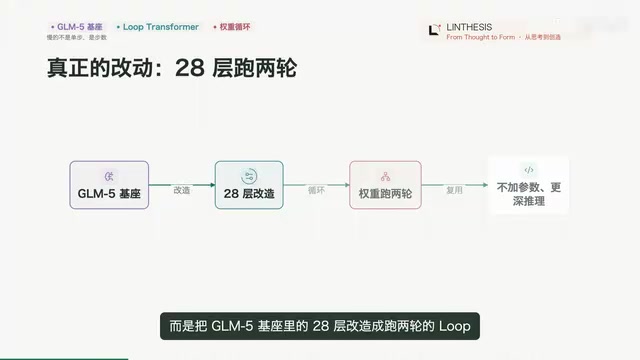
Zhipu releases GLM-5.4, its first Loop Transformer flagship—no added parameters, deeper reasoning.
Zhipu launches GLM-5.4, its first flagship model on the Loop Transformer architecture. Adapted from GLM-5, it loops its middle 28 layers twice, adding reasoning depth without new parameters. Training needs only ~10% more compute, math, science, and long-context abilities improve markedly, and explicit thinking shrinks ~10%. It handles multi-step planning like code-based video editing, game building, and robotic arm design, but can get stuck looping—a flaw dubbed "Thunderous Deep Thinking." Officially "just the beginning," with a larger successor coming soon.
GLM-5.4 Released: An In-Depth Look at Zhipu's First Loop Transformer Flagship Model
Zhipu has released GLM-5.4, its first flagship large model built on the Loop Transformer architecture. Unlike the usual approach of simply stacking more layers and parameters, GLM-5.4 chooses to run the same set of layers through a second pass—replacing "remembering more" with "thinking deeper." This model was adapted from the GLM-5 base and achieves significant gains in mathematics, scientific reasoning, and long-context tasks, while its thinking process actually becomes shorter. This article breaks down the model's real value across four dimensions: architecture principles, training strategy, benchmark performance, and capability boundaries.
Loop Transformer: Running the Same Set of Layers Twice
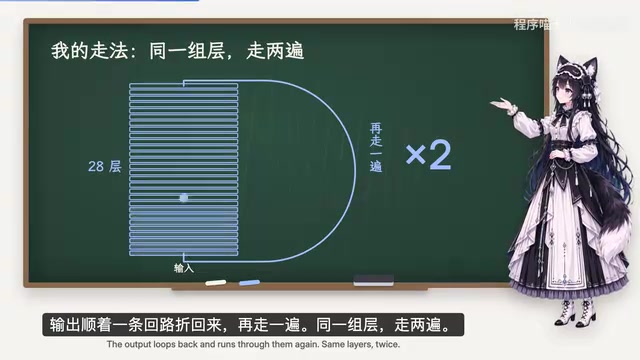
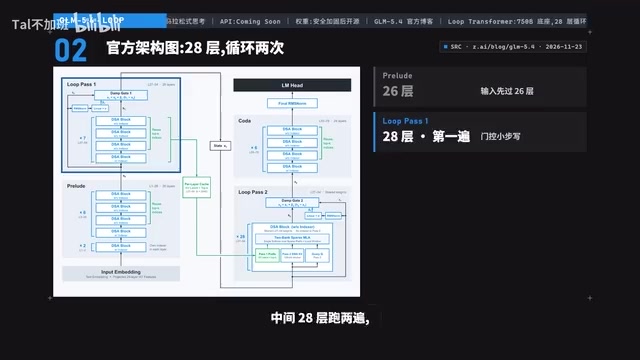
A traditional Transformer operates like a one-way street: each token travels from the first layer to the last, and after a single pass, the answer is output. The conventional way to make a model think deeper is to add layers, add parameters, and increase model size. GLM-5.4 takes a different path—after its middle 28 layers complete the first pass, they don't directly produce a result. Instead, the output is folded back along a loop, letting the same set of layers run through again, with the second pass continuing the reasoning from where the first left off.
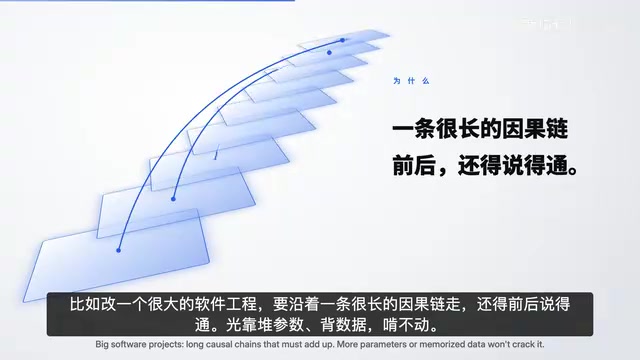
The key point is that the layers are still those same 28 layers, not a single parameter is added—what increases is "depth." Using the analogy from the official video: the first pass looks at the big picture, the second pass refines it. This mechanism targets tasks that depend on thinking deeply rather than remembering a lot. For example, modifying a very large software project requires pushing along a long causal chain while keeping the logic consistent throughout. Such tasks are hard to crack by merely stacking parameters and memorizing data.
It's worth noting that the loop structure itself is not new—similar ideas were proposed as early as 2018. The real difficulty lies in scale: loop models trained from scratch, given the same compute, actually underperform ordinary models. This explains why Loop Transformer has long remained at the paper level, and why GLM-5.4 chose a more pragmatic engineering route.
Loop Transformer and Parameter Sharing
The core idea of Loop Transformer is parameter sharing: the same set of Transformer layers is invoked multiple times during inference, with each invocation reusing exactly the same weights. This stands in stark contrast to traditional Transformers, where each layer has its own independent parameters. Parameter sharing is not a new concept—Universal Transformer (2018) proposed having all layers share the same set of weights and dynamically deciding the number of loops through an Adaptive Computation Time (ACT) mechanism. However, early work faced vanishing gradients and optimization difficulties, and was less efficient than standard Transformers in large-scale training. GLM-5.4's engineering contribution lies in its strategy of "base adaptation + training only the loop portion," which bypasses the slow convergence and low compute efficiency of training loop models from scratch, enabling the loop structure to land on a flagship-level large model for the first time.
Adapted from the GLM-5 Base, Not Trained from Scratch
Faced with the industry challenge that "training a loop model from scratch isn't worthwhile," the Zhipu team did not start from zero. Instead, they took the already-trained GLM-5 base and continued training it, transforming it into a loop structure. The value of this strategy: the base has already absorbed vast knowledge and language capabilities, so the adaptation only needs to teach the model the "run it twice" reasoning approach rather than relearning everything.

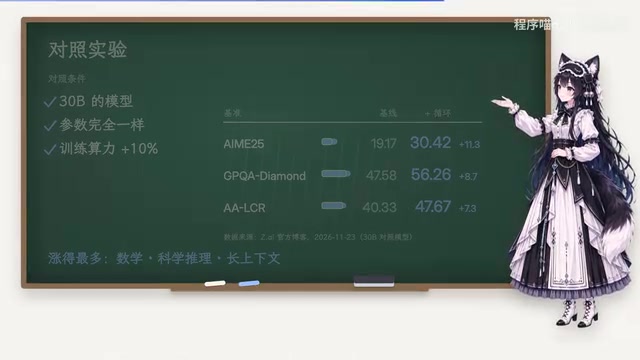
From an engineering perspective, this is a highly cost-effective architectural upgrade. The team's published controlled experiments show that for the same 30B model with identical parameters, training costs only about 10% more compute, and after adding the loop, the most notable improvements are in mathematics, scientific reasoning, and long-context capabilities. In other words, the model's capability growth does not come from parameter inflation but from a longer reasoning path.
This approach has reference value for the large-model industry. As the marginal returns of parameter scaling begin to diminish, architectural "reasoning depth" may become a new competitive dimension. The GLM-5.4 example shows that structural adaptation on an existing base is more realistic than tearing everything down and starting over.
The Engineering Logic of Base Adaptation
"Base adaptation" refers to adjusting an already pre-trained standard Transformer model into a loop mode through continue training, rather than training from scratch after random initialization. The GLM-5 base has already acquired general language representations and world knowledge from massive corpora; the adaptation phase only needs to make the model adapt to the new computation graph of "running the same set of layers twice." In practice, this typically requires inserting gating or adapter layers at the loop's entry and exit points to distinguish the input distributions of the first and second passes. Compared with training from scratch, the adaptation strategy saves the vast majority of pre-training compute and avoids the inherent defect of loop models—difficulty converging in early training due to longer gradient propagation paths. This staged approach of "learn knowledge first, then learn to think" provides a reusable engineering paradigm for other architectural innovations.
Shorter Thinking Process, Controllable Inference Cost
The loop structure naturally raises concerns: does running twice mean slower inference and doubled cost? GLM-5.4's answer is no. Official data shows that the model's written thinking process actually becomes about 10% shorter—some reasoning no longer needs to be written out token by token but is instead placed directly into the loop to "think."
The key to cost control is memory reuse. The second loop pass reuses the memory from the first pass, retaining only a small window, so the extra pass isn't expensive. This "implicit thinking" design shifts part of the reasoning burden from explicit output to the internal loop, appearing externally as more concise answers and internally as more thorough deliberation.
For actual users, this means two things: first, the output tokens per task may decrease; second, the quality of completing complex reasoning tasks improves. Combined, the loop architecture is viable in terms of inference economics.
Implicit Thinking vs. Explicit Chain-of-Thought
"Implicit thinking" means the model completes part of its reasoning steps within the internal loop, rather than outputting intermediate processes token by token as in Chain-of-Thought (CoT). Traditionally, improving complex reasoning capabilities often relies on explicit chain-of-thought—the model generates a large number of intermediate tokens that are visible to the user but consume output cost. GLM-5.4's loop structure allows the second pass to reuse the hidden states (memory) from the first pass, completing refinement internally and thereby reducing the number of explicitly output tokens. This design resembles how humans "draft silently": simple tasks get a direct answer, while complex tasks are reasoned through in the mind before being expressed concisely. The cost is reduced interpretability of the reasoning process, but in exchange for lower output cost and shorter response length. For API services requiring high throughput, implicit thinking can significantly reduce the inference overhead per task.
What It Can Do, and the Boundaries of "Thunderous Deep Thinking"
In terms of capability demonstrations, GLM-5.4 covers a fairly broad task spectrum: editing videos with code, building games, 3D modeling, and even designing six-axis robotic arms. What these tasks have in common is the need for multi-step planning and causal chain reasoning, which exactly matches what the loop architecture excels at—"thinking deeply."
But the model also has obvious flaws. The team openly admits that GLM-5.4 sometimes thinks too long, spinning in the loop and unable to stop—they've nicknamed this phenomenon "Thunderous Deep Thinking." This exposes the inherent risk of the loop architecture: there is only a fine line between reasoning depth and reasoning runaway. How to open up the loop when deep thinking is needed and converge promptly on simple tasks is an engineering problem such models must solve.
Final Thoughts
GLM-5.4 is the Zhipu team's first flagship model built with Loop Transformer, and its core action is just one: running the same set of layers through one more pass. Parameters unchanged, only 10% more compute, yet mathematics, scientific reasoning, and long-context capabilities rise noticeably, and the thinking process is even shorter.
Officially, this generation is positioned as "just the beginning," and the team has revealed that the next model will be much larger than GLM-5.4 and will be released soon. If the scaling path of the loop architecture can continue, then the next competitive focus for large models may no longer be "who has more parameters" but "who knows how to think."
One-line Summary
Zhipu releases GLM-5.4, its first Loop Transformer flagship model—no added parameters, deeper reasoning.
Paragraph Summary
Zhipu has launched GLM-5.4, its first flagship large model built on the Loop Transformer architecture. Adapted from the GLM-5 base, the model runs its middle 28 layers through two passes, adding reasoning depth without adding parameters. Training costs only about 10% more compute, while mathematics, scientific reasoning, and long-context capabilities improve significantly and the explicit thinking process actually shrinks by about 10%. The model supports multi-step planning tasks such as code-based video editing, game building, 3D modeling, and six-axis robotic arm design, but suffers from a "Thunderous Deep Thinking" problem of being unable to stop in the loop. Officially positioned as "just the beginning," the next generation will be larger.
Related articles
GLM-5.4 Coding Test 4.6x Slower? Unpacking the Loop Transformer Architecture
GLM-5.4 coding test took 431 minutes vs. competitor's 109, 4.6x more steps. We analyze its Loop Transformer architecture, KingBench4 score of 55.3, Max tier's 1.04M token cost, and tier selection advice.

Zhipu GLM-5.4 Quietly Released: A Debut for Loop Transformer Architecture
Zhipu GLM-5.4 quietly lands in coding plans: first Loop Transformer flagship with 750B params, 1M token context, AIM math up from 19.2 to 30.4, and native vision for coding from screenshots.
GLM-5.4 Releases 750B Model: Recurrent Transformer Architecture and the 30B Benchmark Controversy
GLM-5.4 releases a 750B model with a recurrent Transformer architecture that runs the same layers twice, claimed to match 2T–3T scale. But the benchmark table tests a 30B small model, not the main model. We break down the architecture changes, benchmark data, four demos, and open-source timeline.