GLM-5.4 Released: How a 750B Model Achieves Stronger Reasoning

Zhipu releases 750B GLM-5.4, using repeated middle layers to deepen reasoning, with major benchmark gains and plans to open-source.
Zhipu AI releases GLM-5.4 with 750B parameters, said to be roughly equivalent to the two-to-three-trillion-parameter tier. Its core innovation runs the middle 28 layers twice—first to build global structure, then to correct it—increasing computational depth without adding parameters. GPQA Diamond rises from 47.58 to 56.26 and M25 from 19.17 to 30.42, while answers shrink about 10%, showing internalized reasoning. Practical metrics include 1M token context, 200 tokens/sec off-peak, and 70-80 tokens/sec at peak. Officials demoed long-chain tasks like MV generation, FreeCAD robotic arm design, a full game, and 3D scene building, and admitted occasional long thinking loops. Weights will be open-sourced after safety hardening, with a larger model coming soon.
Title
GLM-5.4 Released: How a 750B Model Achieves Stronger Reasoning
Meta Description
Zhipu AI releases GLM-5.4, a 750B-parameter model that boosts reasoning depth by running the middle 28 layers twice. GPQA Diamond rises from 47.58 to 56.26, with 1M token context, 200 tokens/sec off-peak, and weights to be open-sourced after safety hardening.
Article Content
Zhipu AI has officially released GLM-5.4, a large model with 750B parameters. The company positions its intelligence level at the "two to three trillion parameter" tier, but the parameter count itself isn't the point—what's truly noteworthy is the substantive change in its stability on complex tasks and its reasoning efficiency.
Complex Tasks No Longer "Break Midway"
According to the official demo content posted on Bilibili, GLM-5.4's most intuitive improvement shows up in long-chain tasks: mathematical derivation, scientific problem analysis, whole-document comprehension, and other scenarios requiring multi-step reasoning—the model is less likely to "break off" midway. This addresses a long-standing pain point in real-world use of large models: when the task chain grows long, the model often loses context or drifts from the goal at some intermediate step, rendering the final result unusable.
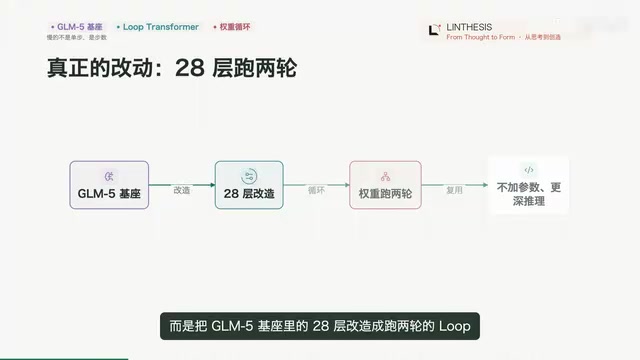
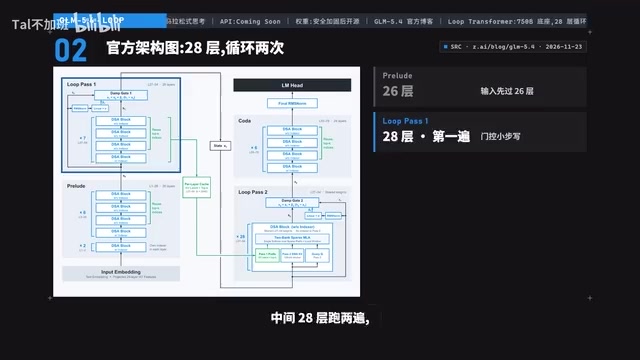
The official solution is quite clever: run the middle 28 layers of the network twice. The first pass builds the global structure, and the second pass corrects on top of that structure. No parameters are added; what's added is computational depth. This "repeated layer" design gives the model stronger reasoning capability without inflating the parameter count.
Background on the "Repeated Layer" Design and Computational Depth
In large model architectures, a Transformer is typically stacked from dozens of layers, each containing an attention mechanism and a feed-forward network. Under the traditional approach, improving model capability relies mainly on increasing layers or parameters, but this brings simultaneous expansion of memory and training costs. GLM-5.4's "repeated middle layers" is a computational depth extension strategy: the same set of weights is invoked multiple times, equivalent to letting the network perform more rounds of representation transformation without adding new parameters. This resembles the iterative idea of "recurrent neural networks," but operates at the Transformer's layer level. Academia has previously explored "layer reuse" and "recursive depth," and the core trade-off is: exchanging more computation time for stronger intermediate representation correction, at the cost of potentially higher inference latency. Understanding this makes it clear why GLM-5.4 can improve the stability of multi-step reasoning without changing parameters.
Benchmark Data: Significant Reasoning Improvement
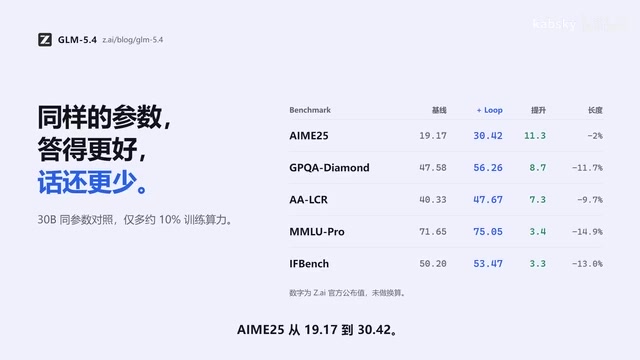
Under the same parameter conditions, GLM-5.4 shows clear progress on reasoning benchmarks. Official comparison data shows: GPQA Diamond rises from 47.58 to 56.26, and M25 rises from 19.17 to 30.42. These two metrics correspond respectively to high-difficulty scientific Q&A and multi-step reasoning tasks, and the magnitude of improvement reflects that the model has genuinely become stronger in scenarios requiring deep thinking.
Another interesting change: answers actually got about 10% shorter. The official explanation is that part of the reasoning process has been moved inside the model, so there's no longer a need to write out all intermediate steps in the output. For users, this means more concise replies; for the system, it means optimized inference efficiency.
What Are GPQA Diamond and M25
GPQA Diamond is the hardest subset of the GPQA (Graduate-Level Google-Proof Q&A) benchmark. The questions are written by domain experts and cover advanced scientific topics in physics, chemistry, biology, and more, and are designed so that ordinary search engines struggle to directly provide answers—making it a hard indicator of a model's "deep scientific reasoning" capability. M25 is an evaluation set for multi-step mathematical and logical reasoning, emphasizing the model's ability to maintain goal consistency in long-chain derivations. What both share is that they don't just look at the final answer; they test whether the model can avoid losing context across multiple reasoning steps. GLM-5.4's improvement on these two benchmarks corresponds exactly to what the article calls "complex tasks no longer breaking midway," indicating the improvement isn't merely from memorization or pattern matching, but from enhanced robustness of the reasoning chain.
Speed and Context: Hard Metrics at the Practical Level
On speed, GLM-5.4 reaches up to 200 tokens per second during off-peak hours, and 70 to 80 tokens per second during peak hours. The context window is 1 million tokens, so an entire document or an entire codebase can be placed in at once.
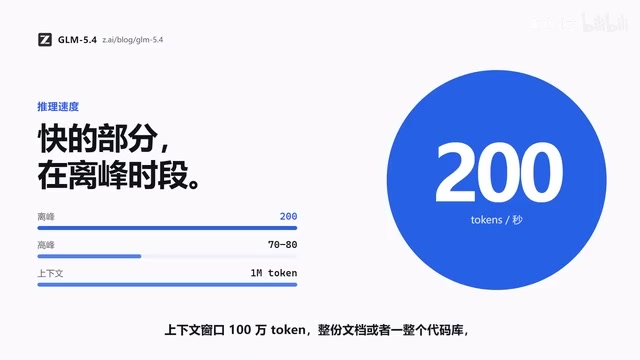
These two metrics directly determine the model's usable scenarios. A 1-million-token context means users no longer need to manually split documents or codebases; the model can process the complete information source at once, which is especially important for tasks like code review, long-document analysis, and understanding large projects.
What a 1-Million-Token Context Means
A token is the basic unit of text processed by a model; in Chinese, roughly one character or one word corresponds to one to two tokens. A 1-million-token context window is approximately equivalent to holding hundreds of thousands of Chinese characters at once, or a substantial portion of a medium-sized code repository. Traditional model contexts are usually only tens of thousands of tokens, so users need to chunk long documents and feed them in segments, easily losing cross-paragraph associations. Million-level context lets the model "see" the complete information source at once, reducing the hassle of manual splitting and reassembly in scenarios like code review, contract comparison, and analysis of lengthy scientific papers. However, the longer the context, the greater the attention computation overhead, and the actual usable length is also limited by inference speed and memory, so this metric needs to be viewed in conjunction with the tokens/second speed.
Broadening Capability Boundaries: From Generating MVs to Building 3D Scenes
The official demo showcases four use cases illustrating GLM-5.4's capabilities on creative and technical tasks: generating an MV with a horse, designing a six-axis robotic arm in FreeCAD, creating a complete game with physics and a combat system, and building a 3D scene you can walk into using pure geometry and shaders.
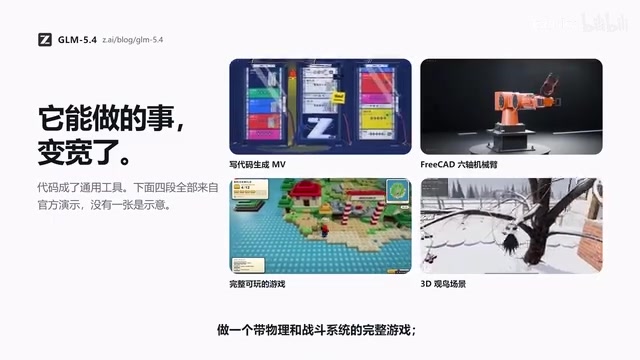
What these demos share is: large task spans, requiring multi-step planning, and involving knowledge integration across different domains. The model's ability to complete such tasks shows that its capability boundary has extended from "answering questions" to "completing projects."
Imperfections and Open-Source Plans
The officials candidly admit the model isn't perfect: sometimes it gets stuck in very long thinking loops. But the same explanation also notes that this kind of repeated self-correction behavior yields gains in accuracy weight beyond the parameter scale. In other words, thinking loops are a side effect of increased reasoning depth, not a pure defect.
The weights will be open-sourced after safety hardening. The officials also revealed that the next, larger model is coming soon.
What "Open-Sourcing After Safety Hardening" Usually Involves
Safety hardening before open-sourcing a large model generally involves several types of work: first, alignment training, using human feedback or rule constraints to reduce the probability of the model outputting harmful content, leaking privacy, or assisting malicious behavior; second, red-team testing, where specialized teams simulate adversarial prompts to find jailbreak or abuse paths and patch them; third, drafting licenses and terms of use to clarify the commercial scope of the weights and the boundaries of responsibility. For a 750B-level model, hardening also requires assessing the hardware threshold for inference deployment and potential abuse risks. Therefore, "open-sourcing after safety hardening" doesn't mean immediately releasing all weights, but rather a process involving technical, legal, and ethical review; when the community gets the weights depends on the completion of these steps.
Analysis: Computational Depth Takes Priority Over Parameter Inflation
GLM-5.4's release sends a clear signal: beyond the parameter-scale race, improving computational depth through architecture design is a viable path. The repeated middle layers approach improves reasoning capability without adding parameters, and shorter answers show that the model has learned more efficient internal reasoning.
For developers and enterprise users, a 1-million-token context, off-peak speed of 200 tokens/second, and improved stability on complex tasks are more practical considerations than parameter numbers. Open-sourcing the model after safety hardening will also give the community an opportunity to verify these capabilities.
One-line Summary
Zhipu releases the 750B GLM-5.4, using repeated middle layers to boost reasoning depth, with significant benchmark gains and plans to open-source.
Paragraph Summary
Zhipu AI releases GLM-5.4 with 750B parameters, which the company says is roughly equivalent to the two-to-three-trillion-parameter tier in intelligence. The core innovation is running the middle 28 layers twice: the first pass builds the global structure, the second corrects it, thereby increasing computational depth without adding parameters. On benchmarks, GPQA Diamond rises from 47.58 to 56.26 and M25 from 19.17 to 30.42, while answer length actually shrinks by about 10%, indicating some reasoning has been internalized. Practical metrics include a 1-million-token context, 200 tokens/second off-peak, and 70-80 tokens/second at peak. Officials demonstrated long-chain tasks such as MV generation, FreeCAD robotic arm design, a complete game, and 3D scene building, and candidly admitted the model occasionally has long thinking loops. Weights will be open-sourced after safety hardening, and the next, larger model is coming soon.
Related articles
GLM-5.4 Coding Test 4.6x Slower? Unpacking the Loop Transformer Architecture
GLM-5.4 coding test took 431 minutes vs. competitor's 109, 4.6x more steps. We analyze its Loop Transformer architecture, KingBench4 score of 55.3, Max tier's 1.04M token cost, and tier selection advice.

Zhipu GLM-5.4 Quietly Released: A Debut for Loop Transformer Architecture
Zhipu GLM-5.4 quietly lands in coding plans: first Loop Transformer flagship with 750B params, 1M token context, AIM math up from 19.2 to 30.4, and native vision for coding from screenshots.
GLM-5.4 Releases 750B Model: Recurrent Transformer Architecture and the 30B Benchmark Controversy
GLM-5.4 releases a 750B model with a recurrent Transformer architecture that runs the same layers twice, claimed to match 2T–3T scale. But the benchmark table tests a 30B small model, not the main model. We break down the architecture changes, benchmark data, four demos, and open-source timeline.