Amazon Replaces Sonnet 4.6 with Strands Decider, Saving Millions of Dollars

Amazon replaced Sonnet 4.6 with its self-developed Strands Decider, saving millions in inference costs.
Amazon internally replaced Sonnet 4.6 with its self-developed Strands Decider model, saving millions of dollars, a case that sparked discussion on Hacker News. The article argues that Sonnet 4.6, as a general-purpose large model, is comprehensive but has a higher unit price, while Strands Decider is likely a specialized decision model for routing and judgment in Agent systems; the replacement is essentially architectural cost optimization. The takeaway: high-frequency internal tasks with clear rules need not default to the strongest model; specialized small models or rule engines are more cost-effective; large companies can amortize costs via self-developed models at scale, while smaller teams can compress expenses through prompt optimization, caching, and distillation. The community focused on post-replacement effects and the cost basis, but original information did not disclose details.
Amazon recently sparked discussion on Hacker News: internally, it replaced the previously used Sonnet 4.6 with its self-developed Strands Decider model, saving millions of dollars in costs. This case reveals how large tech companies optimize AI inference costs—not simply pursuing the most powerful model, but matching more economical solutions to specific tasks.
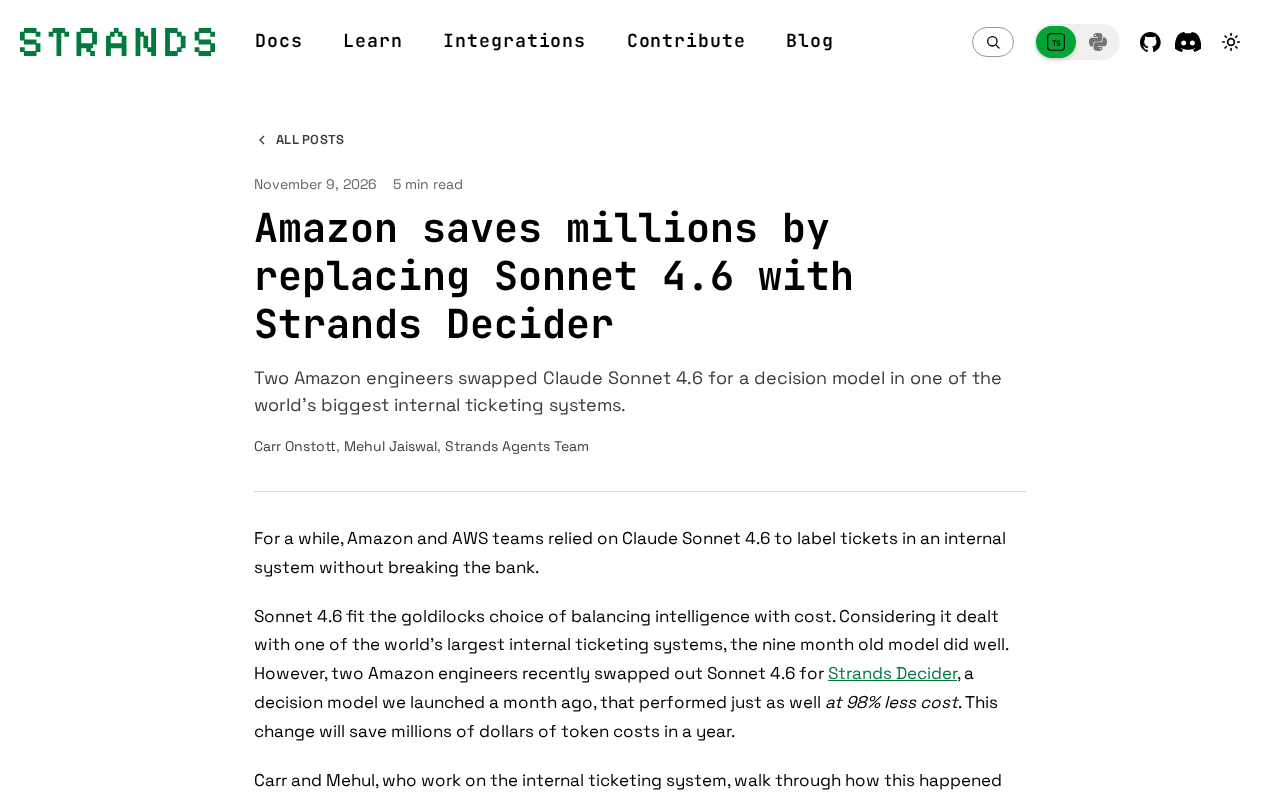
The Cost Logic Behind the Replacement
According to the Hacker News post, Amazon achieved millions of dollars in cost savings by replacing Sonnet 4.6 with Strands Decider. Although the post did not disclose specific call volumes or unit price details, the scale of "millions of dollars" suggests the high frequency of the relevant inference tasks within Amazon.
As a general-purpose large model, Sonnet 4.6 is comprehensive in capability but relatively expensive per call. For a large number of repetitive, formatted decision-making tasks internally, using a lighter, more specialized model can often significantly reduce costs while maintaining acceptable results. The name Strands Decider also hints at its positioning: a model focused on the "decision" step, rather than general conversation or generation.
What Strands Decider Might Be
Judging from the name, Strands Decider is likely a specialized component under Amazon's Strands system. Combined with Amazon's布局 in the AI Agent field, Strands may be a framework for task orchestration, and Decider is the module responsible for routing, selection, or judgment.
This "decider" pattern is not uncommon in Agent systems: decomposing complex processes, letting lightweight models handle branch judgments, and reserving expensive large models for the parts that truly require deep reasoning. If Strands Decider indeed assumes such responsibilities, then replacing Sonnet 4.6 is not just a model swap but a cost optimization at the architectural level.
It should be noted that the above inferences are based on naming and industry conventions; the original post did not elaborate on the technical details of Strands Decider.
Model Distillation is a common cost optimization technique: using the outputs of a large model (teacher model) as training data to train a smaller model (student model) to mimic its behavior. In Agent systems, tasks such as deciders usually have fixed input formats and limited output spaces (e.g., choosing branches, judging whether to continue), making them very suitable for building specialized models via distillation or small-scale fine-tuning. Compared with directly calling a general-purpose large model, distilled models have clear advantages in latency and unit price, at the cost of weaker generalization ability and the need for continuous iteration as task distributions change. This also explains why Amazon would separately train Strands Decider for high-frequency internal tasks—when call volumes are large enough, the one-time training cost of a specialized model can be quickly amortized.
Implications for AI Application Development
The direct takeaway for developers from this case is: do not assume by default that all tasks require the strongest model. In actual projects, tasks can first be classified—which require complex reasoning, and which are merely simple classification, extraction, or routing. For the latter, specialized small models or rule engines are often more cost-effective.
Another noteworthy signal is the cost advantage of self-developed models. Large tech companies have the ability to train specialized models for high-frequency internal scenarios, thereby amortizing costs in scaled calls. For small and medium-sized teams, although the barrier to training specialized models is higher, they can similarly compress inference expenses through prompt optimization, caching, model distillation, and other means.
Community Reaction and Controversies
The post on Hacker News received 83 points and 15 comments, with moderate discussion heat. Community attention focused on two aspects: first, whether the effect declined after the replacement; second, the specific basis of "saving millions of dollars."
Due to limited original information, these questions have no public answers yet. But what is certain is that model replacement decisions are never purely a cost issue; effect, latency, and maintenance costs all need to be taken into account. Amazon's willingness to replace in a production environment indicates that Strands Decider's performance on the target tasks reached an acceptable level.
Conclusion
Amazon's replacement of Sonnet 4.6 with Strands Decider, saving millions of dollars, is a typical case of "matching models to tasks." It reminds practitioners that AI cost optimization opportunities often lie in architecture design, rather than simply waiting for model price cuts. For high-frequency internal tasks with clear rules, the value of specialized models deserves reassessment.
One-line Summary
Amazon replaced Sonnet 4.6 with its self-developed Strands Decider, saving millions of dollars in inference costs.
Paragraph Summary
Amazon internally replaced Sonnet 4.6 with its self-developed Strands Decider model, saving millions of dollars in costs, a case that sparked discussion on Hacker News. The article analyzes that Sonnet 4.6, as a general-purpose large model, is comprehensive but has a higher unit price, while Strands Decider is likely positioned as a specialized decision model responsible for routing and judgment in Agent systems; the replacement is essentially architectural cost optimization. The takeaway is: high-frequency internal tasks with clear rules do not need to default to the strongest model; specialized small models or rule engines are more cost-effective; large companies can amortize costs through self-developed specialized models in scaled calls, while small and medium teams can compress expenses via prompt optimization, caching, distillation, and other means. The community focused on post-replacement effect changes and the cost basis, but the original information did not disclose details.
Related articles

AI Writes Your Code—Do You Still Need to Learn Git? Five Reasons
AI coding agents handle Git operations automatically—is it still necessary to learn Git? Five reasons: team communication, reviewing agent PRs, monitoring code changes, fallback when AI goes down, and the joy of learning—plus how the focus of learning Git is shifting in the agent era.

Anthropic Reportedly Prices IPO at $83 Per Share, Valuing Company at $1.5 Trillion
Anthropic reportedly prices IPO at $83 per share, above the expected range, with a fully diluted valuation of $1.5 trillion. This article analyzes the signal significance of the pricing and its impact on the AI industry's financing environment.

Open-Source Code Hosting Platform Codeberg Suffers Outage, Sparking Debate in Developer Community
Open-source code hosting platform Codeberg.org suffered an outage, sparking Hacker News debate over nonprofit platform stability and open-source infrastructure dependency risks.