Amazon's Zoox Set to Lift 100-Vehicle Robotaxi Cap in Nevada
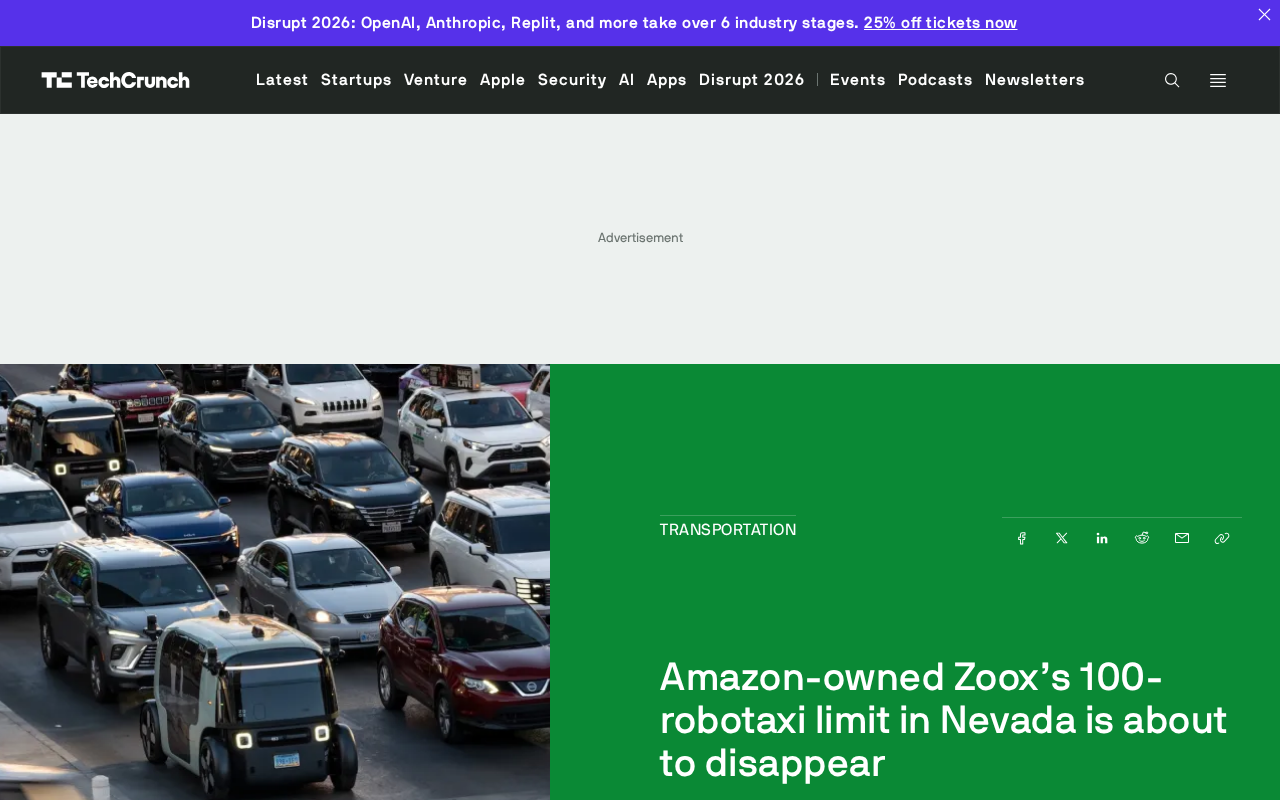
Zoox's Nevada 100-vehicle robotaxi cap expires this month, marking a key step toward scaled commercial operations in Las Vegas.
Amazon's autonomous vehicle company Zoox is set to have its 100-vehicle Nevada robotaxi operating cap expire this month — a regulatory milestone seen as implicit approval of its safety record. Las Vegas, with its strong tourism demand, friendly road conditions, and mature AV legislation, has become one of the most competitive robotaxi markets in the US. Zoox differentiates itself with purpose-built, steeringwheel-free, bidirectional vehicles rather than retrofitted production cars. With the cap lifted and Amazon's backing, Zoox is poised to compete more aggressively — though challenges around manufacturing costs, dispatch efficiency, and public trust remain as the industry shifts its focus from operational permission to profitability.
Zoox's Expansion Signal in Las Vegas
Amazon-owned autonomous vehicle company Zoox is approaching a pivotal turning point. According to an updated permit document, the cap that previously limited Zoox to operating 100 robotaxis in Nevada is set to expire later this month. This means Zoox could significantly expand its self-driving fleet in the Las Vegas area, paving the way for broader commercial operations.
The timing of this development carries considerable weight. Las Vegas is one of the most fiercely competitive markets in the US for autonomous ride-hailing, attracting the attention of multiple leading players. The removal of Zoox's vehicle cap comes just as local competition is heating up, reflecting the company's strategic intent to seize the initiative and expand its market presence.
The Industry Signal Behind Regulatory Loosening
For the autonomous driving industry, fleet size caps are typically a "buffer zone" set by regulators during the safety validation phase. The 100-vehicle limit is essentially a pilot-style management approach — allowing companies to accumulate real-world operational data within a controlled scope while giving regulators room to assess safety performance.
The imminent removal of this cap can be interpreted as a form of endorsement from Nevada regulators regarding Zoox's operational safety. Once the vehicle ceiling is lifted, Zoox can theoretically deploy vehicles flexibly according to its own capacity and market demand — a significant milestone in its transition from testing and validation toward scaled commercial operations.
Worth noting is that Zoox uses purpose-built autonomous vehicles with no steering wheel and bidirectional driving capability, setting it apart from competitors who retrofit existing production vehicle platforms. This ground-up design approach requires a longer development cycle but may demonstrate unique advantages at scale.
Zoox's vehicle design philosophy is notably distinctive in the industry. Its proprietary vehicle resembles a symmetrical capsule pod, with a drive-and-steer system at each of its four corners, passengers seated facing each other on both sides of the cabin, and no conventional "front" or "rear." This bidirectional capability means the vehicle can travel in reverse without needing to turn around, significantly improving dispatching efficiency in urban short-haul scenarios. By contrast, competitors like Waymo and Baidu Apollo largely retrofit existing production vehicles (such as the Jaguar I-PACE or Lincoln MKZ) for autonomous driving — a shorter development path but one constrained by the original vehicle platform's hardware design. Zoox's "purpose-built" approach from scratch demands higher upfront investment but grants far greater freedom in sensor placement, cabin design, and system redundancy. Since being acquired by Amazon for approximately $1.2 billion in 2016, Zoox has been committed to this long-cycle strategy. The removal of its fleet cap marks an important signal that years of R&D investment are beginning to translate into operational results.
Las Vegas: The Autonomous Driving Arena
Las Vegas has become a prime battleground for robotaxis for reasons closely tied to its urban characteristics. As a major tourism and convention hub, the city boasts high demand for short-distance travel, a relatively structured road network, and mild year-round weather — all of which create a relatively favorable operating environment for autonomous vehicles.
As competition intensifies, companies are vying for limited operating licenses, road access, and consumer mindshare. Zoox's removal of its fleet size restriction will undoubtedly strengthen its competitive position in this market. With the financial and technical backing of Amazon, Zoox possesses considerable resource advantages in this long-haul race.
There is also an institutional factor that makes Las Vegas particularly attractive to autonomous vehicle companies: Nevada was among the first US states to legislate allowing self-driving vehicles to operate on public roads, passing relevant regulations as early as 2011, resulting in a relatively mature and technology-friendly regulatory framework. Companies currently operating or testing robotaxis in Las Vegas include not only Zoox but also Waymo — which has already achieved commercialization in Phoenix — as well as Uber's autonomous driving division, which is actively expanding. This multi-player competition makes Las Vegas not just a geographic operating market, but an industry benchmark — a proving ground where whoever can establish an efficient, safe, and profitable operating model may unlock the playbook for expanding to other cities.
The Real-World Considerations of Commercial Viability
Despite the fleet cap removal being a positive signal, the scaling of autonomous ride-hailing still faces numerous practical challenges. Vehicle manufacturing costs, operational dispatch efficiency, the ability to handle extreme weather and complex road conditions, and the establishment of public trust are all critical variables that determine whether a business model can succeed.
From an industry-wide perspective, this development at Zoox is yet another reflection of the autonomous driving sector's transition from "technology validation" to "commercial operations." As more cities and regulatory bodies begin loosening operational restrictions, the competitive focus will gradually shift from "can it operate on public roads" to "can it be profitable" and "can it deliver a user experience superior to traditional transportation."
For consumers, more robotaxis entering the market means more mobility options. For the industry, this competition unfolding across Las Vegas may become an important window through which to observe the commercial prospects of autonomous driving.
Related articles
NVIDIA cuML Accelerates Spectral Clustering: 100x+ Speedup Over Scikit-Learn Benchmarked
NVIDIA cuML lets Scikit-Learn spectral clustering run on GPU without code changes, delivering 200x+ speedups on large datasets. Learn how it works and how to use it.

Google DeepMind Launches New Institute to Bring the AGI Debate into the Open
Google DeepMind has launched a new institute to bring AGI debate into the public sphere. We analyze what this signals about the shift from technical competition to AI governance.
How Cooley Is Reinventing IPO Legal Workflows with ChatGPT: A Look at the GO Public Tool
Cooley built GO Public on ChatGPT Work to accelerate IPO legal workflows, helping lawyers catch issues earlier and focus judgment where it matters most.