AMD Ryzen AI Halo Local AI Dev Kit Deep Dive: Is $4,000 Worth It?

AMD's $4,000 Ryzen AI Halo dev kit offers 128GB unified memory for local LLM inference — promising but software ecosystem lags.
AMD's Ryzen AI Halo developer kit targets local AI inference with a unified memory architecture supporting up to 128GB, an XDNA 2 NPU, and x86 flexibility. While it solves the VRAM capacity bottleneck for running large quantized models locally, inference speed is limited by memory bandwidth, and the software ecosystem around ROCm and XDNA still trails NVIDIA's CUDA. At $4,000, it's a compelling experimental platform for privacy-focused developers, but not yet a production-grade solution.
AMD Enters the Local AI Development Market
AMD recently launched an AI developer kit based on the Ryzen AI Halo platform, priced at around $4,000. The announcement sparked lively debate on Hacker News (50 upvotes, 46 comments). The product targets a rapidly heating niche: local AI inference and experimentation platforms for developers.
As large language models (LLMs) become mainstream, more developers want to run and fine-tune models locally rather than relying entirely on cloud APIs. Local solutions offer advantages in data privacy, latency control, and potentially lower long-term costs. AMD's Ryzen AI Halo is designed precisely to address these needs.
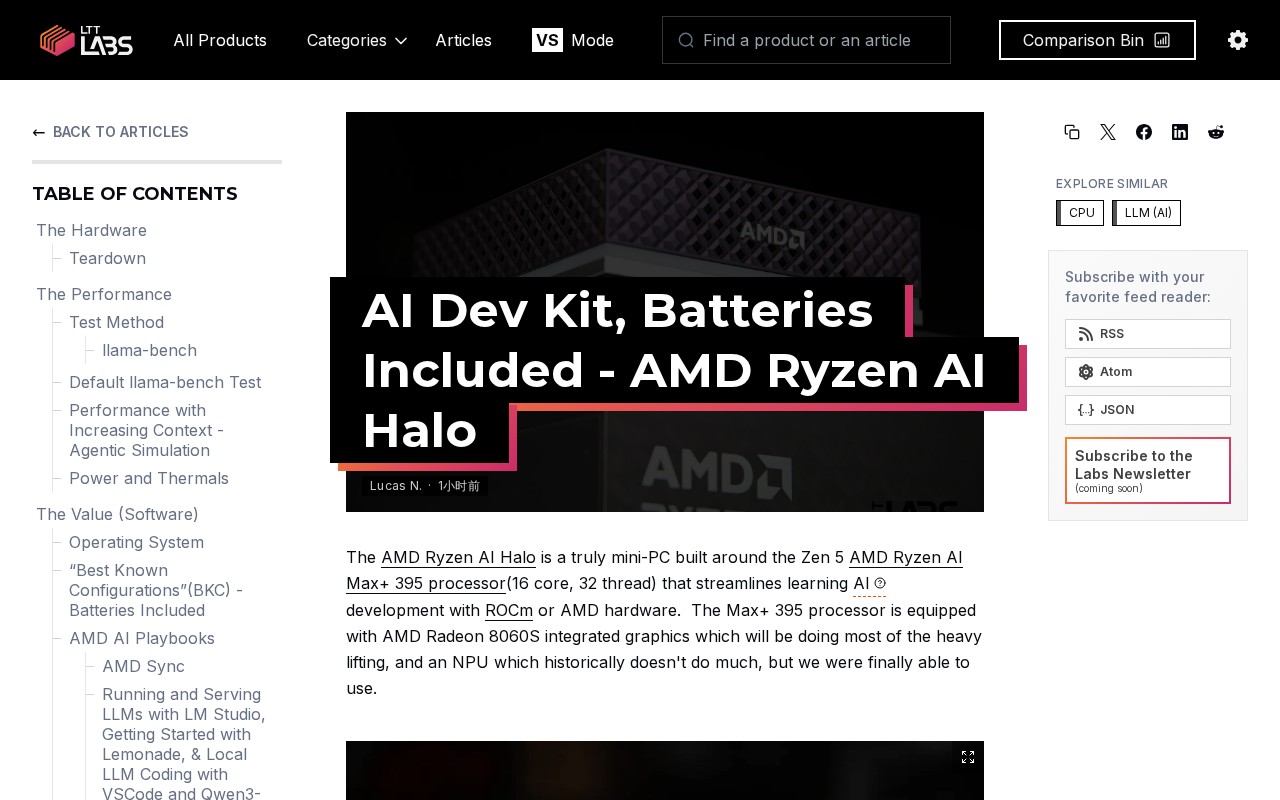
Ryzen AI Halo: Positioning and Architecture
Ryzen AI Halo (part of the Strix Halo series, branded as "Ryzen AI Max") is AMD's APU platform targeting high-performance mobile and embedded use cases. APU (Accelerated Processing Unit) is AMD's heterogeneous computing concept introduced in 2011, integrating CPU and GPU on the same die to eliminate the latency and bandwidth overhead of transferring data between discrete chips. Ryzen AI Halo extends this idea into a three-in-one design — a Zen 5 CPU for general-purpose compute, an RDNA 3.5 integrated GPU for graphics and parallel floating-point workloads, and a dedicated XDNA 2 NPU (Neural Processing Unit) optimized specifically for AI inference operations like matrix multiplication.
The XDNA architecture traces its roots to the AI Engine technology AMD acquired through Xilinx. XDNA 2 significantly improves INT8 and FP16 throughput over its predecessor, with AMD claiming 50+ TOPS (Tera Operations Per Second). The NPU excels at running specific AI workloads at very low power, but its programming model is fundamentally different from CUDA/OpenCL — it requires AMD's Ryzen AI Software framework for scheduling, and native support in mainstream inference libraries is still maturing.
The core selling point of this heterogeneous architecture is the unified memory architecture: the CPU, GPU, and NPU all share a single large memory pool, configurable up to 128GB. For running large models, this means you can load the full weights of a large model into what effectively acts as "VRAM," without being constrained by the 8GB to 24GB limits typical of discrete GPUs.
Why Developers Care About Unified Memory Architecture
Unified Memory Architecture (UMA) allows the CPU, GPU, and NPU to share the same physical memory pool, eliminating the PCIe bus data-transfer overhead between CPU system memory and GPU VRAM in traditional setups. Apple's M-series chips brought this design to the high-end consumer market, with the SoC's built-in LPDDR5X memory delivering up to 800GB/s bandwidth (M3 Ultra).
However, bandwidth is the real bottleneck for large model inference — LLM inference is inherently memory-bandwidth-bound, as model weights must be read from memory once for each token generation step. NVIDIA's H100 delivers 3.35TB/s of HBM3 memory bandwidth, while Ryzen AI Halo, constrained by LPDDR5x architecture, typically falls in the 100–300GB/s range. So while 128GB of capacity solves the "can it run" problem, bandwidth determines "how fast it runs."
In traditional GPU setups, running a 70-billion-parameter model often requires multiple high-end GPUs in tandem, with costs easily reaching tens of thousands of dollars. Notably, quantization has fundamentally changed this landscape: a raw 70B parameter model stored in FP16 requires roughly 140GB of memory, but with INT4 quantization (compressing each parameter to 4 bits), the memory footprint drops to around 35–40GB — well within the reach of Ryzen AI Halo's 64GB or 128GB configurations. The llama.cpp project popularized the GGUF quantization format, supporting multiple precision levels from Q2_K to Q8_0, allowing developers to flexibly trade off precision and quality against memory constraints. It's precisely the maturation of quantization that has unlocked real market demand for high-memory platforms like Ryzen AI Halo.
This was one of the focal points in the Hacker News discussion. Many developers compared it to Apple's Mac Studio (which also uses a unified memory architecture with M-series chips). Apple's solution has earned a solid reputation in local LLM inference thanks to its high-bandwidth LPDDR5 memory, and AMD is essentially offering a similar approach as an alternative within the x86 ecosystem.
The Realistic Performance and Cost Trade-Off
It's important to be clear-eyed: unified memory does not equal high-performance inference. The compute power and memory bandwidth of an integrated NPU and iGPU still fall well short of professional discrete GPUs (such as NVIDIA H100, A100, or even the consumer RTX 4090).
The value of a local AI developer kit is better understood through these lenses:
- Ability to run large models (memory capacity advantage, breaking through the VRAM bottleneck)
- Data stays local (privacy protection and compliance requirements)
- No API call costs (controllable long-term usage costs)
When it comes to inference speed (tokens/second) — the key performance metric — a $4,000 kit can't realistically compete with cloud GPU clusters. For production environments requiring high throughput, this type of device isn't the right fit. But for prototyping, model experimentation, and privacy-sensitive scenarios, it offers an appealing middle ground.
The $4,000 Price Tag: Expensive or Worth It?
Pricing was another flashpoint in the community discussion. $4,000 is steep for individual developers, but compared to "a multi-GPU workstation capable of running models at the same scale," the value proposition is surprisingly competitive.
A workstation with dual RTX 4090s (roughly 48GB of combined VRAM) runs in the same $4,000–$5,000 range, with significant drawbacks in power consumption, thermal management, and physical size. By contrast, the Ryzen AI Halo kit has a clear edge in power efficiency and portability — this class of APU typically operates at much lower TDP, making it well-suited for desktop or small-form-factor deployments.
From a long-term cost perspective, cloud LLM API costs can be substantial at scale — a GPT-4-class model might run several dollars per million tokens, and at high call volumes, annual costs can reach hundreds of thousands of dollars. A one-time $4,000 hardware investment has a clear payback logic at sufficient usage volumes.
Software Ecosystem: AMD's Biggest Battle
AMD's persistent challenge in AI remains the software ecosystem. NVIDIA has built an almost monopolistic developer moat with CUDA, rooted in nearly two decades of ecosystem investment — tens of thousands of AI research papers, open-source libraries (cuDNN, cuBLAS, TensorRT), and deep framework-level integration (PyTorch CUDA backend, JAX XLA) all lock in to CUDA, creating enormous switching costs.
AMD's ROCm (Radeon Open Compute) platform, launched in 2016, provides HIP (Heterogeneous-compute Interface for Portability) as a CUDA compatibility layer, allowing much CUDA code to run on AMD GPUs with minor modifications. ROCm has picked up meaningful momentum in recent years — PyTorch officially ships ROCm pre-built packages, and llama.cpp supports a ROCm backend. But stability in production environments, driver version fragmentation, and enterprise-grade technical support remain areas where ROCm clearly lags behind CUDA.
The real-world usability of the XDNA 2 NPU is also an open question. The NPU looks impressive on paper (TOPS), but its software stack is even younger than ROCm. Getting mainstream inference frameworks like llama.cpp, vLLM, and PyTorch to fully leverage the NPU still requires mature driver and runtime support — an area AMD still needs time to polish.
The Local AI Hardware Race: A Microcosm of the Industry
The launch of the AMD Ryzen AI Halo developer kit reflects a structural shift across the industry: AI computing is migrating from pure cloud toward a hybrid "cloud + edge/local" model. Multiple forces are driving this — data sovereignty regulations (like the EU's GDPR and China's Data Security Law) require that sensitive data be processed locally, pushing enterprises toward on-premises deployments; and the emergence of Meta's open-source LLaMA series and Mistral's open-weight models in 2023–2024 gave developers their first real opportunity to deploy high-quality models locally.
From NVIDIA's DGX Spark (formerly Project DIGITS) and Apple's Mac Studio, to AMD's Ryzen AI Halo, hardware vendors are all competing for the emerging "desktop AI device for developers" category. They share common characteristics: large-capacity unified memory, integrated AI acceleration units, and a relatively compact form factor. The influx of hardware players also means pricing competition in this category will intensify — good news for developers.
Developers now have more choices, and competition will drive prices down. But before making a purchase decision, you need to clarify your core requirements: if model experimentation and data privacy are your priorities, these local AI kits are worth serious consideration; if you need maximum inference performance, professional GPU solutions remain the only real option.
Closing Thoughts
The AMD Ryzen AI Halo AI developer kit represents an ambitious foray by the x86 camp into local AI hardware. Its unified memory architecture breaks through the capacity bottleneck for loading large models, and mature quantization techniques further expand the range of runnable models. But the inference speed ceiling — limited by memory bandwidth rather than capacity — and the still-maturing XDNA software ecosystem mean this product is better viewed today as a "promising experimental platform" rather than a production-grade inference node. In this fast-moving space, the ultimate winner will be determined by who achieves the best balance of hardware performance, software ecosystem, and price-to-performance ratio.
Key Takeaways
Related articles

Disaster and Glory of the Apollo Program: The History We Must Revisit Before Returning to the Moon
From the fatal Apollo 1 fire to Apollo 8's daring lunar orbit to Apollo 11's successful landing—revisiting the disasters, fears, and compromises of the Apollo program and their lessons for today's return to the Moon.

Netflix Trust Exercise Turns Into Firing Trap: Where Are the Boundaries of Corporate Trust?
A Netflix employee was fired after sharing private info in a trust exercise. We analyze the risks of corporate trust exercises and how employees can protect themselves.

AMD CDNA5 Architecture Deep Dive: Technical Evolution and the AI Computing Competition Landscape
Deep analysis of AMD's CDNA5 architecture covering Chiplet packaging upgrades, HBM memory evolution, and low-precision compute optimization, examining how AMD challenges NVIDIA's AI chip dominance.