America's Largest Newspaper Chain Partners with Palantir to Analyze Reader Data: Privacy Controversy and Industry Implications

America's largest newspaper chain partners with Palantir for reader analytics, sparking privacy and ethics debate.
America's largest newspaper chain has partnered with Palantir to leverage its data platform for deep reader analytics. While commercially rational for a struggling industry, the collaboration raises concerns about privacy, media independence, and the ethics of sharing reader data with a company deeply tied to government surveillance. The tech community debates whether the partnership represents smart business or a betrayal of reader trust.
Event Overview: Why a Newspaper Giant Chose Palantir
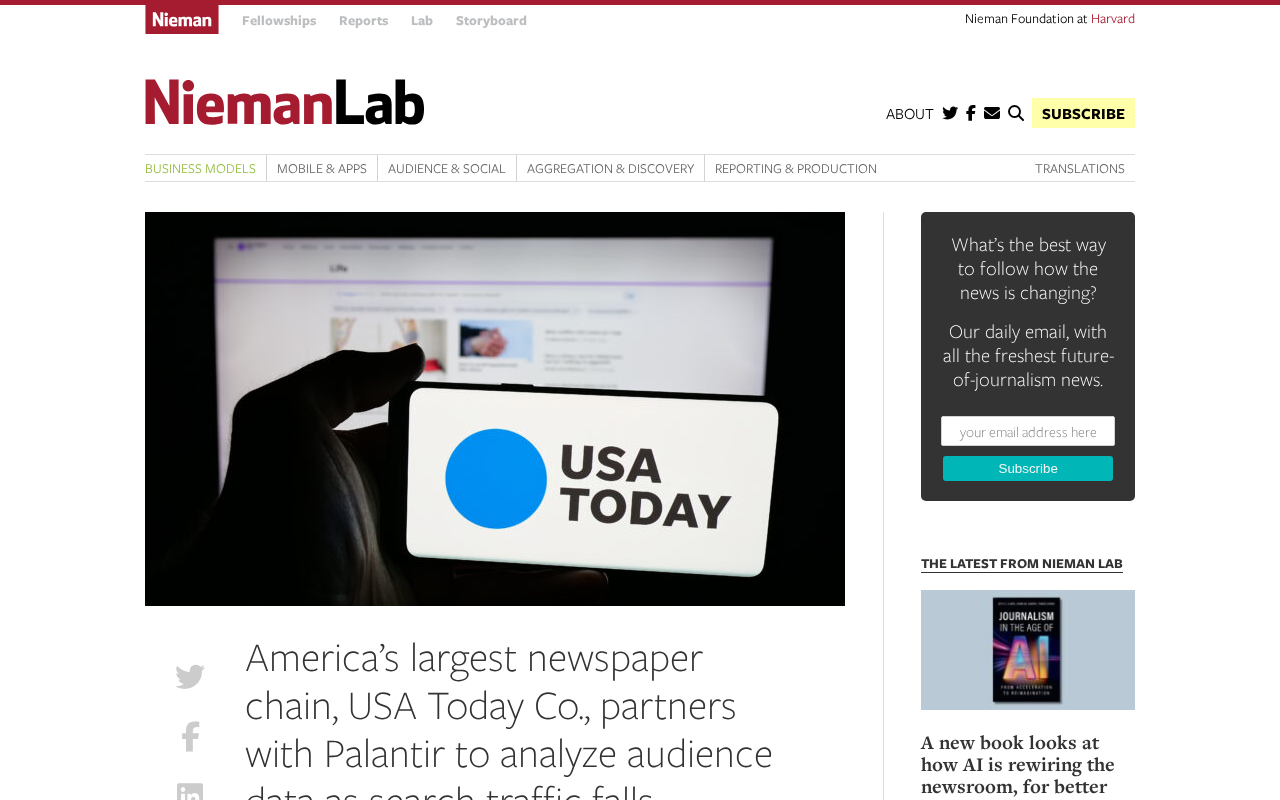
America's largest newspaper chain has announced a partnership with data analytics company Palantir, leveraging its technology platform to conduct deep analysis of reader audience data. The news sparked intense discussion on Hacker News, garnering 59 upvotes and nearly 20 comments, reflecting tech professionals' heightened attention and complex attitudes toward collaborations between the news industry and big data companies.
At the core of this partnership is handing over the massive reader behavioral data accumulated by traditional news media to Palantir—a company renowned for its data integration and analytics capabilities—for processing. For a newspaper industry struggling through a painful transformation, understanding readers, operating with precision, and improving subscription conversion rates are existential imperatives. However, choosing to partner with a company as sensitive as Palantir inevitably touches the raw nerves of privacy and ethics.
Who Is Palantir: The Controversial Giant of Data Analytics
To understand the significance of this partnership, one must first know Palantir. Palantir Technologies was founded by Peter Thiel and others in 2003 and is known for its powerful data integration, analytics, and visualization platforms. Its two core products, Gotham and Foundry, serve government intelligence agencies and commercial enterprises, respectively.
Palantir's Technology Platform Architecture
Palantir's two core products represent two distinct data analytics paradigms. Gotham was originally designed for intelligence analysis and excels at discovering hidden relationships between entities within massive heterogeneous datasets. Its core capability is knowledge graph construction and relationship reasoning—for example, automatically identifying connection networks between individuals from communication records, financial transactions, and social networks. Foundry, aimed at commercial enterprises, is positioned as a "data operating system." Its core value lies in performing ontology modeling on data scattered across different systems and formats, creating a unified semantic layer that allows non-technical users to perform complex cross-source data analysis through drag-and-drop interfaces. Foundry's technical differentiation lies in its data lineage tracking capability—the complete transformation path of every piece of data from raw input to final analytical result is recorded, which is particularly important in regulated industries.
Palantir's Government Background and Public Controversy
Palantir's primary clients have long included the CIA, FBI, Department of Defense, and Immigration and Customs Enforcement (ICE), among other government agencies. It is precisely this deep integration with intelligence and law enforcement systems that has made Palantir a perpetual target of public scrutiny regarding surveillance and privacy violations.
Therefore, when a newspaper group possessing vast amounts of ordinary readers' reading habits, subscription information, geographic locations, and even political leanings chooses to partner with Palantir, the community's first reaction is often one of vigilance: How will this reader data be used? Could it be utilized for purposes beyond news operations?
Why Newspapers Urgently Need Data Analytics Capabilities
Setting aside the controversy, from a business logic perspective, the newspaper industry's embrace of data analytics is almost inevitable. Over the past two decades, print newspaper advertising revenue has plummeted off a cliff, forcing the media industry to transition toward digital subscription models. In this transformation, reader data has become the most valuable asset.
Industry Background of Newspaper Digital Transformation
The decline data for American newspapers is staggering: according to Pew Research Center statistics, U.S. newspaper advertising revenue plunged from approximately $49.5 billion in 2005 to less than $9 billion in 2020—a decline of over 80%. Meanwhile, the number of daily newspapers in the U.S. shrunk from approximately 1,450 in 2004 to fewer than 1,000 by 2023, creating vast "news deserts"—communities lacking local news coverage. Against this backdrop, large newspaper groups have attempted to reduce costs through economies of scale by acquiring and consolidating local papers. Digital subscriptions have become the core revenue strategy, but compared to the success stories of top brands like The New York Times with over 10 million digital subscribers, digital transformation for local newspapers is far more difficult—they lack brand premium, technical teams, and data infrastructure.
From Content Distribution to Precision Operations
By analyzing reader data, media organizations can answer a series of critical questions:
- Which content best retains subscription users?
- Which types of readers are most likely to churn?
- How can personalized content be pushed to different demographics?
- When is the optimal time to deploy a paywall?
These insights are directly tied to subscription revenue and user retention.
For large groups owning hundreds of local newspapers, cross-regional, cross-platform integration of scattered reader data is itself a massive technical challenge. This is precisely where data integration platforms like Palantir Foundry excel—they can connect data from different sources and formats into a unified analytical view. From a purely technical standpoint, this is a well-matched partnership.
Three Key Points of Community Debate
The discussion on Hacker News revealed clear divisions, primarily centered on the following areas.
The Tension Between Privacy and Trust
One of journalism's core values is credibility and oversight of power. When media organizations hand reader data to a company deeply connected to government surveillance systems, some commenters worry this could damage the media's image of independence, or even create potential conflicts of interest—after all, news organizations are supposed to be the force that holds government accountable, not entities sharing user data with intelligence-linked companies.
Questioning the Rationality of the Technology Choice
Other practitioners raised questions from a purely technical perspective: Does reader data analysis really require a platform of Palantir's scale and price point? The market has plenty of mature data analytics and user profiling tools—from Google Analytics to various Customer Data Platforms (CDPs)—that are less expensive and less controversial. Was Palantir chosen out of genuine technical need, or for other strategic considerations?
Customer Data Platforms (CDPs) and Alternatives
Customer Data Platforms (CDPs) have become an important category in marketing technology in recent years, with representative products including Segment (acquired by Twilio), Adobe Real-Time CDP, and Salesforce Data Cloud. The core function of CDPs is to unify user behavioral data from multiple touchpoints—websites, apps, email, CRM—attributing them to a single user identity (i.e., "identity resolution") to form 360-degree user profiles that support personalized recommendations and precision marketing. For the media industry, Piano, Chartbeat, and Parse.ly are more vertical options specifically designed for content websites, offering content performance analysis, subscription conversion funnel optimization, and churn prediction. Compared to Palantir, these tools are typically one to two orders of magnitude cheaper and don't involve sensitive government connections. The possible rationale for choosing Palantir lies in situations where data sources are extremely fragmented (hundreds of newspapers each with their own independent tech stacks) and deep integration with non-digital data (such as print distribution data, advertising systems) is required—scenarios where general-purpose CDPs may fall short.
A Signal of Big Data Companies Penetrating Traditional Industries
Another perspective holds that this reflects the accelerating trend of large tech and data companies penetrating traditional industries. Palantir has been aggressively expanding into commercial markets in recent years, with media, healthcare, manufacturing, and other industries all becoming target clients. The newspaper partnership may be just the beginning.
Deeper Reflection: Media Ethics Boundaries in the Data Age
This partnership touches on a broader question: In a data-driven era, how should news media balance commercial survival with ethical responsibility?
Media organizations need revenue to sustain high-quality journalism, and data analytics can genuinely improve business efficiency. But readers entrust their faith to media organizations largely based on identification with their independence and values. When data processing is outsourced to a controversial company, does that trust get diluted?
Legal and Compliance Frameworks for Outsourced Data Processing
In the United States, the processing of media reader data is subject to multiple layers of legal frameworks. At the federal level, there is no unified comprehensive privacy legislation (unlike the EU's GDPR), but state laws vary significantly: California's CCPA/CPRA grants consumers the right to know, the right to delete, and the right to opt out of data sales; Virginia, Colorado, Connecticut, and other states have passed similar legislation. When media groups hand reader data to third parties for processing, they typically need to clearly delineate the roles of data controller and processor through Data Processing Agreements (DPAs), specifying purpose limitations, retention periods, and security measures. It's worth noting that Palantir's data usage in government contracts (such as ICE using Palantir to track undocumented immigrants) is not equivalent to its data usage in commercial contracts—but public trust perception often doesn't make this distinction, which is precisely the source of reputational risk.
You might not have noticed, but the transparency of the partnership itself is also critical. Are readers informed? Where are the boundaries of data usage? Is there third-party oversight? The answers to these questions will determine whether this partnership is viewed as a normal business upgrade or a potential threat to reader privacy.
Historical Precedents of News Credibility and Tech Partnerships
Controversy over media-tech company partnerships is nothing new. In 2019, when multiple news organizations partnered with Amazon to distribute news content through Alexa, it sparked discussions about whether user voice data was being used for commercial purposes. Earlier still, Facebook's Instant Articles project allowed media to host content directly on Facebook's platform—while improving loading speed and reach, it also caused media to lose control over reader relationships and data. This lesson is still frequently cited across the industry today. Google's news ecosystem works similarly: the search engine drove traffic to media through AMP (Accelerated Mobile Pages) technology while simultaneously deepening media dependence on Google's infrastructure. These precedents demonstrate that when choosing technology partners, media organizations need to carefully weigh short-term efficiency gains against long-term loss of independence.
Conclusion: The Balancing Test Between Business Logic and Credibility
The partnership between America's largest newspaper chain and Palantir is a microcosm of the traditional media digital transformation wave, and a testament to data analytics capabilities increasingly becoming a core competitive advantage. From a business logic perspective, it's a reasonable and even necessary step; but from the dimensions of ethics and trust, it raises unavoidable questions.
For the entire industry, this case may become an important observation sample: how media can leverage data to improve operations while guarding the lifeline of credibility. And for professionals concerned with tech ethics, it serves as yet another reminder—technology choices are never just about technology; they are also choices about values.
Related articles

Cursor AI Programming in Practice: Build a Student Management System from Scratch in 30 Minutes
A Bilibili creator demonstrates Cursor AI programming: generating a student management system in 30 minutes with natural language. Details on Agent mode, Claude selection, prompt techniques, and thresholds.

Top 20 AI Coding Tools Ranking: From Rock-Solid to Lackluster, a Scored Matrix
Bilibili creator releases top 20 AI coding tools ranking, tiered T0–T4 from rock-solid to lackluster, with Claude Code and Codex tied at T0. This article details the scoring dimensions (capability, reliability, robustness, durability, cost, domestic availability) and tool performances to help developers choose the right AI coding assistant.

Vibe Coding Systematic Tutorial: Master AI-Assisted Programming from Zero
A three-month Vibe Coding tutorial from a Bilibili creator covering Codex, ClaudeCode, and Cursor, from core logic to commercial project practice for beginners.