Ando Takes on Slack: A Team Messaging App Built for Humans and AI Agents to Work Side by Side

Ando raises $20M to challenge Slack with a messaging app that treats AI agents as first-class team members.
Ando is a startup reimagining enterprise collaboration by embedding AI agents as first-class participants in team messaging workflows — not as passive plugins. The company has raised $20M in pre-seed and seed funding from Accel, Index Ventures, and Emergence. By natively integrating agents into the messaging layer where decisions and tasks flow, Ando aims to give AI full context to act autonomously. Whether it can overcome Slack's network effects, deep integrations, and Salesforce backing will depend on both the strength of the AI agent paradigm shift and the quality of the product itself.
Ando Sets Its Sights on Enterprise Collaboration
A startup called Ando is taking aim at team collaboration giant Slack — and its core differentiator is enabling not just human coworkers to communicate, but AI agents to participate in workflows as full members of the team.
Ando has raised a total of $20 million across pre-seed and seed rounds, backed by a notable roster of investors including top-tier venture firms Accel, Index Ventures, and enterprise software-focused Emergence. The size of the raise and the caliber of the backers signal strong investor conviction in the "human-AI collaborative work platform" category.
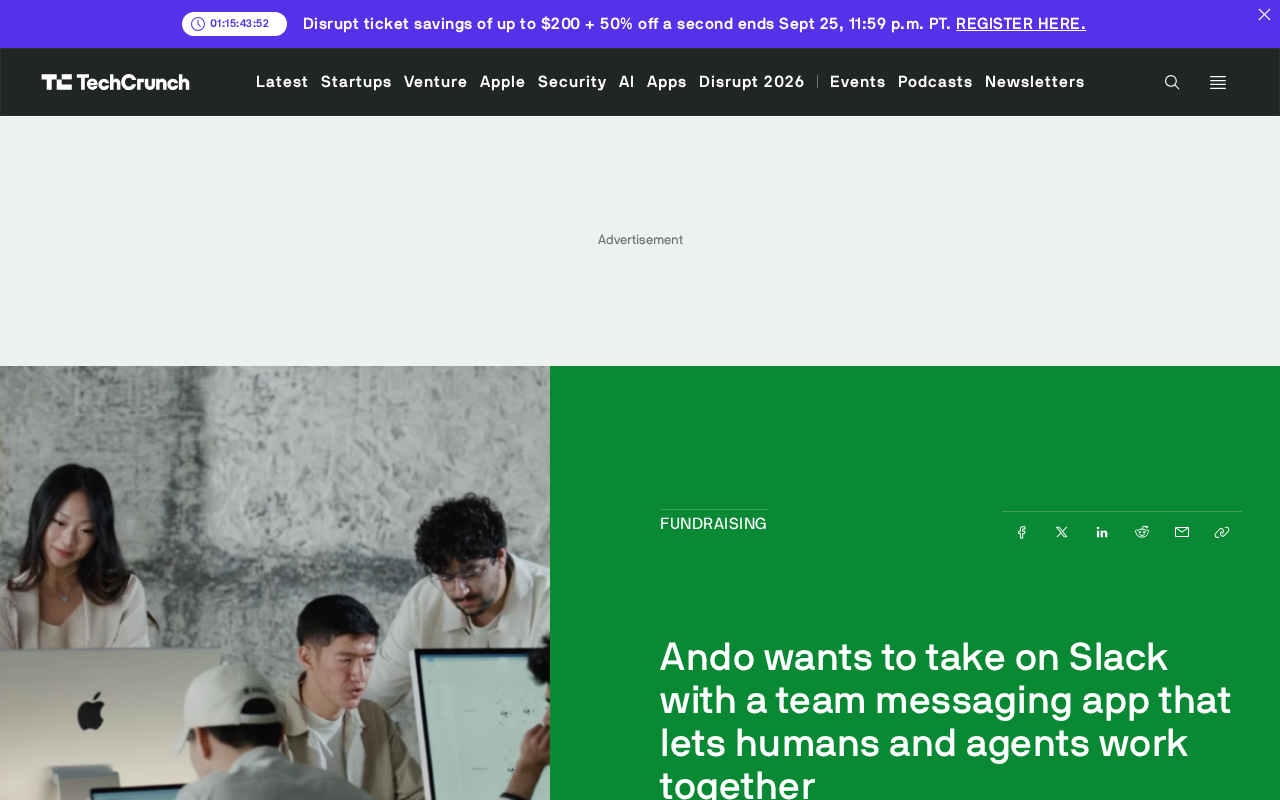
Human-AI Collaboration: Redefining Team Messaging
Traditional team messaging tools like Slack and Microsoft Teams were fundamentally designed for human-to-human communication. While they later added automation capabilities through bots, integrations, and plugins, AI has always occupied a subordinate role as a "tool."
Ando takes a different approach: it aims to make AI agents "first-class citizens" in team messaging, collaborating alongside human members as equals. In this model, agents are no longer passive bots that simply respond to commands — they can actively participate in discussions, execute tasks, and drive projects forward. This positioning aligns with the broader industry shift from "conversational assistants" toward "autonomous agents."
Why a Messaging App Is the Right Entry Point
Messaging apps are the nerve center of modern enterprise collaboration. Decisions, task assignments, and information flows largely happen here. If AI agents can be embedded directly into this primary communication channel, they gain full context — enabling them to better understand team intent and take meaningful action. Compared to standalone AI tools, this "natively embedded in the collaboration flow" approach offers a natural advantage in both information access and execution.
AI Agent refers to an AI system with autonomous planning and execution capabilities. The key distinction from traditional chatbots: chatbots passively respond to individual commands, while agents can break down a complex goal into multi-step tasks, invoke external tools (such as search, code execution, or database queries), and dynamically adjust their execution path based on intermediate results — all the way to goal completion. Since 2023, as large language model capabilities have surged, agent frameworks (such as AutoGPT, LangChain Agents, and the OpenAI Assistants API) have rapidly become a focal point in AI application development. Enterprise environments are a critical deployment arena for agents — within collaboration tools, agents can automatically summarize meeting notes, track action items, query internal documentation, and even trigger cross-system business workflows, all without requiring humans to issue instructions step by step.
The Opportunity — and the Difficulty — of Challenging Slack
Challenging Slack is no easy feat. Slack has amassed a massive user base, a mature integration ecosystem, and the full weight of Salesforce behind it. Any new entrant faces enormous user switching costs and formidable network effect barriers.
That said, the rise of AI agents may be opening a window for a "lane change" opportunity. As the core value proposition of collaboration tools expands from "connecting people" to "enabling humans and agents to work together," incumbent players' product architectures may not be able to adapt quickly to this paradigm shift — and that's where players like Ando see their opening. Whether Ando can translate its concept into a product that is genuinely useful and reliable will be the deciding factor.
Network effects and switching costs are the hardest barriers to overcome in enterprise collaboration software. Much of Slack's value comes from the fact that every colleague at a company uses it — once workflows, message history, and third-party integrations (hundreds of apps including GitHub, Jira, Zoom, and more) are all consolidated on one platform, the cost of migrating individually is extremely high, while migrating as an organization requires coordinated, company-wide decisions. Salesforce's $27.7 billion acquisition of Slack in 2021 further deepened its integration with the CRM ecosystem, raising switching costs even higher. Historically, the only player to meaningfully dent Slack's market share has been Microsoft Teams — and that was through bundling with Office 365, not product differentiation. For Ando to break through, it needs to identify high-stakes use cases that legacy architectures simply cannot serve, but that users urgently need. Native AI agent integration may be exactly that breakthrough.
Closing Thoughts
Publicly available information on Ando remains largely limited to the funding announcement. The specifics of the product, the boundaries of its agent capabilities, and real-world performance have yet to be fully disclosed. But given its positioning and the caliber of its backers, Ando represents a compelling and closely watched exploration of the convergence between enterprise collaboration software and AI agents. As more product details emerge, the viability of this challenge to Slack will become increasingly clear.
Related articles
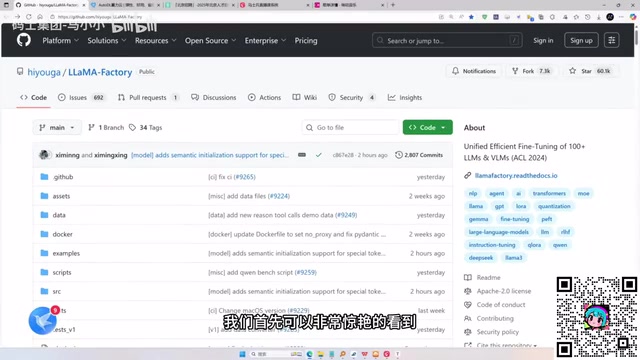
LLaMA-Factory in Practice: A Complete No-Code Guide to Fine-Tuning Large Models
An introduction to LLaMA-Factory, the open-source fine-tuning tool: its 60.1K-star background, supported models and algorithms, local vs. cloud deployment, and CUDA setup steps.
Zeng Ming's Deep Retrospective: Why OpenAI May Not Be the Ultimate Winner — and Why the Corporate System Will Disappear
Zeng Ming's deep retrospective on the AI endgame: model companies are just infrastructure, OpenAI and Anthropic won't be the final winners; the next battle is the Agent entry point standard; the corporate system will disappear as AI restructures collaboration, and only mission-driven companies can survive the cycle.

OpenHands v1.28.0: OpenCode and PI Added as Built-in Agents, API Keys Requestable In-Conversation
OpenHands ships 5 releases in 21 days: v1.27.0 adds OpenCode and PI as built-in agents, v1.28.0 enables in-chat key requests. ACP integration, credential reuse, model list changes, and upgrade advice.