Andrew Ng: AI Extinction Fears Are 'Science Fiction'
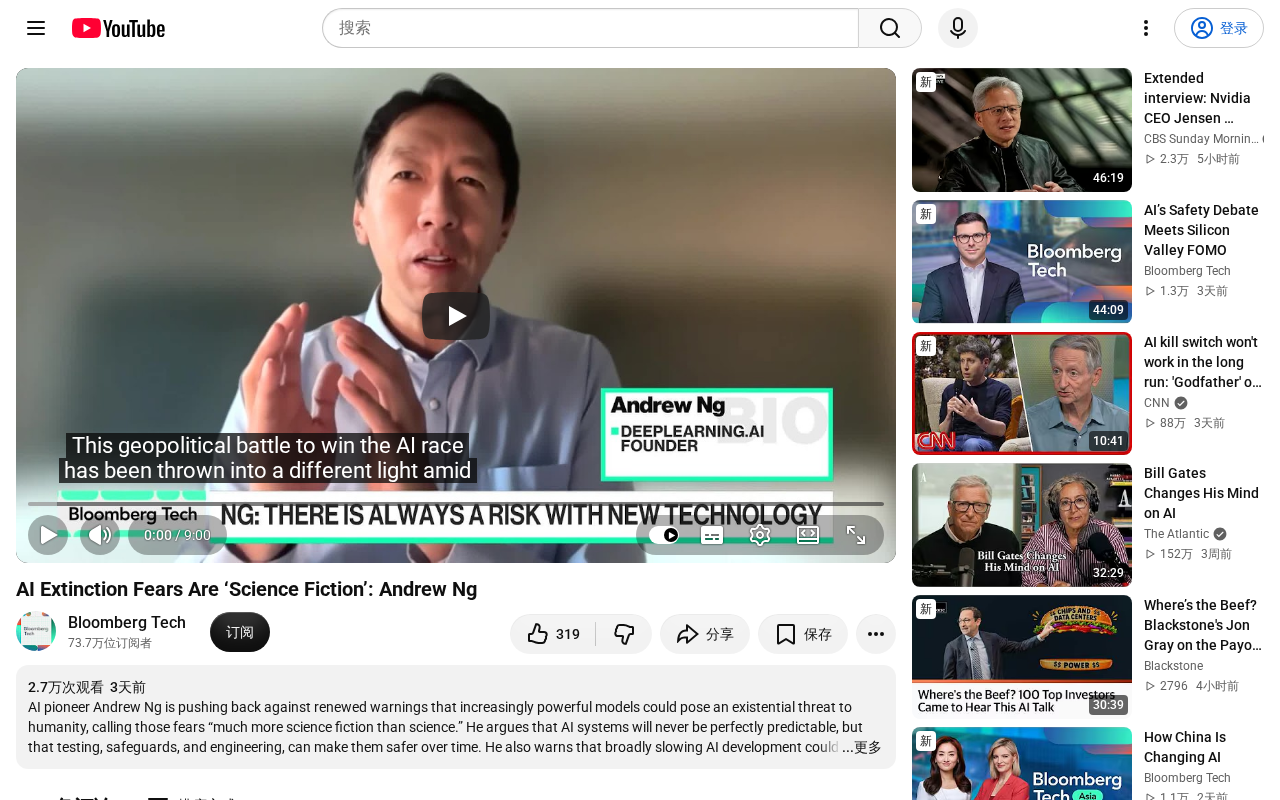
Andrew Ng dismisses AI extinction fears as sci-fi, urging focus on real, present-day problems like algorithmic bias.
Prominent AI scholar Andrew Ng has publicly challenged AI doomsday narratives, arguing that fears of AI causing human extinction resemble science fiction and lack verifiable technical grounding. He contends that resources should target present, governable issues — like algorithmic bias, labor disruption, and data privacy — rather than highly uncertain existential risks. He also warns that apocalyptic framing could generate innovation-stifling regulations that ultimately benefit large incumbents. The AI safety camp counters with an insurance-logic argument: because the consequences of a runaway superintelligence would be irreversible, safety measures must be built in early. The divide reflects differing time horizons and risk tolerances, exposing deep tensions at the heart of today's AI governance debates.
Andrew Ng's Clear Stance
Prominent AI scholar Andrew Ng has once again publicly voiced his skepticism about AI doomsday narratives. He stated plainly that fears of artificial intelligence leading to human extinction are essentially "science fiction" — not serious judgments grounded in the actual trajectory of technological development.
As a pioneer in deep learning, co-founder of Coursera, and a key early figure in the Google Brain project, Ng's views have long carried significant weight in the industry. His latest remarks continue his consistent opposition to "AI apocalypse" rhetoric, and once again bring to the surface the divide between academia and industry on the question of AI risk.
The Real Concerns Behind the 'Sci-Fi' Label
Ng's core argument is this: diverting limited attention and resources toward distant, highly uncertain "existential risks" risks causing us to overlook the real problems that exist today.
In his view, rather than worrying about some non-existent "superintelligence" destroying humanity, we should focus on the challenges AI is already creating in practice — algorithmic bias, labor market disruption, data privacy, and the misuse of technology. These are problems that can be observed, quantified, and governed. "Human extinction" narratives, by contrast, typically lack any verifiable technical pathway to support them.
Why This Debate Matters So Much
The question of whether AI poses an "existential threat" has been intensifying in Silicon Valley and academic circles in recent years. Some researchers and entrepreneurs are calling for strict regulation of frontier models, or even a pause on certain high-risk development efforts. The camp represented by Ng, however, argues that over-dramatizing doomsday scenarios risks creating unnecessary regulatory barriers, stifling innovation, and fueling irrational public fear of AI.
At its core, this disagreement is not merely a technical one — it's fundamentally about the direction of regulatory policy. If policymakers are primarily driven by "extinction risk" narratives, they may craft rules that restrict open-source development and raise the barriers to research, ultimately benefiting the few large companies that already control the most resources.
Existential Risk (X-Risk) is the central concept in this debate. It refers to an event that could permanently and irreversibly end human civilization or severely curtail its long-term potential. The concept was systematically articulated by philosopher Nick Bostrom in his 2014 book Superintelligence, and has since become a core framework for the AI safety community. Institutions supporting this perspective include the Machine Intelligence Research Institute (MIRI) and the Future of Humanity Institute (FHI) in the UK, as well as the early OpenAI co-founded by Sam Altman and others. Their central concern: once an AI system surpasses human general intelligence, humans will lose the ability to control its goals and behavior — and that process may be irreversible. It is precisely this "once it's out of control, there's no fixing it" logic that leads X-Risk advocates to argue that even a very low probability of occurrence justifies investing substantial resources in prevention. Ng's fundamental disagreement with this camp stems from his belief that current AI systems have no clear technical pathway toward that kind of autonomy, and that anchoring policy discussions to such an assumption severely distorts resource allocation priorities.
Two Sides of the Debate
It's worth noting that while Ng's position is compelling, it is not without pushback. Scholars who support AI safety research argue that precisely because a runaway superintelligence would be irreversible, safety mechanisms should be built in before the technology matures — analogous to taking out insurance against low-probability, high-consequence events.
In other words, the disagreement is partly a matter of time horizon and risk tolerance: Ng emphasizes "problems we can solve right now," while the AI safety camp emphasizes "consequences we cannot afford in the future." Both perspectives have a rational core, and the real challenge lies in finding a balance between driving innovation and guarding against risk.
It's also worth noting that this debate has a concrete political-economic dimension — namely, that "AI safety" discourse can be strategically leveraged by different interest groups. Some critics have pointed out that leading closed-source AI companies, including OpenAI and Anthropic, publicly advocate for strict regulation of frontier models, yet if such regulations were actually implemented, the high compliance costs would tend to favor large companies that already have scale advantages, effectively creating competitive barriers against startups and the open-source community. This phenomenon is sometimes referred to as "Regulatory Capture." Ng himself has long championed open-source AI development and has been openly opposed to regulatory proposals that could restrict the release of open-source models. This means the debate over AI risk involves not just philosophical differences about technology, but also deep-seated competition over market dynamics and industry structure. Readers assessing the various positions would do well to also consider the underlying interests at play.
Implications for the Industry and the Public
Ng's voice is a reminder that we need to maintain a degree of calm when navigating the media environment around AI. Technological progress should neither be excessively mythologized nor irrationally demonized.
For practitioners, pragmatically addressing bias, safety, and compliance issues in AI applications is likely more valuable than debating far-off science fiction scenarios. For the general public, understanding the true boundaries of AI's capabilities and avoiding being swept up in extreme narratives is equally important.
The debate over AI's future is far from over — and voices like Ng's, coming directly from the front lines of technology, are an indispensable voice of reason in the conversation.
Related articles

LLaMA-Factory in Practice: A Complete No-Code Guide to Fine-Tuning Large Models
An introduction to LLaMA-Factory, the open-source fine-tuning tool: its 60.1K-star background, supported models and algorithms, local vs. cloud deployment, and CUDA setup steps.

Zeng Ming's Deep Retrospective: Why OpenAI May Not Be the Ultimate Winner — and Why the Corporate System Will Disappear
Zeng Ming's deep retrospective on the AI endgame: model companies are just infrastructure, OpenAI and Anthropic won't be the final winners; the next battle is the Agent entry point standard; the corporate system will disappear as AI restructures collaboration, and only mission-driven companies can survive the cycle.

OpenHands v1.28.0: OpenCode and PI Added as Built-in Agents, API Keys Requestable In-Conversation
OpenHands ships 5 releases in 21 days: v1.27.0 adds OpenCode and PI as built-in agents, v1.28.0 enables in-chat key requests. ACP integration, credential reuse, model list changes, and upgrade advice.