android/skills: A Deep Dive into the 7,869-Star Android AI Skills Library

Android's official android/skills repo turns dev tasks into AI-callable skill modules, pushing AI-assisted coding toward engineering.
android/skills is an AI skills library maintained by the official Android team, written in Kotlin, with 7,869 GitHub stars. It is not a traditional SDK component, but a collection of reusable skill modules that break down common Android development tasks. Each skill is a structured instruction or tool definition for AI assistants like Claude and Copilot. Its core value is turning prompt engineering into an engineering asset, reducing AI hallucinations.
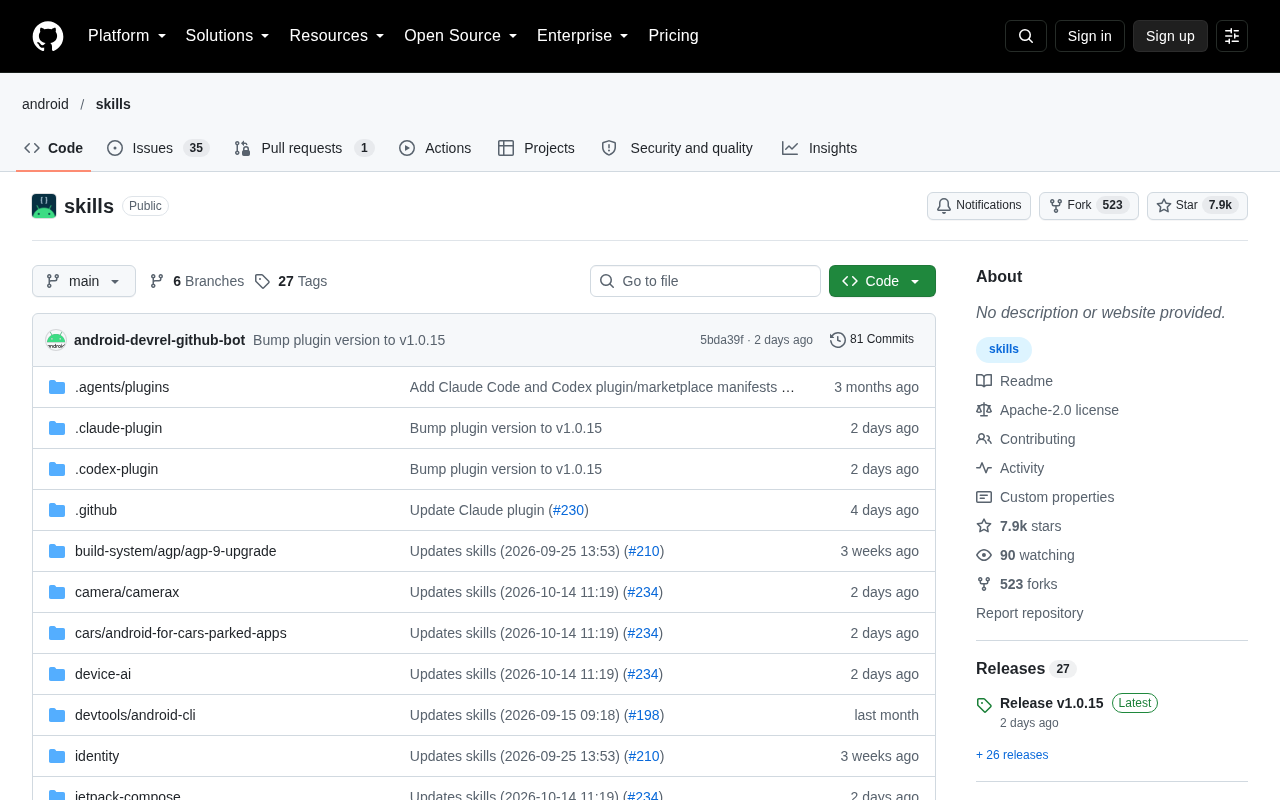
On GitHub, a repository named android/skills is quietly changing the way Android developers interact with AI. Maintained by the official Android team and written in Kotlin, the project has already amassed 7,869 stars and 523 forks, with 35 new stars added in a single day.
What Is android/skills?
android/skills is not a traditional Android SDK component, but rather a collection of "skills" designed for AI agents and developers. Its core idea is to break down common tasks in Android development—from project configuration and dependency management to code generation and debugging optimization—into reusable skill modules.
Each skill is essentially a structured instruction or tool definition that AI assistants (such as Claude, Copilot, or local LLMs) can read and execute, providing more precise assistance in Android development scenarios. This design turns "prompt engineering" into an engineering asset, so that AI-assisted development no longer relies on ad-hoc conversational tricks.
Prompt Engineering refers to the technique of carefully designing input instructions to guide large language models toward producing the desired output. In early AI-assisted development, developers often relied on ad-hoc conversational tricks—repeatedly adjusting wording, manually supplying project context, and correcting the model's mistaken assumptions. Such practices are highly dependent on personal experience, difficult to reuse or transfer, and unable to guarantee consistent output quality across team members. The core breakthrough of android/skills is transforming prompt engineering from a "personal craft" into an "engineering asset": each skill file is essentially an officially validated combination of structured prompts and tool definitions, containing task boundaries, input/output contracts, and best-practice constraints. This way, the effectiveness of AI-assisted development no longer depends on whether a developer "knows how to ask," but on which skills are loaded—making AI performance in the Android domain reproducible, maintainable, and versionable.
Core Features and How It Works
Skills as Files
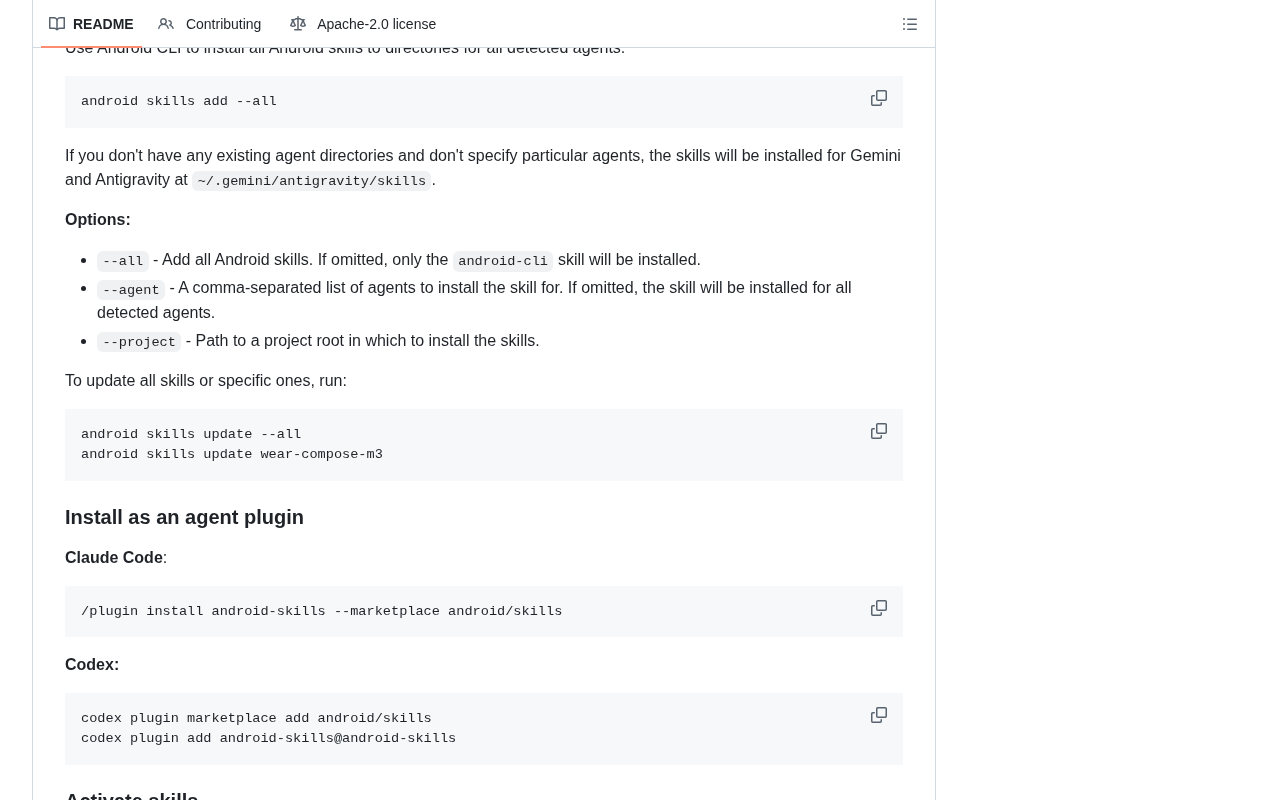
Each skill in the repository typically contains a description file that defines input parameters, execution logic, and output format. The choice of Kotlin makes it a natural fit for the Android ecosystem, allowing developers to invoke these skills directly within Gradle build flows or IDE plugins.
Integration with AI Agents
These skills are designed in a format that AI agents can discover and invoke. When a developer describes an Android development task to an AI assistant, the assistant can match the corresponding skill and execute it according to preset best practices, rather than generating potentially outdated or incorrect code from scratch. This reduces the risk of AI hallucinations in Android development.
AI Hallucination refers to large language models generating information that appears plausible but is actually incorrect or nonexistent. In programming scenarios, this often manifests as recommending deprecated APIs, fabricating nonexistent library functions, or ignoring platform-specific lifecycle constraints. The Android ecosystem is particularly prone to triggering hallucinations because its APIs iterate frequently, device fragmentation is severe, and behavior differs significantly across API levels. android/skills encodes official best practices as skill files, allowing AI agents to match and load the corresponding skill before generating code, thereby injecting accurate API versions, dependency rules, and architectural constraints at the prompt level. This "check skills first, generate code second" workflow is equivalent to equipping AI with a real-time, up-to-date official reference manual, significantly reducing the probability that the model outputs outdated or incorrect content from memory. It is an engineering approach to mitigating the hallucination problem.
Official Maintenance and Authority
Being directly maintained by the Android team means the skill content keeps pace with platform updates. Unlike community-scattered prompt repositories, every skill in android/skills has been officially reviewed, with timely responses to API changes, permission model adjustments, and more.
Version Catalog is a dependency management mechanism introduced in Gradle 7.0. It centrally declares the versions, coordinates, and plugins of all dependency libraries through a libs.versions.toml file, replacing the hardcoded version numbers previously scattered across each module's build.gradle.kts. Its advantages include: unified version management to avoid conflicts, IDE autocomplete support, type-safe dependency references, and easy sharing of configuration across multi-module projects. The dependency management skill in android/skills explicitly stipulates the use of Version Catalog and the avoidance of dynamic versions (such as 1.2.+), precisely because dynamic versions lead to non-reproducible builds and introduce unexpected changes. Understanding Version Catalog is a prerequisite for grasping the actual constraints of this skill, and it is also the officially recommended practice for dependency management in modern Android projects.
Practical Value for Android Developers
For everyday developers, the biggest appeal of this repository is saving time on context setup. In the past, making AI understand an Android project's structure and constraints required extensive background description. Now, by directly referencing the corresponding skill in android/skills, AI can work within the correct framework.
Take dependency management as an example: a skill can explicitly specify rules such as using Version Catalog, avoiding dynamic versions, and prioritizing Maven Central. When AI generates build.gradle.kts, it will automatically follow these conventions, reducing later correction costs.
The testing phase benefits as well. Skills can define architectural patterns for UI tests, assertion library choices, and mocking strategies, so AI-generated test code better aligns with Android's official recommended practices.
How It Differs from Community Solutions
Resource libraries like awesome-android focus on link aggregation, whereas android/skills focuses on executable knowledge. It is not just a list, but encodes "how to do it" into a format AI can consume.
Compared with general-purpose AI coding assistants, android/skills provides domain constraints. General assistants may suggest deprecated APIs or overlook Android-specific lifecycle issues, while skill modules are designed to avoid these pitfalls.
Why It Is Worth Watching
AI-assisted programming is moving from "conversational" to "engineered." android/skills represents the platform's official response to this trend: instead of letting each developer figure out prompts on their own, it provides standardized skill interfaces.
The 7,869 stars and 523 forks show that the community has noticed the value of this direction. While a single-day gain of 35 stars is not explosive, the steady growth indicates it is gradually being adopted by developers.
If you are experimenting with AI-assisted development in Android projects, this repository is worth adding to your toolbox. It will not directly generate a complete app, but it can make AI perform more reliably in the specific domain of Android.
One-line Summary
Android officially launched the android/skills repository, breaking development tasks into AI-invokable skill modules to advance the engineering of AI-assisted programming.
Paragraph Summary
android/skills is an AI skills library maintained by the official Android team, written in Kotlin, with 7,869 GitHub stars. It is not a traditional SDK component, but a collection that breaks common Android development tasks into reusable skill modules. Each skill is essentially a structured instruction or tool definition for AI assistants like Claude and Copilot to read and execute. Its core value lies in turning prompt engineering into an engineering asset, reducing the risk of AI hallucinations and outdated API recommendations in Android development. Unlike link-aggregation libraries such as awesome-android, android/skills focuses on executable knowledge. In practice, developers can reference the corresponding skill to let AI work within the correct framework, saving context setup time and ensuring that dependency management, test generation, and other steps automatically follow official best practices.
Related articles

Free Unlimited Claude Code Solution: Agnes AI + CC Switch Setup Guide
No paid subscription needed — pair the free AI platform Agnes AI with the open-source tool CC Switch to provide a backend for Claude Code, enabling unlimited free calls to text, image, and video models. This guide covers the full setup, test results, and usage boundaries.

A Complete Zero-Cost Guide to Getting Started with Claude Code for Beginners in China
A beginner's guide to Claude Code for users in China: two installation methods (command line and IDE plugin), full configuration steps for replacing the official API with the free domestic LongCat model, and a hands-on demo of building a small tool with natural language, plus tips.

When the NSA Gets Involved: The AI Supply Chain Crisis Behind Open-Source CVEs and API Key Hijacking
Multiple open-source projects disclosed severe CVEs in one day, PHP flaws alarmed the FBI, and Railway and OpenCode were breached with API keys stolen. This article breaks down the vulnerability window, AI-accelerated exploitation, and the AI supply chain crisis behind the API key black market, with a developer defense checklist.