Anima: An Open-Source Tool for Generating Interactive Biological Models from Natural Language

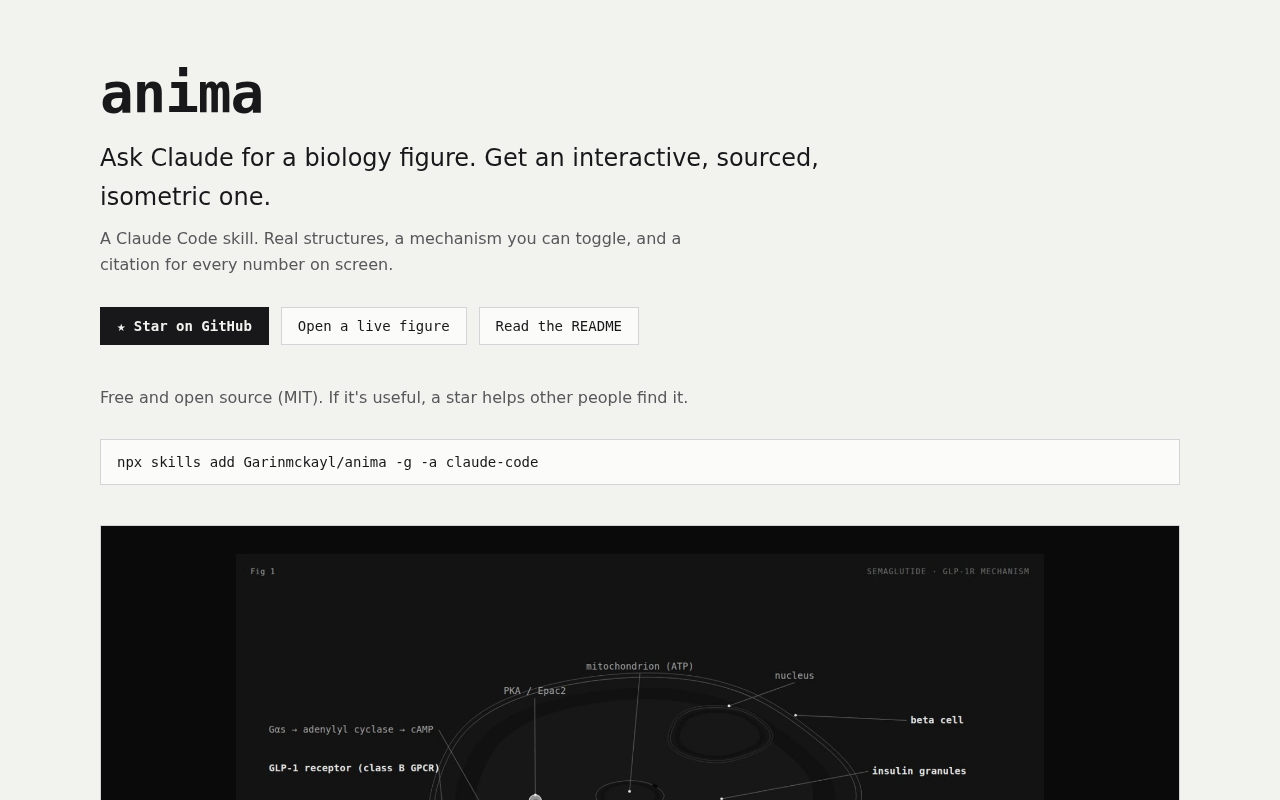
Anima is an open-source project that auto-generates interactive biological models from natural language descriptions.
Anima is an open-source project showcased on Hacker News that tries to automatically convert everyday English descriptions of biological processes into interactive simulation models. Traditionally, building gene regulatory network or metabolic pathway models requires mastering specialized languages like SBML or tools like COPASI and VCell, creating a barrier for wet-lab researchers, while Anima aims to lower modeling entry to the natural language level. It targets rapid prototyping and education, where interactive models help convey dynamic behaviors such as negative feedback and oscillations. Its open-source strategy helps build trust and community contributions. However, it has limited Hacker News traction (4 points, 0 comments) and is still early-stage. Its core challenge is balancing natural language ambiguity with model precision, and semantic parsing accuracy and biological terminology coverage will determine whether it can move from demo to practical use.
In the "Show HN" section of Hacker News, an open-source project called Anima has drawn attention: it attempts to let users describe biological processes in plain English, then automatically generate interactive biological models. For developers in bioinformatics, computational biology, and education technology, this may be a signal worth watching.
What problem does it solve?
Traditionally, building a biological model — whether it's a gene regulatory network, a metabolic pathway, or cell signaling — requires mastering specialized modeling languages (such as SBML) or simulation tools (such as COPASI, VCell). This creates a technical barrier for researchers with wet-lab backgrounds. Anima's approach is to lower the entry point of "modeling" to the level of natural language: you write a description of some biological mechanism, and the tool attempts to parse it into a structured model and generate an interactive interface.
Judging from its positioning around "plain English," it targets rapid prototyping and educational scenarios, rather than replacing rigorous quantitative modeling platforms.
SBML (Systems Biology Markup Language) is an XML-based standardized exchange format used to describe biochemical reaction networks, including species, reactions, parameters, and mathematical expressions. It is maintained by the SBML community and is currently supported by hundreds of modeling and simulation tools, making it the de facto common language in the field of systems biology. The core value of SBML lies in interoperability: the same model file can flow freely between different platforms such as COPASI, VCell, and the BioModels database. However, SBML itself only describes model structure and mathematical relationships, and does not directly include simulation algorithms — users typically also need to pair it with specialized solvers.
COPASI is an open-source, cross-platform biochemical system simulation tool that supports deterministic ODE solving, stochastic simulation, steady-state analysis, and parameter scanning. It provides a graphical interface so researchers can build and run models without programming, and it also supports Python scripting. VCell focuses more on spatial modeling and cell-level simulation, capable of handling reaction-diffusion systems and cell geometry. Both require users to understand the syntax of modeling languages — precisely the barrier Anima seeks to lower.
What interactive models mean
The word "interactive" is key in the context of Anima. If biological models are only static images or formulas, it's hard to convey dynamic behavior — such as how a negative feedback loop maintains homeostasis, or under what parameters an oscillator becomes unstable. Interactive models allow users to adjust parameters and observe system responses, which is closer to the kind of "computational thinking" that biology education aims to cultivate.
If Anima can reliably convert a piece of text into a simulation model with adjustable parameters, it has a place in classroom demonstrations, hypothesis testing, and even supplementary materials for papers.
Negative feedback loops are one of the core mechanisms for maintaining homeostasis in biological systems: when the system output deviates from a set point, the feedback mechanism suppresses the deviation and brings the system back to dynamic equilibrium. In modeling, negative feedback typically appears as a set of differential equations with inhibitory terms, and its steady state and convergence speed depend on parameter values. Oscillators (such as circadian rhythms and the cell cycle) typically require negative feedback plus time delay or nonlinear terms, producing periodic behavior within specific parameter ranges; once parameters go out of bounds, oscillations may become unstable or disappear. These dynamic behaviors are difficult to convey intuitively with static formulas, but interactive models allow users to drag parameter sliders and observe system responses in real time, making the "parameter-behavior" relationship more intuitive.
The possibilities opened up by open source
Choosing open source is a pragmatic way for such tools to build trust. Biological modeling involves a large number of domain-specific assumptions, and closed-source black boxes are hard for researchers to trust. Open source allows the community to review parsing logic, contribute model templates, and adapt to new biological systems.
However, the project currently has limited traction on Hacker News (4 points, 0 comments), meaning it is still at an early stage. For a tool that goes "from natural language to executable models," the biggest challenge is often not the interface, but the accuracy of semantic parsing and the coverage of biological terminology. There is an inherent tension between the ambiguity of natural language and the precision required by models. How Anima handles ambiguity and whether it provides a manual correction step will determine whether it can move from demonstration to practical use.
Semantic parsing here refers to mapping natural language descriptions into structured model elements — identifying genes, proteins, reactions, regulatory relationships, parameters (such as rate constants and concentrations), and the causal and mathematical relationships among them. Synonyms, abbreviations, and context dependence in biological terminology make this task particularly difficult: for example, "expression" may refer to gene transcription or protein translation, and "inhibition" may correspond to competitive binding or allosteric regulation. LLMs perform well in general language understanding, but they are prone to producing "plausible but wrong" outputs when it comes to precise domain semantics and numerical constraints. Therefore, a viable approach is usually to add a validation layer after LLM parsing, or to provide a manual correction interface so domain experts can confirm key modeling assumptions before generating simulation code.
Directions worth watching
In the track of applying AI to scientific modeling, Anima represents a trend: using the semantic understanding capabilities of large language models as a "modeling assistant." Whether it succeeds depends on a simple question — whether biologists are willing to use text descriptions instead of directly operating modeling tools. The answer to this question may only emerge after the community provides more feedback.
One-line Summary
Anima is an open-source project that automatically generates interactive biological models from natural language descriptions.
Paragraph Summary
Anima is an open-source project showcased on Hacker News that attempts to automatically convert biological processes described in everyday English into interactive simulation models. Traditionally, building models of gene regulatory networks or metabolic pathways requires mastering specialized languages such as SBML or tools such as COPASI and VCell, creating a barrier for researchers with wet-lab backgrounds, while Anima tries to lower the modeling entry point to the level of natural language. The project targets rapid prototyping and educational scenarios, and interactive models help convey dynamic behaviors such as negative feedback and oscillations. Its open-source strategy helps build trust and community contributions. However, the project has limited traction on Hacker News (4 points, 0 comments) and is at an early stage. Its core challenge lies in balancing the ambiguity of natural language with the precision required by models, and the accuracy of semantic parsing and coverage of biological terminology will determine whether it can move from demonstration to practical use.
Related articles

Free Unlimited Claude Code Solution: Agnes AI + CC Switch Setup Guide
No paid subscription needed — pair the free AI platform Agnes AI with the open-source tool CC Switch to provide a backend for Claude Code, enabling unlimited free calls to text, image, and video models. This guide covers the full setup, test results, and usage boundaries.

A Complete Zero-Cost Guide to Getting Started with Claude Code for Beginners in China
A beginner's guide to Claude Code for users in China: two installation methods (command line and IDE plugin), full configuration steps for replacing the official API with the free domestic LongCat model, and a hands-on demo of building a small tool with natural language, plus tips.

When the NSA Gets Involved: The AI Supply Chain Crisis Behind Open-Source CVEs and API Key Hijacking
Multiple open-source projects disclosed severe CVEs in one day, PHP flaws alarmed the FBI, and Railway and OpenCode were breached with API keys stolen. This article breaks down the vulnerability window, AI-accelerated exploitation, and the AI supply chain crisis behind the API key black market, with a developer defense checklist.